From soft sheet to heat-treated part
Where to buy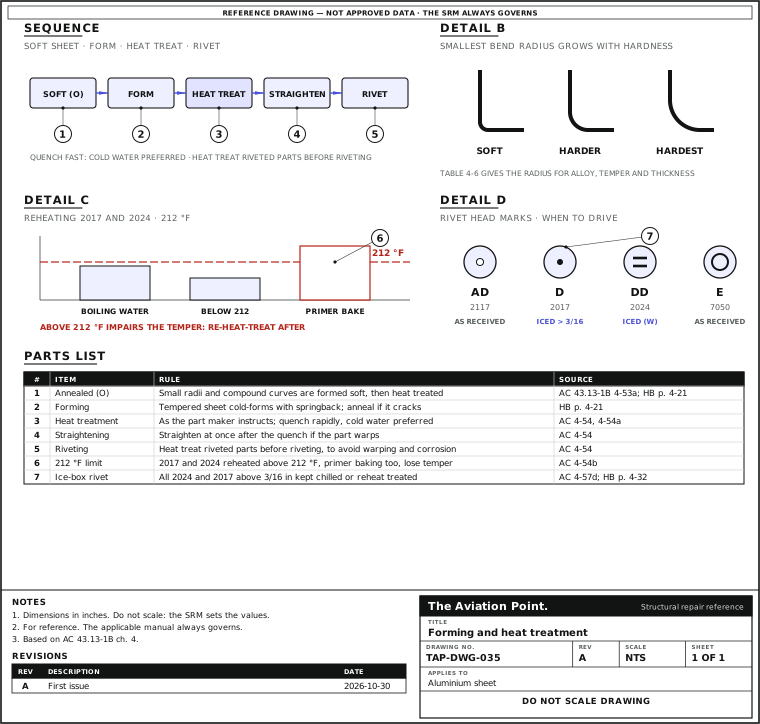
Quick check
A fuselage frame needs forming. Which route fits?
- Form it from soft sheet, then heat-treat
Best fit. A part such as a fuselage frame is formed from soft, annealed sheet and heat-treated after forming.
- Form it from soft sheet and leave it soft
Not this one. Do not leave a structural part annealed.
- Form it cold from heat-treated sheet
Not this one. That suits single curvature with straight bend lines and a large radius.
The drawing and the specification it calls up govern.
Which temper to form
Match the original. Replacement aluminium sheet is identical to the original, or properly altered. If another alloy is considered, MMPDS (the successor to MIL-HDBK-5, which AC 43.13-1B cites) has the comparative strengths (AC par. 4-53).
The forming decides the temper. Single curvature with straight bend lines and a large radius can be formed from heat-treated sheet. A part such as a fuselage frame is formed from soft, annealed sheet and heat-treated after forming (AC par. 4-53a).
Cold forming in the tempered condition, at room temperature, saves the warp and twist that heat treatment brings. Expect springback. If the metal cracks over a small radius, form it annealed. Small radii and compound curves are formed annealed, then heat-treated to temper before use (Handbook p. 4-21).
Do not leave a structural part annealed. An annealed repair of equal strength weighs more than a heat-treated one (AC par. 4-53b). Unpainted parts are made of clad sheet (par. 4-53a).
Bend radius. The minimum radius depends on composition, temper and thickness: thinner sheet takes a tighter radius and a harder temper needs a larger one (AC par. 4-55a). Look it up in the bend radius chart. Bend lines should lie across the grain, preferably at 90 degrees, and relief holes go at the ends of bend lines (par. 4-55b).
Work hardening
Too much hammering work-hardens the metal: it stops responding to bending and feels springy. In some cases the part must be annealed during the operation, and then heat-treated again before it goes on the aircraft (Handbook p. 4-75).
A patch plate that must be formed, such as to fit the contour of a lightening hole, is made from sheet in the O condition and heat-treated after forming (Handbook p. 4-106).
Heat treatment, and its limits
Structural aluminium parts are heat-treated to the manufacturer's instructions, in the sequence the specification gives for the temper. The temperatures and times are in that specification and are not repeated here (AC par. 4-54).
Quench from the solution heat-treating temperature as fast as possible after the furnace. Cold water is preferred; hot water or air blast is used for bulk sections such as forgings, to lessen quenching stress. If the part warps, straighten it immediately after the quench. Heat-treat riveted parts before riveting, to avoid warping and corrosion (AC par. 4-54, 4-54a).
The 212 degree rule. Reheating 2017 and 2024 above 212 degrees Fahrenheit impairs the original heat treatment. That includes baking primers. It is not acceptable without a full, correct heat treatment afterwards (AC par. 4-54b). Mind this before putting a formed part in a paint oven.
Temper marks. T4 is solution heat-treated; T6 is solution heat-treated and artificially aged; T3 adds cold work. The full list is in the identification guide.
Ice-box rivets
Some rivet alloys are too hard to drive as received. 2117 (AD) is driven as received. 2017 rivets above 3/16 in diameter and all 2024 (DD) rivets are kept packed in dry ice or refrigerated in the quenched condition until driven, or are reheat-treated just before driving (AC par. 4-57d).
The Handbook adds that DD rivets are annealed and stored in a freezer to slow hardening, hence the name. Most have been replaced by E-type rivets (7050), which are driven as received (Handbook p. 4-32). The E head mark differs by document: MS20470 Rev. H and MS20426 Rev. L require an indented ring, and the Handbook's strength chart says raised ring (Fig. 4-77, p. 4-33). The strength chart says DD must be driven in the W condition; D rivets give 38 KSI as driven and 34 KSI when reheat-treated (p. 4-33).
The AC gives no time limit out of the freezer. The Handbook glossary says only that they harden within a few hours at room temperature and that a subfreezing icebox delays this for several days (p. G-19). A US Navy training manual prints 20 minutes and 24 hours: see the rivet identification chart. Take the limit from the rivet specification and the shop's procedure. The rivet alloy calculator checks the head mark and condition.
Questions people actually ask
Can I bake a primer on a 2024 part?
Not above 212 degrees Fahrenheit without a complete heat treatment afterwards (AC par. 4-54b). Use the primer's room-temperature cure or follow the part's drawing.
Why heat-treat before riveting?
To avoid warping and corrosion in the riveted joint (AC par. 4-54).
Is an E rivet an ice-box rivet?
No. The Handbook says E-type rivets are installed as received (p. 4-32).
Limits of this guide
What the sources support, and no further.
- No furnace temperature, soak time or quench delay is given. They belong to the heat-treatment specification the drawing calls up.
- Heat treatment of structural parts is done to the manufacturer's data, in a controlled facility.
- Rivet substitution follows the approved data: see the rivet alloy calculator.
Where to buy
Distributors coming soon.
Sources
- FAA AC 43.13-1B CHG 1, Chapter 4 — Par. 4-53, selection of aluminium for replacement parts (p. 4-12); par. 4-54, heat treatment and quenching, 4-54b reheating above 212 degrees (pp. 4-12 to 4-13); par. 4-55, bending (p. 4-13); par. 4-57d, driving 2117, 2017 and 2024 rivets (p. 4-19).
- FAA-H-8083-31A, AMT Handbook — Airframe, Volume 1, Chapter 4 — p. 4-21, cold forming and annealing; p. 4-32, DD and ice-box rivets; p. 4-33, rivet alloys and conditions; p. 4-75, work hardening; p. 4-106, forming a patch plate; p. G-19, glossary.
- MS20470 Rev. H and MS20426 Rev. L, 14 Sep 1993 — the indented ring on 7050 rivets: requirement 6 and requirement 5.