Dent, clad scratch and six profiles
Where to buy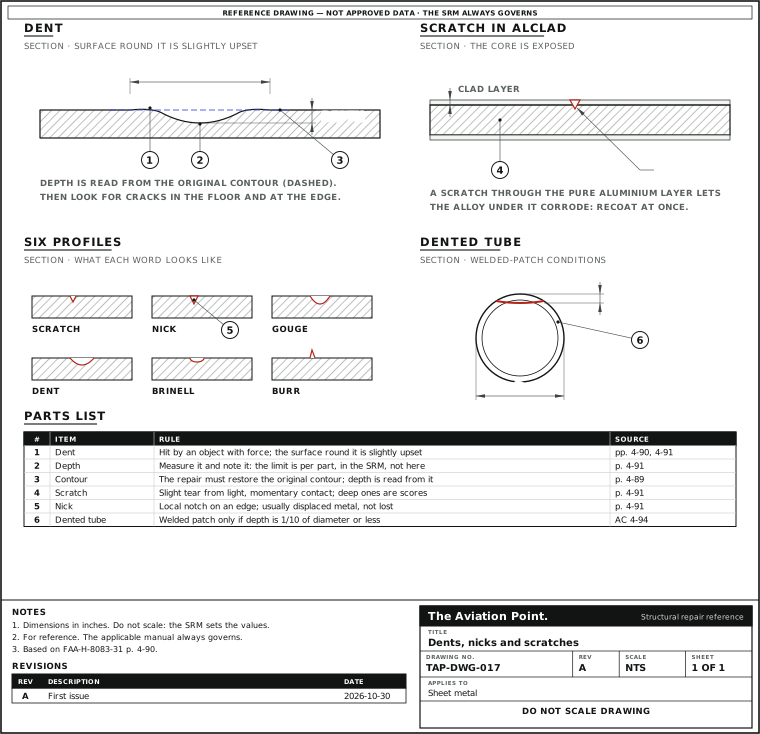
What to do with each
| Damage | Inside the SRM limit | Beyond it |
|---|---|---|
| Scratch | Smooth or blend it out; recoat bare Alclad at once | Patch, or replace |
| Nick | Smooth out the notch so no sharp corner is left | Patch, or replace |
| Dent | Smooth, sand or hammer out, without adding material | Patch, insertion or replace |
| Dent with a crack | Treat as a crack: stop hole, then reinforce | Patch, or replace |
| Gouge | Check whether metal is lost or only displaced; blend if the SRM permits | Patch, or replace |
| Dented tube | Welded patch only if depth is 1/10 of the diameter or less | Sleeve, or replace |
FAA-H-8083-31 pp. 4-90 and 4-91; AC 43.13-1B 4-94. Negligible limits vary for every part: they are in the SRM.
Quick check
A small dent has a crack at its edge. What do you do?
- Hammer it out
Not this one. Smoothing is for a dent with no crack.
- Treat it as a crack
Best fit. A crack changes the class of damage: stop hole, then reinforce.
- Leave it and inspect often
Not this one. Inspecting does not deal with the crack. Go to the cracks guide.
On a real job, the SRM decides.
Look before you hammer
Cracks and abrasions. Check every skin dent and wrinkle for cracks or abrasions (H 4-87). A crack in the floor or at the edge of a dent changes the class of damage: go to the cracks guide.
The load path. The force that dented the skin travelled further. Wrinkled skin, elongated or damaged rivet holes and distorted members usually show near the damage and call for a close look at the neighbouring area (H 4-87).
Clad skin. A scratch that goes through the pure aluminium layer lets the alloy under it corrode (H 4-90). After smoothing, restore the protection.
Name the defect
The Handbook defines them (pp. 4-90 and 4-91). A dent is an indentation from a blow, with the surface round it slightly upset. A nick is a local notch on an edge, usually displaced metal rather than lost. A scratch is a slight tear from light contact; a score is deeper. A gouge is a groove under heavy pressure, with metal lost or mostly displaced. Brinelling is shallow round dents from a small-radius part under high load. A burr is thin metal standing past an edge or hole.
For the full list see the damage classification guide.
Blending and the limit
Smoothing a scratch or nick takes metal away, so the part is thinner where you blend. That is why the limit is written per part, and why the Handbook says that negligible damage still needs action so it does not spread, and frequent inspection (H 4-91).
The one blend ratio in the sources, 20:1 length to depth, is for corrosion dish-outs in AC 43.13-1B 6-115. For a mechanical defect use the ratio and depth limit in the SRM. The blend-out calculator does the arithmetic for any ratio.
Dented steel tube (AC 4-94) can take a welded patch of the same material, one gauge thicker, if the dent is no deeper than 1/10 of the tube diameter, covers no more than 1/4 of the circumference, is no longer than the diameter, is free from cracks, abrasions and sharp corners, and can be reformed without cracking.
Questions people actually ask
Can a dent be left?
Only if the SRM calls it negligible for that part. Nothing is negligible by default.
Is hammering out a dent a repair?
It is a fix without added material, within negligible damage (H 4-91). Check for cracks first, and inspect the area often afterwards.
How deep may I blend a scratch?
The sources give no depth. The SRM sets it per part.
Does a scratch in Alclad matter?
Yes, if it goes through the pure aluminium layer: the alloy under it can corrode (H 4-90).
Limits of this guide
What the sources support, and no further.
- No dent depth or scratch limit is given for sheet. The only dimensions here are the welded-tube conditions of AC 4-94.
- Not for composites or honeycomb skins.
- Typical, not authority. Methods are examples; the SRM governs.
Where to buy
Distributors coming soon.
Sources
- FAA-H-8083-31, AMT Handbook — Airframe, Volume 1, Chapter 4 — p. 4-87, check dents for cracks; pp. 4-90 and 4-91, types of damage and defects, negligible damage.
- AC 43.13-1B with Change 1 — Acceptable Methods, Techniques, and Practices — Chapter 4: paragraph 4-94, dented tubing. Chapter 6: paragraph 6-115, blend ratio.