Key facts
Where to buy| Property | Value | Source |
|---|---|---|
| Density | 0.095 lb/in³ (2.64 g/cm³) | Teal Sheets |
| Rivet shear, driven 5056-H321 | 28 ksi | MIL-HDBK-5J Table 8.1.2(b) |
| Rivet shear, undriven 5056-H32 | 24 ksi | MIL-HDBK-5J Table 8.1.2(b) |
| Rivet code and head | B, raised cross | AC 43.13-1B Table 4-8 |
MIL-HDBK-5J has no bulk allowables table for 5056: it appears as a rivet material in Chapter 8.
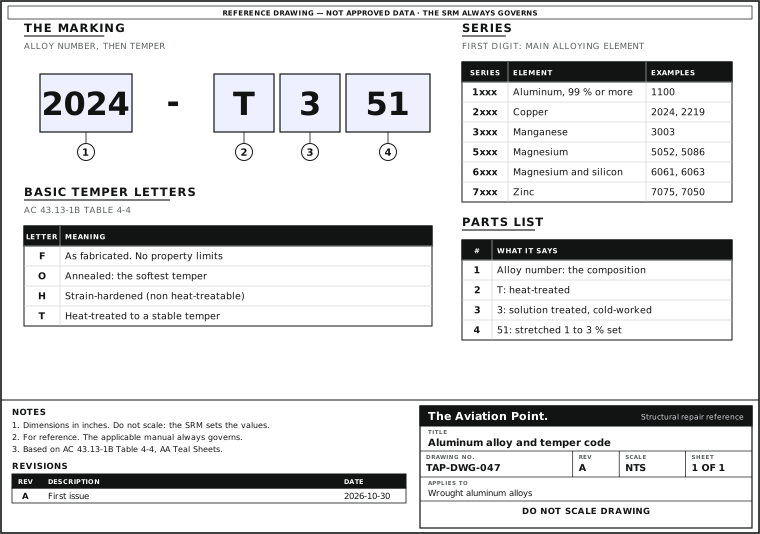
Reading the alloy and temper code
Composition limits, weight percent
| Element | Limit |
|---|---|
| Si | 0.30 |
| Fe | 0.40 |
| Cu | 0.10 |
| Mn | 0.05–0.20 |
| Mg | 4.5–5.6 |
| Cr | 0.05–0.20 |
| Zn | 0.10 |
| Al | Remainder |
A single number is a maximum. Other elements: 0.05 each, 0.15 total, except where the Teal Sheets say otherwise. Source: Aluminum Association Teal Sheets (Aug 2018).
Where it is used
When riveting magnesium alloy structures, 5056 rivets are used exclusively, for their corrosion resistance in that combination (AC par. 7-2d).
The AMT Handbook adds cable sheathing, and any application where aluminum touches magnesium alloys (p. 4-30).
Questions people actually ask
Can I use an AD rivet in magnesium?
The AC says 5056 exclusively. See also the galvanic corrosion calculator.
Limits — when NOT to use this
- Not a source of design allowables. Values are for reference. MMPDS and the SRM govern a repair.
- Not a substitution approval. A different alloy or temper needs approved data.
Where to buy
AmericaDistributor coming soonOur partner for this region is on its way
EuropeDistributor coming soonOur partner for this region is on its way
OceaniaDistributor coming soonOur partner for this region is on its way
Distributors coming soon.
Sources
- FAA AC 43.13-1B CHG 1, Chapters 4 and 7 — Table 4-8; par. 7-2.
- FAA-H-8083-31B, AMT Handbook — Airframe, Volume 1, Chapter 4 — p. 4-30.
- MIL-HDBK-5J (31 Jan 2003), Chapter 3 — Table 8.1.2(b). Cancelled and superseded by MMPDS: check current MMPDS before design use.
- Aluminum Association, International Alloy Designations (Teal Sheets), rev. Aug 2018 — chemical composition limits and nominal densities.
- MMPDS (formerly MIL-HDBK-5) — the current home of design allowables. A repair substantiation cites MMPDS or the SRM, not a website.
Educational reference only. not approved data. Always consult the applicable SRM, AMM, or AC 43.13-1B and your certifying authority.