Key facts
Where to buy| Property | Value | Source |
|---|---|---|
| Type | Precipitation-hardening iron-base alloy | MIL-HDBK-5J, par. 6.2.1.0 |
| Composition | Iron base, nickel 24–27 %, chromium 13.5–16 %, molybdenum 1.0–1.5 %, titanium 1.9–2.35 %, vanadium 0.1–0.5 % | ATI A286 alloy page, chemical composition (AMS 5525) |
| Temperature | High strength to 1,300 °F; oxidation resistance to 1,500 °F | MIL-HDBK-5J, par. 6.2.1.0 |
| Sheet, strip, plate | AMS 5525, solution treated (1,800 °F) and aged | MIL-HDBK-5J, Table 6.2.1.0(a) |
| Bar, forging, tubing | AMS 5731, 5732, 5734, 5737 | MIL-HDBK-5J, Table 6.2.1.0(a) |
| Compared with stainless | Somewhat harder to hot or cold work than the austenitic stainless steels | MIL-HDBK-5J, par. 6.2.1.0 |
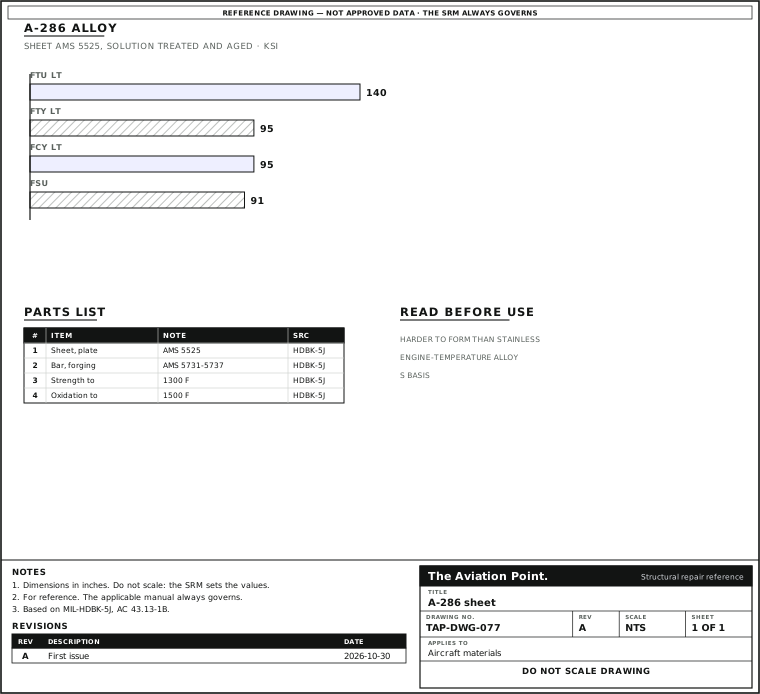
Design allowables — A-286 sheet, strip and plate, solution treated and aged
AMS 5525, thickness over 0.004 in. MIL-HDBK-5J Table 6.2.1.0(b), p. 6-6.
| Property | S basis | Unit |
|---|---|---|
| Ftu, LT | 140 | ksi |
| Fty, LT | 95 | ksi |
| Fcy, LT | 95 | ksi |
| Fsu | 91 | ksi |
| Elongation, LT | 15 | % |
| E | 29.1 | 10³ ksi |
| G | 11.1 | 10³ ksi |
| Density | 0.287 | lb/in³ |
Bars (AMS 5731, 5732, 5734, 5737) have their own columns by diameter in the same table: Ftu 130–140 ksi, Fty 85–95 ksi.
Thicknesses and forms
Sheet, strip, plate over 0.004 in (AMS 5525) and bar, forging, tubing and ring (AMS 5731 to 5737, diameters to 5.000 in).
Forming
The iron-chromium-nickel-base alloys closely resemble austenitic stainless in forging, cold forming, machining, welding and brazing. Their higher strength may require heavier forging or forming equipment, and machining is somewhat more difficult (MIL-HDBK-5J par. 6.2.0.2).
Quick check
What temperature does A-286 hold high strength to?
- 600 °F
Not this one. That is the PH stainless limit.
- 1,300 °F
Best fit. Right.
- 2,000 °F
Not this one. Beyond its oxidation limit of 1,500 °F.
On a real job, the SRM decides.
Welding
Closely resembles austenitic stainless for welding and brazing (MIL-HDBK-5J par. 6.2.0.2). The specific filler and post-weld aging come from the manufacturer or SRM.
Corrosion
Oxidation resistance to 1,500 °F. The public sources give no further corrosion detail.
Where it is used on aircraft
Jet engines and gas turbines: turbine buckets, bolts, discs and sheet metal assemblies (MIL-HDBK-5J par. 6.2.1.0).
Data sheet
Questions people actually ask
Is A-286 stainless steel?
It is an iron-base alloy with the austenitic stainless family's behaviour, but hardened by precipitation. MIL-HDBK-5J files it with heat-resistant alloys, not stainless steels.
Limits — when NOT to use this
- Hot-section material. Specified by the engine or airframe maker.
- Heavier forming loads than stainless.
Where to buy
Distributors coming soon.
Sources
- MIL-HDBK-5J, Metallic Materials and Elements for Aerospace Vehicle Structures (31 Jan 2003) — par. 6.2.0.2, 6.2.1.0 and Tables 6.2.1.0(a), (b), pp. 6-5 and 6-6. Cancelled; superseded by MMPDS.
- MMPDS (formerly MIL-HDBK-5) — the current home of design allowables. A repair substantiation cites MMPDS or the SRM, not a website.
- ATI, A286 alloy — Chemical composition and AMS 5525.