Key facts
Where to buy| Property | Value | Source |
|---|---|---|
| Temper O | Annealed, recrystallized: the softest temper | AC 43.13-1B Table 4-4 |
| Density | 0.101 lb/in³ (2.81 g/cm³) | MIL-HDBK-5J; Teal Sheets |
| Bend radius, 0.064" sheet | 0 – 1t (T6: 4t – 6t) | AC 43.13-1B Table 4-6 |
| Allowables in O temper | None listed | MIL-HDBK-5J Section 3.7.6 |
The handbook's temper index for 7075 covers T6, T73 and T76 types.
Reading the alloy and temper code
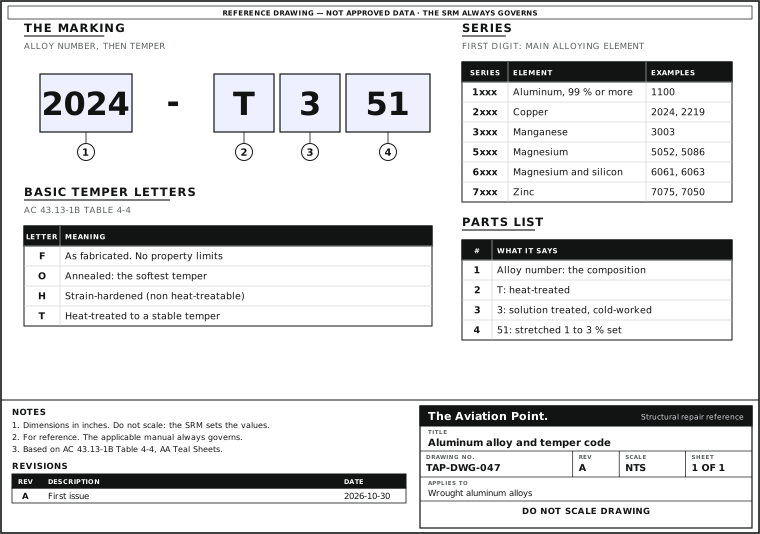
Composition limits, weight percent
| Element | Limit |
|---|---|
| Si | 0.40 |
| Fe | 0.50 |
| Cu | 1.2–2.0 |
| Mn | 0.30 |
| Mg | 2.1–2.9 |
| Cr | 0.18–0.28 |
| Zn | 5.1–6.1 |
| Ti | 0.20 |
| Al | Remainder |
A single number is a maximum. Other elements: 0.05 each, 0.15 total, except where the Teal Sheets say otherwise. Source: Aluminum Association Teal Sheets (Aug 2018).
Bend radii (AC 43.13-1B Table 4-6)
| Alloy and temper | 0.016" | 0.032" | 0.064" | 0.128" | 0.182" | 0.258" |
|---|---|---|---|---|---|---|
| 7075-O | 0 | 0 – 1t | 0 – 1t | ½t – 1½t | 1t – 2t | 1½t – 3t |
| 7075-T6 | 2t – 4t | 3t – 5t | 4t – 6t | 5t – 7t | 5t – 7t | 6t – 10t |
Recommended radii for 90-degree bends, as multiples of sheet thickness t. Alclad sheet may go slightly tighter than bare (Table 4-6 note 1). The drawing or SRM governs.
Minimum bend radius, inches (AMT Handbook Chart 204)
| Alloy and temper | 0.020" | 0.032" | 0.040" | 0.063" | 0.125" | 0.190" |
|---|---|---|---|---|---|---|
| 7178-O, 2024-O, 5052-H34, 6061-T4, 7075-O | .03 | .03 | .06 | .09 | .25 | .38 |
| 7075-T6 | .12 | .19 | .22 | .31 | .88 | 1.38 |
Selected thicknesses from FAA-H-8083-31B Chart 204, p. 4-61. Chart 204 and AC Table 4-6 do not agree everywhere: where they differ, use the larger radius or the SRM.
Form soft, then heat-treat
The AC says some parts are made from soft, annealed sheet and heat-treated after forming (p. 4-12). Check the part's drawing for the final temper.
After heat treatment, use the 7075-T6 values with care: for material supplied O or F and heat-treated by the user, the handbook warns that properties may be lower if it was formed or cold or hot worked first (Table 3.7.6.0(c2), note a).
Heat-treat riveted parts before riveting, to the manufacturer's instruction (AC par. 4-54).
Specifications and product forms
| Specification | Form |
|---|---|
| AMS 4044, AMS 4045, AMS 4078 | Bare sheet and plate |
| AMS-QQ-A-250/12, /24 | Bare sheet and plate |
| AMS 4049, AMS-QQ-A-250/13, /25 | Clad sheet and plate |
Specifications for 7075 as listed by MIL-HDBK-5J. Confirm in the specification which tempers it delivers.
Questions people actually ask
What is the strength of 7075-O?
None of the sources used here prints a value, and MIL-HDBK-5J gives no design allowables. Use the mill certificate. A part in service is not left in O.
Can 7075-O be cold formed?
Yes, that is its purpose. Table 4-6 gives 0 to 1t at 0.032 and 0.064 in. 7075-T6 is a different matter: cold forming can crack it (AC par. 4-58b).
Limits — when NOT to use this
- Not a source of design allowables. Values are for reference. MMPDS and the SRM govern a repair.
- Not a substitution approval. A different alloy or temper needs approved data.
- Not a service temper. Do not install 7075-O where the drawing calls for T6.
Where to buy
Distributors coming soon.
Sources
- FAA AC 43.13-1B CHG 1, Chapters 4 and 7 — Tables 4-4, 4-6; pp. 4-12; pars. 4-54, 4-58.
- FAA-H-8083-31B, AMT Handbook — Airframe, Volume 1, Chapter 4 — Chart 204, p. 4-61.
- MIL-HDBK-5J (31 Jan 2003), Chapter 3 — Section 3.7.6, Tables 3.7.6.0(a), (c2). Cancelled and superseded by MMPDS: check current MMPDS before design use.
- Aluminum Association, International Alloy Designations (Teal Sheets), rev. Aug 2018 — chemical composition limits and nominal densities.
- MMPDS (formerly MIL-HDBK-5) — the current home of design allowables. A repair substantiation cites MMPDS or the SRM, not a website.