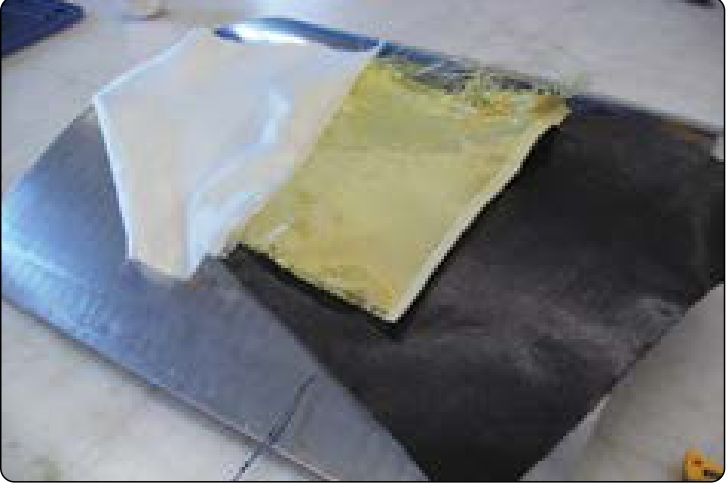
E-glass at a glance
Where to buy| Item | What the sources say | Source |
|---|---|---|
| Name | Electrical glass: identified as such for electrical applications; high resistance to current flow | FAA-H-8083-31B, p. 7-5 |
| Composition | Borosilicate glass | FAA-H-8083-31B, p. 7-5 |
| Advantages | Lower cost than other composites; chemical and galvanic corrosion resistance; does not conduct electricity | FAA-H-8083-31B, p. 7-5 |
| Colour and forms | White; dry fabric or prepreg | FAA-H-8083-31B, p. 7-5 |
| Typical uses | Secondary structure such as fairings, radomes and wing tips; helicopter rotor blades | FAA-H-8083-31B, p. 7-5 |
| Fabric weights | 1.4 oz/yd² (48 g/m², styles 108 and 1080) to 19.7 oz/yd² (668 g/m², style 7587); dry thickness 2.2 to 27.2 mil | Hexcel HexForce data sheets |
| Breaking strength of fabric | 80 to 750 lbf/in (warp) across those styles; 7781 is 570 / 450 lbf/in warp / fill | Hexcel HexForce data sheets |
| Service temperature | Not set by the glass; set by the resin and cure (see the resin pages) | — |
Fabric figures come from the Hexcel HexForce sheets for styles 108, 1080, 120, 1581, 7500, 7580, 7587 and 7781, all E-type yarn. Full table on the glass fabric styles page.
Using E-glass in a repair
AC 43.13-1B paragraph 3-2 covers repairs to fiberglass laminate used for non-structural fairings, covers, cowlings and honeycomb panel facings. It says these repairs are not to be used on radomes or on advanced composite parts such as carbon or Kevlar.
The material rule comes first: the repair material must preserve the strength, weight, aerodynamic and electrical properties of the part, best done with the same chemical composition or a manufacturer-approved substitute (paragraph 3-1a). Moisture left on the surface inhibits the cure of the resin, so the laminate is dried thoroughly before bonding.
For a carbon part, fiberglass is not a free substitute. Where glass touches carbon under aluminium, or is used as the isolating ply, the SRM says how. See repair materials by part.
Light fiberglass facing repair (AC 43.13-1B 3-2)
| Step | Action | What to do |
|---|---|---|
| 1 | Check | Tap test for voids and delamination. Remove paint by dry sanding; no chemical strippers. |
| 2 | Clean | Wash with detergent and water, then an acceptable cleaner. |
| 3 | Sand and re-clean | Sand with 280-grit paper, clean off residue and moisture, and dry the laminate. |
| 4 | Resin or plies | Mix resin per the maker. Surface scars: one or two coats. Deeper: contoured glass cloth soaked in resin. |
| 5 | Peel ply | Cover with peel ply, work out bubbles and excess resin, let it cure. |
| 6 | Finish | Sand to contour, seal all edges against water, refinish. |
Questions people actually ask
Is E-glass the same as fiberglass?
It is the most common type. S-glass and S2-glass are the higher-strength structural types (FAA-H-8083-31B, p. 7-5).
Does E-glass corrode against aluminium?
The FAA lists corrosion resistance, chemical and galvanic, as an advantage of fiberglass. Carbon is the one that is cathodic against aluminium.
Limits — when NOT to use this
- Not primary structure. The sources place it in secondary structure.
- Not for radomes or advanced composites by AC 43.13-1B 3-2 methods. Those need the manufacturer’s data.
- No strength allowable here. Laminate strength depends on resin and ply schedule, which the SRM gives.
Where to buy
Distributors coming soon.
Sources
- FAA-H-8083-31B, AMT Handbook — Airframe, Volume 1 (2023), Chapter 7 — fiberglass types and use (p. 7-5).
- AC 43.13-1B, Change 1, Chapter 3, Fiberglass and Plastics — paragraph 3-1 (p. 3-1), paragraph 3-2 (pp. 3-1 to 3-2): fiberglass laminate repairs.
- Hexcel HexForce Style 108 Fiber Glass Fabric Product Data (DSF_108) — 1.43 oz/yd², plain, 60 × 47, 2.5 mil, 80 / 70 lbf/in.
- Hexcel HexForce Style 1080 Fiber Glass Fabric Product Data (DSF_1080) — 1.41 oz/yd², plain, 60 × 47, 2.2 mil, 120 / 90 lbf/in.
- Hexcel HexForce Style 120 Fiber Glass Fabric Product Data (DSF_120) — 3.16 oz/yd², 4 harness satin, 60 × 58, 3.5 mil, 160 / 160 lbf/in.
- Hexcel HexForce Style 7580 Fiber Glass Fabric Product Data (DSF_7580) — 6.20 oz/yd², plain, 24 × 14, 7.8 mil, 300 / 200 lbf/in.
- Hexcel HexForce Style 7781 Fiber Glass Fabric Product Data (DSF_7781) — 8.81 oz/yd², 8 harness satin, 57 × 54, 8.6 mil, 570 / 450 lbf/in.