Key facts
Where to buy| Property | Value | Source |
|---|---|---|
| Composition | Chromium 16–18 %, nickel 6.5–7.75 %, aluminum 0.75–1.5 %, carbon up to 0.09 % | Metal supplier's 17-7 PH datasheet, chemical composition (AMS 5528) |
| Related grade in the AC table | PH15-7Mo: carbon 0.09, chromium 15, nickel 7, molybdenum and aluminum | AC 43.13-1B CHG 1, Table 4-3 |
| Sheet, plate | AMS 5528, TH1050 | MIL-HDBK-5J, Table 2.6.10.0(b) |
| Service limit | High strength and good corrosion and oxidation resistance up to 600 °F | MIL-HDBK-5J, par. 2.6.10.0 |
| Forming | Supplied in Condition A for ease of forming; readily cold formed | MIL-HDBK-5J, par. 2.6.10.0 |
| Growth in hardening | Net growth 0.0045 in/in from Condition A to TH1050 | MIL-HDBK-5J, par. 2.6.10.0 |
Design allowables — 17-7PH sheet and plate, TH1050 (AMS 5528)
TH1050 only. MIL-HDBK-5J Table 2.6.10.0(b), p. 2-214.
| Property | Sheet 0.015–0.187, A basis | Sheet 0.015–0.187, B basis | Plate 0.188–0.500 and 0.501–1.000, S | Unit |
|---|---|---|---|---|
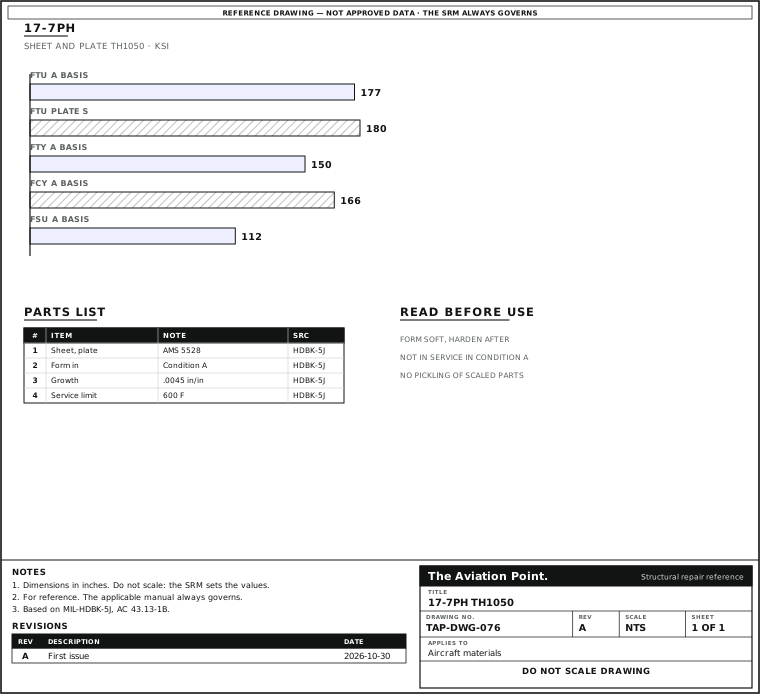
| Ftu, LT | 177 | 184 | 180 | ksi |
| Fty, LT | 150 | 167 | 150 | ksi |
| Fcy, LT | 166 | 185 | 166 (to 0.500) | ksi |
| Fsu | 112 | 117 | 114 (to 0.500) | ksi |
| Elongation LT (S basis) | — | — | 6 | % |
| E | 29.0 | 29.0 | 29.0 | 10³ ksi |
| Density | 0.276 | 0.276 | 0.276 | lb/in³ |
Design values come from material austenite conditioned and aged by suppliers; properties of material that has been formed or cold worked may be different. G = 11.5 × 10³ ksi. MIL-HDBK-5J (2003) is superseded by MMPDS.
Thicknesses and forms
Sheet 0.015 to 0.187 in and plate to 1.000 in (AMS 5528). Condition A is the supplied, formable condition.
Forming
17-7PH in Condition A is readily cold formed. Form first, then harden. A net dimensional growth of 0.0045 in/in occurs from Condition A to TH1050, and the part is not used in Condition A or T.
Vapor blasting is recommended for scaled TH1050 parts because pickling risks intergranular corrosion (MIL-HDBK-5J par. 2.6.10.0).
Quick check
When do you form 17-7PH sheet?
- After hardening to TH1050
Not this one. It is far harder to form then.
- In Condition A, then heat treat
Best fit. Right.
- Never, it cannot be formed
Not this one. Condition A forms readily.
On a real job, the SRM decides.
Welding
Conventional inert-gas shielded arc and resistance techniques are generally used. After welding, brazing or hot work, Condition A is restored by re-solution treatment before hardening (MIL-HDBK-5J par. 2.6.10.0).
Corrosion
Good corrosion and oxidation resistance to 600 °F. Do not pickle scaled hardened parts: intergranular corrosion risk.
Where it is used on aircraft
Formed sheet parts needing high strength with stainless corrosion resistance. The handbook notes its heat treatment is compatible with honeycomb panel brazing cycles.
Data sheet
Questions people actually ask
Can I leave 17-7PH as formed?
No. It must be in the heat-treated condition in service and not placed in service in Condition A or T (MIL-HDBK-5J par. 2.6.10.0).
Limits — when NOT to use this
- Hardening growth 0.0045 in/in must be planned for.
- No A-to-service shortcut.
Where to buy
Distributors coming soon.
Sources
- MIL-HDBK-5J, Metallic Materials and Elements for Aerospace Vehicle Structures (31 Jan 2003) — par. 2.6.10.0 and Table 2.6.10.0(b), p. 2-214. Cancelled; superseded by MMPDS.
- FAA AC 43.13-1B CHG 1 — Table 4-3.
- MMPDS (formerly MIL-HDBK-5) — the current home of design allowables. A repair substantiation cites MMPDS or the SRM, not a website.
- Metal supplier's 17-7 PH datasheet — Chemical composition table.