Key facts
Where to buy| Property | Value | Source |
|---|---|---|
| Density | 0.096 lb/in³ (2.66 g/cm³) | MIL-HDBK-5J; Teal Sheets |
| Service range | -452 to 150 °F | MIL-HDBK-5J 3.5.3.0 |
| Arc welding | A | MIL-HDBK-5J Table 3.1.3.4(a) |
| Spot welding | B (O), A (H tempers) | MIL-HDBK-5J Table 3.1.3.4(a) |
| E / Ec / G | 10.2 / 10.4 / 3.85 × 10³ ksi | MIL-HDBK-5J Table 3.5.3.0(b) |
Density and moduli are printed once in the handbook table.
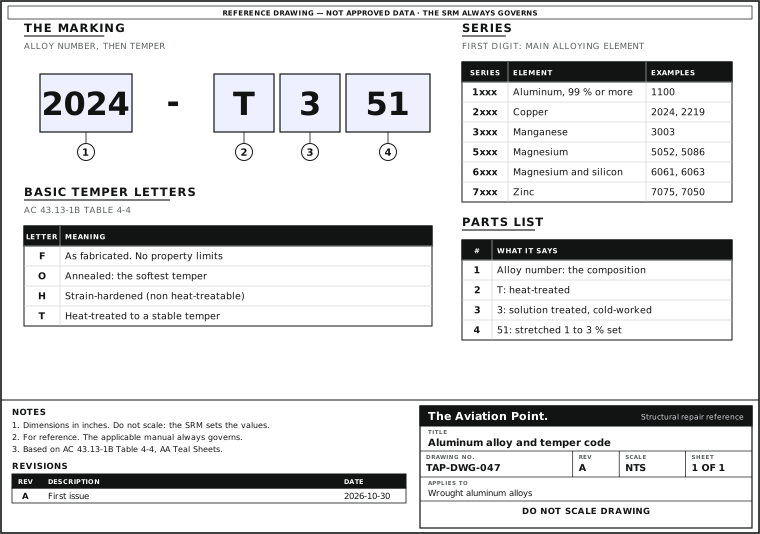
Reading the alloy and temper code
Composition limits, weight percent
| Element | Limit |
|---|---|
| Si | 0.40 |
| Fe | 0.50 |
| Cu | 0.10 |
| Mn | 0.20–0.7 |
| Mg | 3.5–4.5 |
| Cr | 0.05–0.25 |
| Zn | 0.25 |
| Ti | 0.15 |
| Al | Remainder |
A single number is a maximum. Other elements: 0.05 each, 0.15 total, except where the Teal Sheets say otherwise. Source: Aluminum Association Teal Sheets (Aug 2018).
Design allowables, 5086 sheet and plate
| Property, ksi | O A | O B | H32 A | H32 B | H34 S | H36 S |
|---|---|---|---|---|---|---|
| Ftu, L | 35 | 36 | 40 | 41 | 44 | 47 |
| Ftu, LT | 35 | 36 | 40 | 41 | 44 | 47 |
| Fty, L | 14 | 15 | 28 | 30 | 34 | 38 |
| Fty, LT | 14 | 15 | 26 | 28 | 33 | 37 |
| Fcy, L | 14 | 15 | 26 | 28 | 32 | 35 |
| Fcy, LT | 14 | 15 | 28 | 30 | 34 | 38 |
| Fsu | 21 | 22 | 24 | 25 | 26 | 27 |
| Fbru, e/D = 1.5 | 52 | 53 | 58 | 61 | 64 | 68 |
| Fbru, e/D = 2.0 | 70 | 72 | 80 | 82 | 88 | 94 |
| Fbry, e/D = 1.5 | 24 | 26 | 39 | 42 | 48 | 53 |
| Fbry, e/D = 2.0 | 28 | 30 | 48 | 51 | 58 | 65 |
O and H32: 0.020–2.000 in. H34: 0.009–1.000 in. H34 and H36 are S basis. AMS-QQ-A-250/7, MIL-HDBK-5J Table 3.5.3.0(b), p. 3-238. S, A and B are the MIL-HDBK-5J statistical bases. L is the longitudinal grain direction, LT the long transverse. Bearing values are dry-pin values.
The 150 °F warning
Alloys 5083, 5086 and 5456 should not be used under high constant applied stress for continuous service above 150 °F, because they can become susceptible to stress-corrosion cracking (MIL-HDBK-5J 3.1.2.3.1).
In general, the H34 to H38 tempers of 5086 are not recommended, for the same reason. H32 and O are outside that warning.
The FAA handbooks used here do not give a bend radius for 5086: the drawing or SRM sets it.
Specifications and product forms
| Specification | Form |
|---|---|
| AMS-QQ-A-250/7 | Sheet and plate |
| AMS-QQ-A-200/5 | Extruded bar, rod and shapes |
Specifications as listed by MIL-HDBK-5J. Federal QQ-A specifications passed to SAE as AMS-QQ-A. Check the current revision.
Questions people actually ask
Is 5086 stronger than 5052?
Yes. In H32, Ftu is 40 ksi (A basis) against 31 ksi (S basis).
Is 5086 used on aircraft?
The FAA handbooks mention it only as a welding base metal. Check that the drawing calls for it.
Limits — when NOT to use this
- Not a source of design allowables. Values are for reference. MMPDS and the SRM govern a repair.
- Not a substitution approval. A different alloy or temper needs approved data.
- Not above 150 °F under constant high stress.
Where to buy
Distributors coming soon.
Sources
- FAA-H-8083-31B, AMT Handbook — Airframe, Volume 1, Chapter 4 — Chapter 5, filler chart.
- MIL-HDBK-5J (31 Jan 2003), Chapter 3 — Sections 3.1.2.3.1, 3.5.3.0; Tables 3.1.3.4(a), 3.5.3.0(a), (b). Cancelled and superseded by MMPDS: check current MMPDS before design use.
- Aluminum Association, International Alloy Designations (Teal Sheets), rev. Aug 2018 — chemical composition limits and nominal densities.
- MMPDS (formerly MIL-HDBK-5) — the current home of design allowables. A repair substantiation cites MMPDS or the SRM, not a website.