Key facts
Where to buy| Property | Value | Source |
|---|---|---|
| Composition | Nickel 1.65–2.00 %, chromium 0.70–0.90 %, molybdenum 0.20–0.30 %, carbon about 0.40 % | AZoM AISI 4340 composition table |
| Against 4140 | Heat treated in thicker sections and to higher strength levels | MIL-HDBK-5J, par. 2.3.1.0 |
| Bars, forgings, tubing (consumable electrode melted) | AMS 6414 | MIL-HDBK-5J, Table 2.3.1.0(b) |
| Sheet, strip, plate | AMS 6454 (consumable electrode), AMS 6359 (air melted); neither lists minimum properties | MIL-HDBK-5J, Tables 2.3.1.0(a) and (b) |
| Bars and forgings (air melted) | AMS-S-5000, AMS 6415 | MIL-HDBK-5J, Table 2.3.1.0(a) |
| Strength levels used | Ftu = 260 ksi or higher; not used at 220 ksi | MIL-HDBK-5J, par. 2.3.1.0 |
| Tempering trap | Embrittlement when tempered in the range 500 to 700 °F | MIL-HDBK-5J, par. 2.3.1.0 |
Design allowables — AISI 4340, quenched and tempered
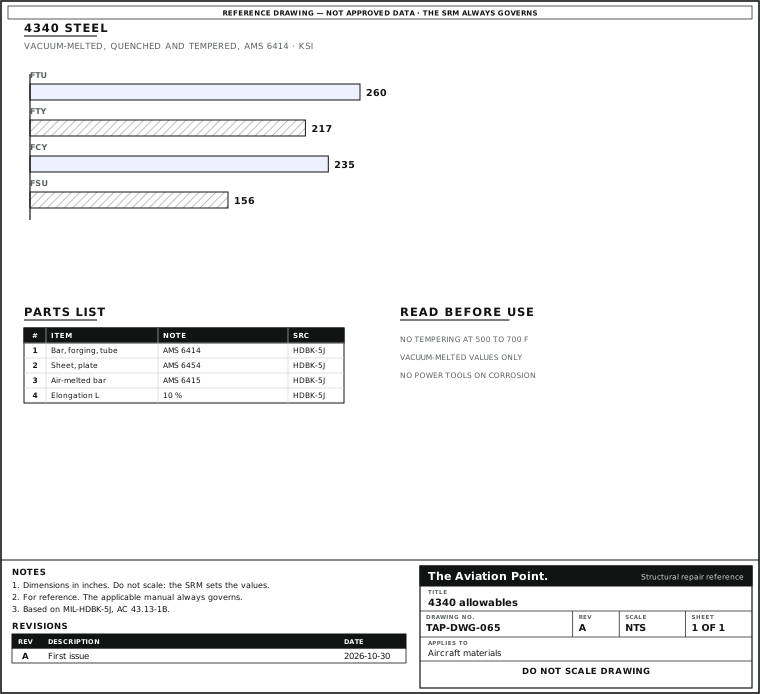
Bars, forgings and tubing, consumable-electrode (vacuum) melted only. MIL-HDBK-5J Table 2.3.1.0(f1).
| Property | S basis | Unit |
|---|---|---|
| Ftu | 260 | ksi |
| Fty | 217 | ksi |
| Fcy | 235 | ksi |
| Fsu | 156 | ksi |
| Elongation, L (S basis) | 10 | % |
| Specification | AMS 6414 | — |
Applicable to consumable-electrode vacuum-melted material only (footnote a), and only to parts for which the Ftu has been substantiated by quality control testing (footnote b). The maximum section depends on the quench; the table's footnotes give it for oil, salt and water. Source: MIL-HDBK-5J (31 Jan 2003), Table 2.3.1.0(f1), p. 2-22. E = 29.0 × 10³ ksi and density 0.283 lb/in³ are printed for the low-alloy steels in Table 2.3.1.0(c1).
Thicknesses and forms
Forms: bars, forgings and tubing (AMS 6414); sheet, strip and plate exist (AMS 6454, AMS 6359) but their specifications give no minimum mechanical properties.
Section size: the 260 ksi values require full hardening. The handbook footnotes limit the section by quench: about 1.70 in for martempering and 2.50 in in oil for the lower groups, larger for others; read the footnote for the exact figure against the alloy column.
Forming
4340 is machined and forged, then heat treated. It is not a cold-bending steel; the public FAA documents give no bend radius for it.
Do not cold-straighten a heat-treated part. The mechanical properties are valid only for steel quenched to 90 percent or more martensite at the centre (MIL-HDBK-5J, par. 2.3.1.0).
Quick check
You find red rust in a pit on a 4340 forging. What is the right first move?
- Wire-wheel it with a power drill
Not this one. Power tools overheat and notch the surface of a highly-stressed steel part (AC 43.13-1B par. 6-165).
- Remove it by hand with mild abrasive mats or fine paper and check the limits in the SRM
Best fit. Right. Careful, complete removal by mild abrasives; chemical removers need engineering authorization.
- Brush on a chemical rust remover
Not this one. Prohibited without engineering authorization: high-strength steel is subject to hydrogen embrittlement.
On a real job, the SRM decides.
Welding
No weld data for 4340 in the public FAA documents or MIL-HDBK-5J. The AC says not to weld alloy steel parts heat treated for their mechanical properties (par. 4-89c). Treat 4340 parts as not weldable unless the manufacturer or the SRM gives a procedure.
Corrosion
4340 at 260 ksi is far above the AC limit of Rockwell C40 (180 ksi) for special treatment, so par. 6-165 applies: remove corrosion products with mild abrasives only, no power tools, no chemical removers without engineering authorization (hydrogen embrittlement). Surface scratches can cause sudden failure.
Where it is used on aircraft
Highly loaded forged and machined parts at 260 ksi or higher; the handbook names 4340 and 300M for that level (par. 2.3.1.0).
Landing-gear and drive components are typical examples in industry practice; the SRM tells you which parts on your aircraft.
Data sheet
Questions people actually ask
What is the design strength of 4340?
MIL-HDBK-5J gives Ftu 260 ksi, Fty 217 ksi, Fcy 235 ksi, Fsu 156 ksi, S basis, for vacuum-melted bars, forgings and tubing under AMS 6414 (Table 2.3.1.0(f1)).
Why is 4340 not used at 220 ksi?
Embrittlement during tempering in the 500 to 700 °F range, MIL-HDBK-5J par. 2.3.1.0.
Limits — when NOT to use this
- Vacuum-melted values only. They do not apply to air-melted material.
- Not a repair stock. Replacement of a 4340 part is by part number, not by a bar from a catalog.
- No welding or hand-sanding advice. Corrosion and cracks go to engineering.
Where to buy
Distributors coming soon.
Sources
- MIL-HDBK-5J, Metallic Materials and Elements for Aerospace Vehicle Structures (31 Jan 2003) — par. 2.3.1.0; Tables 2.3.1.0(a), (b) and (f1) p. 2-22. Cancelled; superseded by MMPDS.
- FAA AC 43.13-1B CHG 1 — par. 4-89c and par. 6-165.
- MMPDS (formerly MIL-HDBK-5) — the current home of design allowables. A repair substantiation cites MMPDS or the SRM, not a website.
- AZoM, AISI 4340 alloy steel — Chemical composition table (carbon given as 0.37-0.43; page says about 0.40).