Strength along and across the fiber (Toray T700S/epoxy, 60% fiber volume)
Where to buy| Direction | Tensile strength | Tensile modulus | Ratio to 0° strength |
|---|---|---|---|
| 0° (along fiber) | 415 ksi (2,860 MPa) | 19 Msi (134 GPa) | 100% |
| 90° (across fiber) | 12 ksi (81 MPa) | — | about 3% (calculated) |
| In-plane shear | 20 ksi (136 MPa) | — | about 5% (calculated) |
Toray T700S data sheet, composite properties normalised to 60% fiber volume, cured with epoxy at 130 °C. T800S gives 477 ksi / 11 ksi (3,290 / 79 MPa). Ratios calculated by The Aviation Point.
Carbon tape prepreg (HexPly 8552)
| Property | Carbon tapes |
|---|---|
| Resin content | 33–38% |
| Flow | 10–22% |
| Volatiles | 1.0% max |
| Gel time at 350 °F | 12–22 min |
HexPly 8552 data sheet, US units, 2020.
Why direction matters
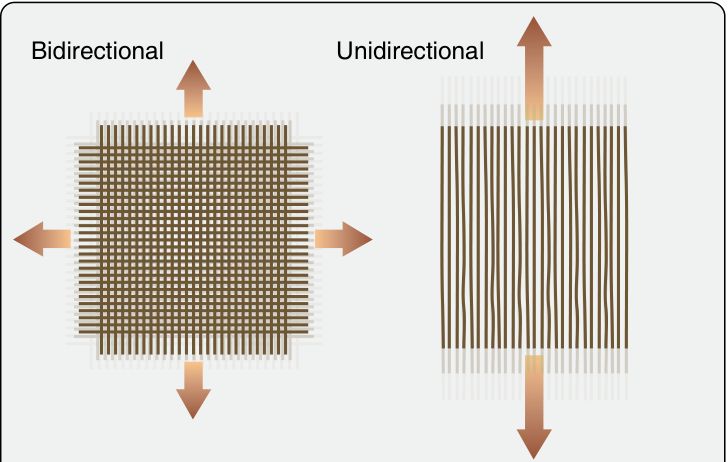
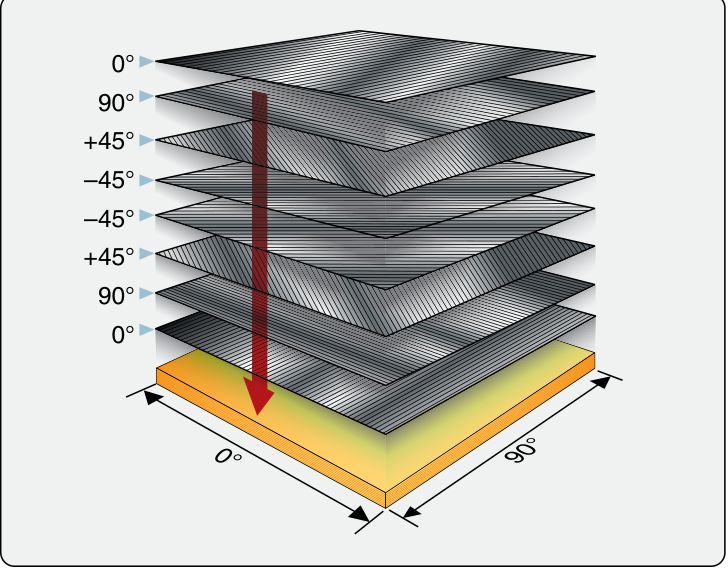
The FAA handbook shows unidirectional against bidirectional material in Figure 7-1 and defines ply orientation from the warp or roll direction (p. 7-3). Quasi-isotropic layups mix 0°, ±45° and 90° plies so the laminate is similar in all directions (Figure 7-2).
A repair ply laid at the wrong angle puts the strong direction where the load does not go. Orientation is read from the SRM, never guessed from the damaged area.
Limits — when NOT to use this
- Ratios are for one fiber and resin pair.
- Not a ply design. The SRM gives plies, angles and cure.
Where to buy
AmericaDistributor coming soonOur partner for this region is on its way
EuropeDistributor coming soonOur partner for this region is on its way
OceaniaDistributor coming soonOur partner for this region is on its way
Distributors coming soon.
Sources
- Toray Composite Materials America, TORAYCA T700S Standard Modulus Carbon Fiber Data Sheet (Rev. 11/24/2025) — fiber and composite properties, tow sizes, resin compatibility.
- Toray Composite Materials America, TORAYCA T800S Intermediate Modulus Carbon Fiber Data Sheet (Rev. 04/13/2018) — fiber and composite properties, tow sizes, resin compatibility.
- Hexcel HexPly 8552 Product Data Sheet (US units, 2020) — neat resin properties, prepreg physical properties, cure procedure, storage life.
- FAA-H-8083-31B, AMT Handbook — Airframe, Volume 1 (2023), Chapter 7 — unidirectional and bidirectional (Figure 7-1); ply orientation (Figures 7-2 and 7-3, p. 7-3).
Educational reference only. not approved data. Always consult the applicable SRM, AMM, or AC 43.13-1B and your certifying authority.