Key facts
Where to buy| Property | Value | Source |
|---|---|---|
| Composition | Nickel 0.40–0.70 %, chromium 0.40–0.60 %, molybdenum 0.20–0.30 %, carbon about 0.40 % | Metal supplier's AISI 8740 datasheet |
| Role | AISI 8630, 8735 and 8740 are the alternates to 4130, 4135 and 4140 | MIL-HDBK-5J, par. 2.3.1.0 |
| Sheet, strip, plate | AMS 6358 | MIL-HDBK-5J, Table 2.3.1.0(a) |
| Bars and forgings | AMS-S-6049 (noncurrent), AMS 6327, AMS 6322 | MIL-HDBK-5J, Table 2.3.1.0(a), (c3) |
| Tubing | AMS 6323 | MIL-HDBK-5J, Table 2.3.1.0(a) |
| Condition for design values | Quenched and tempered | MIL-HDBK-5J, Table 2.3.1.0(c3) |
Design values — AISI 8740 bars and forgings, quenched and tempered
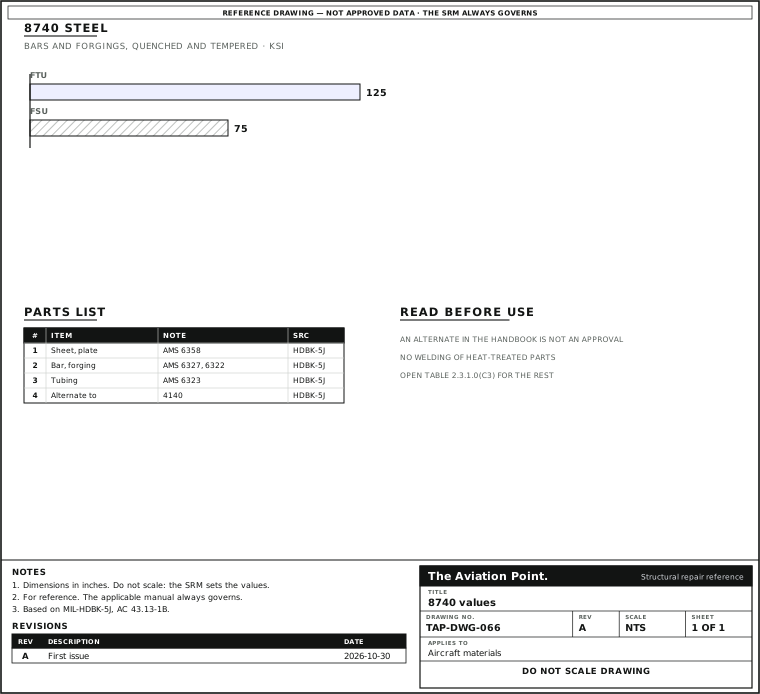
Bars and forgings. MIL-HDBK-5J Table 2.3.1.0(c3).
| Property | S basis | Unit |
|---|---|---|
| Ftu | 125 | ksi |
| Fsu | 75 | ksi |
| E | 29.0 | 10³ ksi |
| G | 11.0 | 10³ ksi |
| Density | 0.283 | lb/in³ |
Only Ftu and Fsu are listed here: the table prints one block for 8630 and 8740 with several specifications and thicknesses (1.500 and 1.750 in appear), and the 8740 yield and bearing columns cannot be separated reliably from the printed layout. Read Table 2.3.1.0(c3), p. 2-19, for them. Design values apply only to parts whose Ftu has been substantiated by quality control testing (footnote b).
Thicknesses and forms
Forms: sheet, strip and plate (AMS 6358, no minimum properties), bars and forgings (AMS 6327, 6322) and tubing (AMS 6323).
Design values in the handbook are for bars and forgings in a thickness up to about 1.5 to 1.75 in, quenched and tempered.
Forming
Like 4140, it is machined or forged and then heat treated; it is not a cold-forming steel. The public FAA documents give no bend radius.
Quick check
The drawing says 4140 bar; the shop has 8740 bar in stock. May you use it?
- Yes, the handbook says 8740 is the alternate
Not this one. The handbook groups alloys; it does not approve a substitution on your part.
- Not without approved data; a substitution is an engineering decision
Best fit. Right. Material on the drawing or an approved alternate only.
- Yes if it has the same hardness
Not this one. Hardness alone does not prove composition, toughness or weld behaviour.
On a real job, the SRM decides.
Welding
No weld data in the public documents. The AC rule applies: do not weld alloy steel parts heat treated for their mechanical properties (AC 43.13-1B par. 4-89c). Ask engineering.
Corrosion
Treat as a high-strength steel when heat treated above Rockwell C40: mild abrasives only, no power tools, no chemical removers without engineering authorization (AC 43.13-1B par. 6-165).
Where it is used on aircraft
Bars, forgings and tubing where the design calls for an alternate to 4140. The material called out on the drawing is the one you use.
Data sheet
Questions people actually ask
Is 8740 interchangeable with 4140?
MIL-HDBK-5J calls it an alternate to 4140, which is a statement about the handbook's grouping, not an approval to substitute on a repair. Use the drawing or SRM material.
Limits — when NOT to use this
- Partial table only. Yield and bearing values are not reproduced here; open Table 2.3.1.0(c3).
- No welding or bend data in the public documents.
Where to buy
Distributors coming soon.
Sources
- MIL-HDBK-5J, Metallic Materials and Elements for Aerospace Vehicle Structures (31 Jan 2003) — par. 2.3.1.0; Tables 2.3.1.0(a) and (c3), p. 2-19. Cancelled; superseded by MMPDS.
- FAA AC 43.13-1B CHG 1 — par. 4-89c and par. 6-165.
- MMPDS (formerly MIL-HDBK-5) — the current home of design allowables. A repair substantiation cites MMPDS or the SRM, not a website.
- Metal supplier's AISI 8740 datasheet — Chemical composition table.