Choosing the bar
Where to buy| Choice | What the Handbook says | If you get it wrong |
|---|---|---|
| Shape | First consideration. The face is usually concave to fit the shop head; complicated bars are forged or built up by welding | A wrong shape deforms the rivet head |
| Weight | From a few ounces to 8 or 10 lb, depending on the work. No weight-by-rivet table is given | Too light: the sheet bulges toward the shop head. Too heavy: it bulges away |
| Material | Low-carbon steel, case hardened, or alloy bar stock. Better steel lasts longer and needs less reconditioning | Soft faces dent and stay marked |
| Face | Hard enough to resist indentation, not hard enough to shatter | A dented face prints on the rivet |
| Edges | Slightly rounded, clean, smooth and well polished | Sharp edges mar the sheet around the rivet |
H-31 pp. 4-35 and 4-36, "Bucking Bar". Also called a dolly, bucking iron or bucking block.
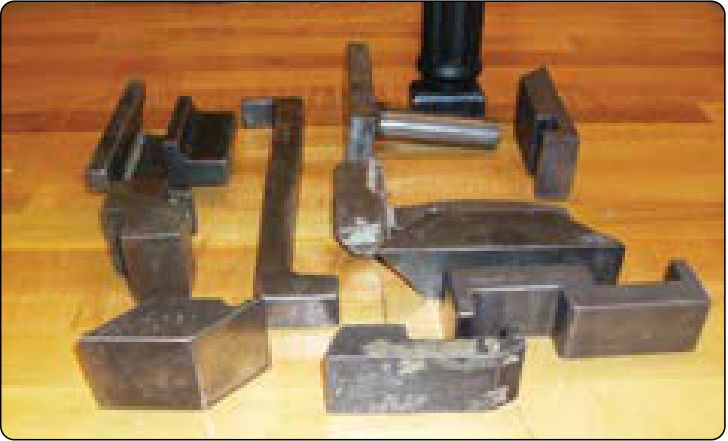
Buck a rivet
| Step | Action | What to do |
|---|---|---|
| 1 | Choose the bar | Shape for the access and the head, then weight for the sheet and the rivet. |
| 2 | Put the face on the shank | Hold the face at right angles to the rivet shank. If it is not square, the shank bends with the first blows and the material is marred with the last. |
| 3 | Let the weight work | Do not bear down on the shank. Hands guide the bar and give the tension and rebound; the bar's weight does most of the work. |
| 4 | Vibrate with the gun | Coordinated bucking lets the bar bounce in unison with the set. The opposing blows squeeze the rivet and make it swell. |
| 5 | Stay until it is done | Do not take the bar away while the gun is running: the set can be driven through the material. |
| 6 | Signal | A tap on the work tells the shooter the result: one tap, hit again; two, good; three, drill it out. |
Typical mistakes
| Mistake | What you see | Fix |
|---|---|---|
| Bar tilted | Bent shank, marred skin | Face square to the shank |
| Bar too light | Material bulges toward the shop head | A heavier bar |
| Bar too heavy | Material bulges away from the shop head | A lighter bar |
| Bearing down hard | Little rebound, poor head | Let the weight work; guide with the hands |
| Bar lifted early | Set driven through the material | Hold it until the last blow |
H-31 p. 4-36.
Care
Keep the face clean, smooth and polished, and the edges lightly rounded. A bar that is rebuilt or reground should keep its original shape.
Reduced-vibration bars exist to lower the risk of hand injury; the Handbook points them out (p. 4-38).
Quick check
After riveting, the sheet bulges away from the shop head. What is the likely cause?
- The bar is too heavy
Best fit. A too-heavy bar and its force make the material bulge away from the shop head.
- The bar is too light
Not this one. That gives the opposite fault: bulging toward the shop head.
- The rivet is too long
Not this one. A long rivet gives a large shop head; it does not bulge the sheet.
On a real job, the SRM decides.
Questions people actually ask
What weight bucking bar do I need?
The Handbook gives a range, from a few ounces to 8 or 10 lb, and no table. Pick the shape first, then adjust weight until the sheet stays flat and the head forms cleanly.
Can I use a bar with a worn face?
A dented or rough face marks every shop head. Reface or replace it; the Handbook wants bars kept smooth and polished.
What is the tap code?
Teams use taps on the bar: one tap, not fully seated; two taps, good rivet; three taps, bad rivet (p. 4-40). Agree the code before you start.
Limits of this guide
What the sources support, and no further.
- Not approved data. The SRM or drawing may call for a specific bar or method.
- No weight table. The FAA handbooks give no weight per rivet size; none is shown here.
Where to buy
Distributors coming soon.
Sources
- FAA-H-8083-31B, AMT Handbook: Airframe (2023), Chapter 4 — pp. 4-35 to 4-36, "Bucking Bar"; p. 4-38 on reduced-vibration tooling; p. 4-40, tap code. Fig. 4-83.