The drawing
Where to buy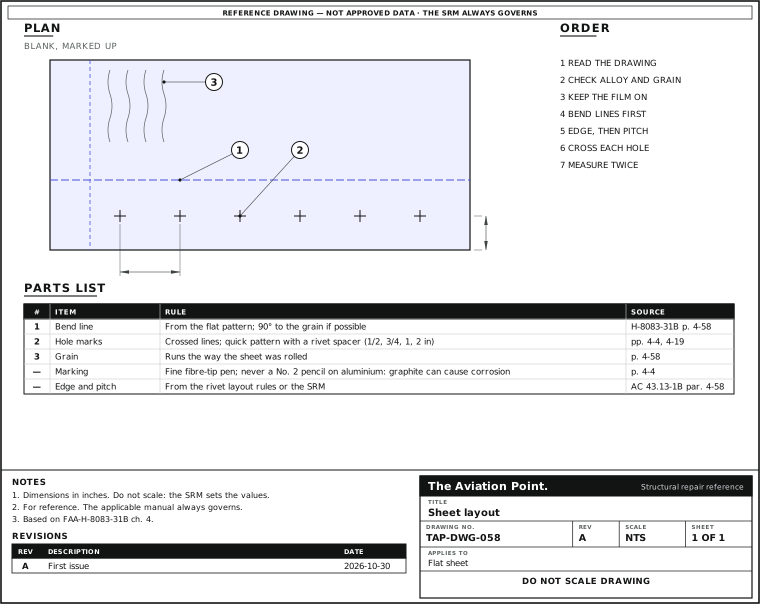
Step by step
| Step | Action | What to do |
|---|---|---|
| 1 | Read the drawing | Base measurements, alloy, thickness, bend radii. |
| 2 | Check the stock | Plate and sheet carry code markings about every five inches. Confirm alloy and temper. |
| 3 | Keep the film on | Mark on the membrane, on masking tape, or directly with a fine fibre-tip pen. |
| 4 | Lay out the flat pattern | Work out setback and bend allowance first: calculator. |
| 5 | Check the grain | Bend lines should lie at 90° to the grain if possible. |
| 6 | Mark the rivets | Rows, edge distance, pitch; a rivet spacer gives quick 1/2, 3/4, 1 and 2 in patterns. |
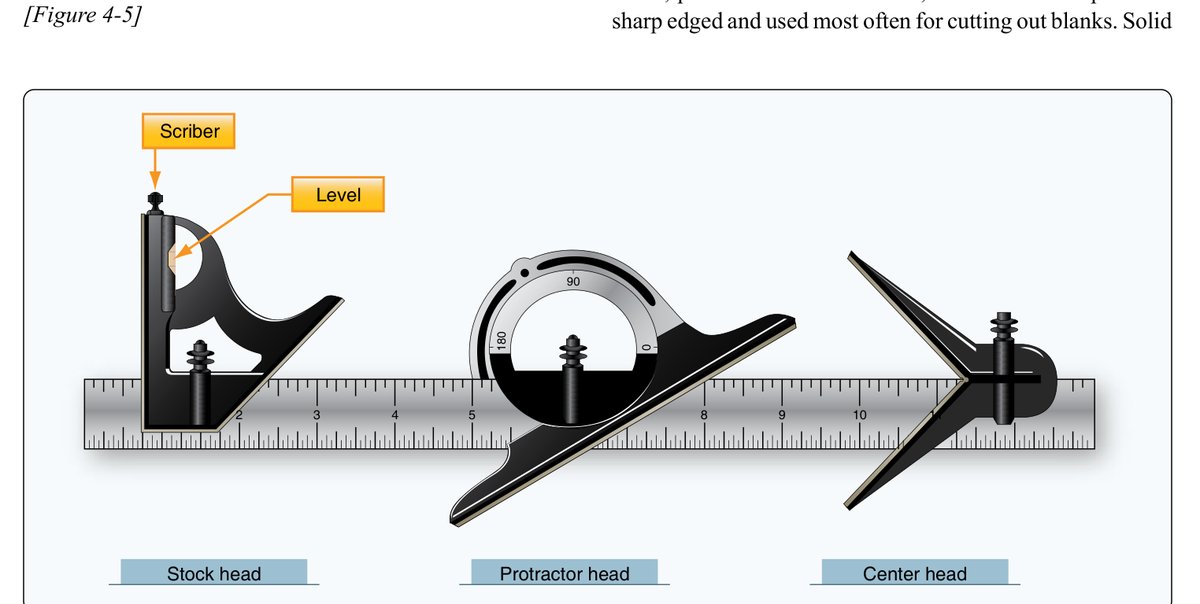
| 7 | Check it | Combination square for 90° and 45°; dividers to transfer a measurement. Then cut. |
Tools you need
| Tool | What for | Buying guide | Catalog |
|---|---|---|---|
| Combination square | 90° and 45°, any angle with the protractor head | Layout tools | — |
| Rivet spacer | Fast, accurate rivet patterns | Layout tools | — |
| Fine fibre-tip pen | Marks without corrosion risk | — | — |
| Scale and dividers | Transfer and measure | Starter kit | — |
| Hole finder | Transfers holes to a new skin | Layout tools | Hole finders |
What to check when it is done
| Look at | Good | If not |
|---|---|---|
| Marks | Pen or tape, no graphite, no deep scribe in the finished part | Clean off; replace if scored |
| Grain | Across the bend where possible | Reconsider the nesting |
| Dimensions | Match the drawing, measured twice | Fix before cutting |
Questions people actually ask
Why not a pencil?
The graphite in a No. 2 pencil can cause corrosion on aluminium.
Limits of this guide
What the sources support, and no further.
- The manual governs. Where the SRM, the drawing or the fastener maker says otherwise, follow them; this page explains general practice.
- Marks that remain: cleaning and finish rules come from the manual.
Where to buy
AmericaDistributor coming soonOur partner for this region is on its way
EuropeDistributor coming soonOur partner for this region is on its way
OceaniaDistributor coming soonOur partner for this region is on its way
Distributors coming soon.
Sources
- FAA-H-8083-31B, Aviation Maintenance Technician Handbook: Airframe, Chapter 4 — p. 4-3, combination square; p. 4-4, dividers, rivet spacers, marking; p. 4-29, stock markings; p. 4-58, terms, grain.
- FAA AC 43.13-1B CHG 1, Acceptable Methods, Techniques and Practices — par. 4-55, bend lines at an angle to the grain.
Educational reference only. not approved data. Always consult the applicable SRM, AMM, or AC 43.13-1B and your certifying authority.