The work cell and the downdraft table
Where to buy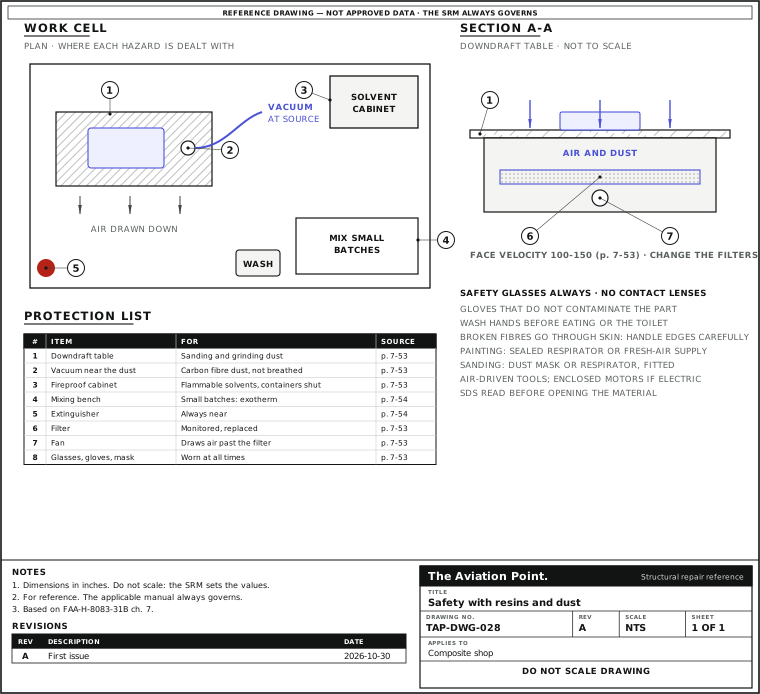
Hazard by hazard
| Hazard | What the handbook asks | In the cell |
|---|---|---|
| Chemicals | Read and understand the safety data sheet (SDS) for every resin, solvent and adhesive; it lists hazards, and some materials irritate the lungs or are carcinogenic | SDS at the bench; read before opening |
| Eyes | Safety glasses at all times; face shield for mixing or pouring acids; never contact lenses, because solvents can melt them and dust gets under them | Glasses on before anything is opened |
| Dust | Do not breathe carbon dust; good air flow; vacuum near the source; dust mask or respirator for sanding; sealed respirator with the right filters or fresh-air supply for paint | Downdraft table and vacuum at the sander |
| Skin | Approved gloves that protect the skin and do not contaminate the part; wash hands before the toilet or eating; handle damaged parts with care, since single fibres penetrate and break off in the skin | Glove station, wash basin |
| Fire | Solvents are flammable: close containers, fireproof cabinet, away from static; air-driven tools preferred, enclosed motors if electric; do not mix too much resin, because it overheats and smokes; extinguisher near | Cabinet, small batches, extinguisher |
FAA-H-8083-31B Vol. 1 pp. 7-53 and 7-54, Repair Safety. AC 43.13-1B p. 3-1 asks for the SDS to be reviewed, shelf life observed, and gloves and approved masks worn.
Dust, cutting and the downdraft table
Sanding and cutting make the dust, so the controls go at the tool. A downdraft table pulls the air and dust down through the work surface and into a filter, so it never passes the operator's face; it also collects most of the particles for disposal. The handbook says to size and maintain it for an average face velocity between 100 and 150 and to change the filters on a schedule. It prints the unit as cubic feet per minute, but a face velocity is a speed in feet per minute: confirm the figure against the table maker's manual.
Cutters that work for metal wear quickly on carbon and glass: the handbook recommends diamond-grit or carbide tools, with high speed and slow feed, and a toothless carbide or diamond bandsaw blade. Do not cut other materials on equipment used for composites: they contaminate the next part. A waterjet cannot be used on honeycomb because it puts water in the core.
Resin, solvent and static
Close solvent containers when not in use and keep them in a fireproof cabinet. Static builds up during sanding and when bagging film is unrolled, so keep solvents away from it. Air-driven tools are preferred. Electric tools are not recommended, because carbon is conductive and can short them; if electric, they must be the totally enclosed type.
Epoxy hardens by an exothermic reaction. A big pot heats itself, can smoke and can start a fire, so mix only what you can lay up, and keep an extinguisher in reach. The mix ratio and pot life calculators give the batch size and the time you have.
For UAV, model and homebuilt work
Garage shops skip the downdraft table and then sand in the open. A vacuum at the sander, a fitted respirator and a damp wipe-down instead of dry sweeping make the biggest difference. Keep resin, food and drink in separate places, wash before eating, and keep solvents out of the house. The handbook has no special rule for hobby shops: the same hazards apply.
Questions people actually ask
Do I need a respirator to sand cured carbon?
Yes: the handbook says a dust mask or respirator when sanding, a properly fitted one, plus a vacuum near the source. Do not breathe carbon fibre dust.
Why no contact lenses in the shop?
Some solvents can melt the lenses against the eye, and dust gets under them.
What about waste?
The handbook says only that the downdraft table collects dust for disposal. Cured offcuts, resin, solvent and filters follow local and national rules: check with the SDS and your local authority.
Why mix small batches?
Mixed epoxy heats itself in the pot. A big batch can smoke and start a fire, and the pot life is shorter.
Limits of this guide
What the sources support, and no further.
- This is not a safety plan. The SDS of each material and local regulation govern. The handbook gives general rules; exposure limits are not in it and not here.
- Not covered. Waste and disposal rules, ventilation rates for spraying, medical surveillance and hazards of acids and welding.
- The layout is an example of where the handbook's controls go; it is not an approved shop design.
Where to buy
Distributors coming soon.
Sources
- FAA-H-8083-31B, AMT Handbook — Airframe, Volume 1 (2023), Chapter 7 — p. 7-19, air tools and conductive carbon; p. 7-52, cutters and cutting equipment, dedicated equipment; pp. 7-53 and 7-54, Repair Safety: safety data sheets, eye, respiratory and skin protection, downdraft tables, fire protection.
- AC 43.13-1B, Change 1, Chapter 3, Fiberglass and Plastics — p. 3-1, paragraph 3-1 note: review the safety data sheets, observe shelf life, wear gloves and approved masks.