The decision on one sheet
Where to buy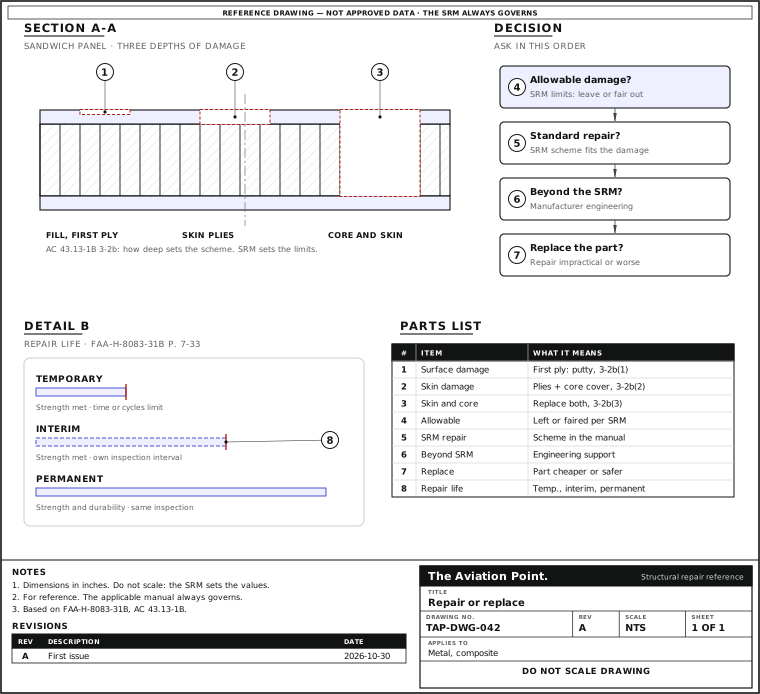
Ask the four questions in order
| Step | Action | What to do |
|---|---|---|
| 1 | Is the damage allowable? | Look in the SRM's allowable damage section. The Handbook gives no universal limits. |
| 2 | Does an SRM scheme cover it? | Look in the SRM repair section. One maker's method does not carry over to another. |
| 3 | Is it outside the SRM? | Then you need the manufacturer's engineering support. |
| 4 | Should the part be replaced? | The SRM and the cost decide this one. |
Four questions, in this order
| Question | The answer comes from | Source, and the catch |
|---|---|---|
| Is the damage allowable? | SRM: allowable damage and limits | Size, number, depth, location and load decide how serious a delamination is (Handbook p. 7-13). The Handbook gives no universal limits. |
| Does an SRM scheme cover it? | SRM repair section | Review the manufacturer's repair data to find which repair is permissible (AC 43.13-1B 3-1). The Handbook steps are not a substitute for the SRM; one maker's method does not carry over to another (p. 7-35 note). |
| Is it outside the SRM? | Manufacturer engineering support | Required for methods not described in the maintenance manual or SRM (Handbook p. 4-93). |
| Should the part be replaced? | SRM, and cost | The Handbook's tests are for sheet metal (p. 4-90): repair impractical, replacement cheaper, or the part easy to change. It states none for composites. |
Steps 1 and 2 are the SRM's tables. The Handbook never replaces them.
Compare the three lives of a repair
Temporary
- Strength
- Meets the strength requirements.
- Durability
- Limited by time or flight cycles.
- Afterwards
- Removed and replaced at the end of its life.
Interim
- Strength
- Restores the required strength.
- Durability
- Does not restore the required durability.
- Afterwards
- Has a different inspection interval or method.
Permanent
- Strength
- Restores the strength.
- Durability
- Restores the durability.
- Afterwards
- Same inspection method and interval as the original part.
The SRM says which of the three a repair is.
Temporary, interim or permanent
The Handbook sorts repairs by how long they last (pp. 7-33, 7-34). A temporary repair meets the strength requirements but is limited by time or flight cycles; at the end of its life it is removed and replaced.
An interim repair restores the required strength but not the required durability, so it has a different inspection interval or method. A permanent repair restores strength and durability, and has the same inspection method and interval as the original part.
For the work order this means three entries the SRM supplies: which of the three the repair is, the date or cycle limit if it is not permanent, and the inspection interval.
What the advisory circular allows
AC 43.13-1B applies only when the manufacturer has no repair or maintenance instructions. Its data generally covers minor repairs, and for a major repair it can only be the basis of FAA approval. It may serve as approved data, quoted by chapter, page and paragraph in block 8 of Form 337, if you judge it appropriate, directly applicable and not contrary to the manufacturer's data (AC page 1, paragraph 1; Handbook p. 4-93).
Chapter 3 adds rules that decide between repair and replace: replace damaged material with identical chemical composition or a substitute the manufacturer approves; avoid abrupt changes of cross-section; and lay up test specimens during the actual repair, from the same adhesive batch and cured at the same pressure, temperature and time (3-1a to 3-1c).
The fibreglass repairs of paragraph 3-2 are not for radomes or for graphite or Kevlar parts (note under 3-2).
Major repair
A major repair needs FAA Form 337. The Handbook lists the parts where strengthening, reinforcing, splicing or fabrication of primary structure counts, among them box beams, semimonocoque wings and control surfaces, spars and wing ribs (p. 4-93). Whether a given composite repair is major is a call for the certificated person who signs for it, and the SRM often says.
What belongs in the file
This is our checklist, not the Handbook's: the NDI damage map with sizes, the SRM reference and revision, the repair scheme and its life, the material batch and expiry, the cure record, the test specimen result, and the next inspection due.
For UAV, model and homebuilt work
Most small airframes have no SRM. The kit maker's build and repair notes are the nearest thing, and the same order applies: allowable first, a published repair second. If neither covers the damage and nobody can give you engineering data, replacing the part is the sound choice.
Questions people actually ask
Can I repair anything the Handbook describes?
No. The Handbook says its steps do not replace the aircraft's SRM, and the methods of one manufacturer do not apply to another (p. 7-35).
What if the SRM has no repair for my damage?
Ask the aircraft manufacturer for engineering support. It is required for methods not in the maintenance manual or SRM (Handbook p. 4-93).
Is an interim repair as good as a permanent one?
It restores strength but not durability, so it carries a different inspection interval or method (pp. 7-33, 7-34).
Does AC 43.13-1B cover carbon and Kevlar repairs?
The fibreglass repairs of 3-2 do not. They exclude radomes and advanced composites such as graphite and Kevlar.
Limits of this guide
What the sources support, and no further.
- No limits here. Allowable damage, sizes, depths and repair life come from the SRM or from the manufacturer's engineers.
- Metal tests only. The Handbook's reasons to replace a part are written for sheet metal; none are given for composites.
- Not covered. Thermoplastic parts, bonded repairs to metal and the airworthiness-release paperwork of a given authority.
Where to buy
Distributors coming soon.
Sources
- FAA-H-8083-31B, AMT Handbook — Airframe, Volume 1 (2023), Chapters 4 and 7 — p. 4-90, classification of damage, replacement; pp. 4-92 to 4-93, approval of repair, AC 43.13-1 use, manufacturer engineering support, Form 337 list; p. 7-13, delamination and loading; pp. 7-33 to 7-34, temporary, interim and permanent repair; p. 7-35, SRM note.
- AC 43.13-1B, Acceptable Methods, Techniques, and Practices — Aircraft Inspection and Repair (1998, with Change 1) — Paragraph 1, purpose; chapter 3, section 1, paragraphs 3-1 and 3-2 including the notes.