Warp, fill, selvage and the clock
Where to buy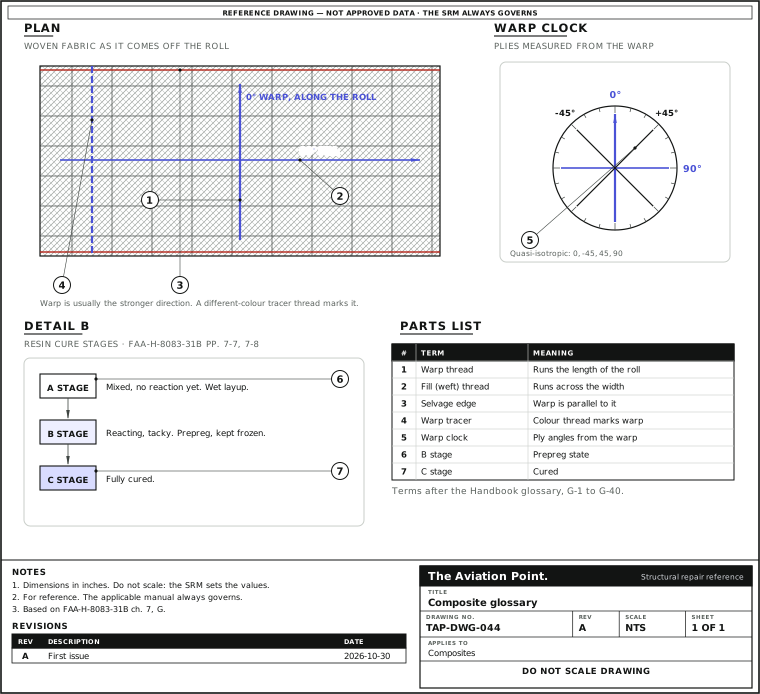
Fibres and fabric
| Term | What it means | Source |
|---|---|---|
| Warp | Threads that run along the length of the roll, parallel to the selvage edge; often the stronger ones | G-39; p. 7-29 |
| Fill (weft, woof) | Threads across the width, woven through the warp. 90° to the warp is called the fill direction | G-15; p. 7-29 |
| Warp tracer | A thread of another colour woven in to show which way the warp runs | G-39 |
| Warp clock | A diagram in the SRM that shows each ply's direction against a reference direction. With no clock on the fabric, 0° is the roll direction | G-39; p. 7-29 |
| Unidirectional fabric | All threads run one way, held by a few cross fibres | G-38 |
| Satin weave | Warp passes under one fill thread and over several; lays over complex shapes | G-29 |
| Quasi-isotropic | Plies stacked 0, -45, 45, 90 (or 0, -60, 60) so the laminate acts like an isotropic material | p. 7-2 |
| Composite | Materials combined so that the result has characteristics different from any of its parts | G-9 |
Resin and cure
| Term | What it means | Source |
|---|---|---|
| Matrix | The material that bonds the fibres and passes load into them; resins are the most common | G-22 |
| Thermosetting resin | Plastic that, once hardened by heat, cannot be softened again | G-36 |
| Thermoplastic resin | Plastic that softens when heated and hardens when cooled | G-36 |
| A stage | Base and hardener mixed, no reaction yet. The resin of a wet layup | pp. 7-7, 7-8 |
| B stage | Reaction started, the material is thick and tacky. Prepreg resin; kept at 0 °F, it stays in B stage | pp. 7-7, 7-8 |
| C stage | The resin is fully cured | p. 7-8 |
| Prepreg | Fibres encapsulated in uncured resin; refrigerated so it does not cure before use | G-27 |
| Microballoons | Tiny hollow spheres of glass or phenolic that add body to a resin | G-22 |
Bagging and bonding
| Term | What it means | Source |
|---|---|---|
| Bleeder | Glass cloth or mat over the layup that soaks up the resin pressed out of the plies; the bleeder ply also gives air and volatiles a path out | G-5; p. 7-19 |
| Breather | Gives air a path out of the vacuum bag; it must touch the bleeder | p. 7-21 |
| Caul plate | A plate that supports the part in the cure, or sits on the repair for even heat and a smoother face | p. 7-19 |
| Peel ply | A thin layer cured onto the part and torn off just before bonding, leaving a clean surface | p. 7-21 |
| Autoclave | A pressure vessel that heats and pressurises the part to cure the resin | G-3 |
| Secondary bonding | Precured parts joined with a layer of adhesive | p. 7-27 |
| Co-bonding | One part precured, the mating part cured at the same time as the adhesive | p. 7-28 |
| Sandwich material | A core bonded between face sheets of metal or resin-impregnated fabric | G-29 |
Damage
| Term | What it means | Source |
|---|---|---|
| Delamination | The separation of the layers of a laminated material | G-11 |
| Disbond | Lost bond along a bondline, such as skin to core | p. 7-13 |
G- numbers are entries in the Handbook's glossary; p. numbers are chapter 7 text. The damage-types guide shows how each damage appears.
Reading a warp clock
The clock gives each ply an angle from the 0° warp, which runs along the roll. 90° is across it, in the fill direction. If the fabric carries no clock, treat 0° as the direction it comes off the roll (p. 7-29). The ply table in the SRM gives the angles. The ply orientation guide shows symmetric stacks.
Questions people actually ask
Which way is 0°?
Along the warp, the length of the roll, unless the SRM's warp clock shows another reference (Handbook p. 7-29, G-39).
Why is prepreg kept frozen?
It is in the B stage, and cold stops the reaction. The cure resumes when it is warmed again (pp. 7-7, 7-8).
What is the difference between a delamination and a disbond?
A delamination is between plies; a disbond is along a bondline, such as skin to core (pp. 7-13, G-11).
Is a bleeder the same as a breather?
No. The bleeder soaks up excess resin; the breather lets air out of the bag and must touch the bleeder (pp. 7-19, 7-21).
Limits of this guide
What the sources support, and no further.
- Handbook definitions only. Resin makers and manuals use their own terms; read the spec sheet.
- No numbers. Cure temperatures, overlaps and plies come from the SRM.
- Not covered. Terms of thermoplastics, pre-impregnation processes and infusion.
Where to buy
Distributors coming soon.
Sources
- FAA-H-8083-31B, AMT Handbook — Airframe, Volume 1 (2023), Chapter 7 and Glossary — pp. 7-2, quasi-isotropic; pp. 7-7 to 7-8, A, B and C stage; p. 7-13, disbond; pp. 7-19, 7-21, bleeder, caul plate, peel ply, breather; pp. 7-27 to 7-29, secondary bonding, co-bonding, warp; glossary G-3 to G-39.