Prepreg life, cold store and thawing
Where to buy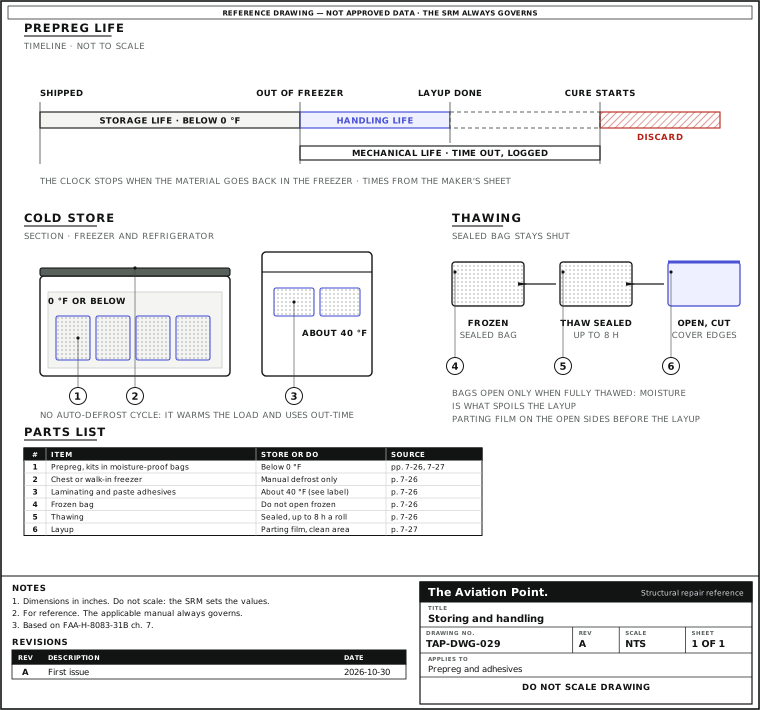
Take prepreg from freezer to layup
| Step | Action | What to do |
|---|---|---|
| 1 | Log the time out | The mechanical life starts when the material leaves the freezer. Every trip counts. |
| 2 | Keep the bag sealed | Let it come all the way up to room temperature before you open it. A cold bag opened early collects moisture. |
| 3 | Keep it clean | Keep it away from dust, oil, vapours and smoke. A clean room is best; otherwise use bags or plastic cover. |
| 4 | Prepare | Cover the unprotected sides with parting film and clean the repair area. |
| 5 | Cut and stack | Cut the plies and stack them in the right orientation. Take the backing material off between plies. |
| 6 | Bag, or put it back | Bag the layup. Material going back in the freezer stops its clock, so log the time in. |
What is stored where
| Material | Store | Notes |
|---|---|---|
| Prepreg | Freezer, below 0 °F | Sealed, moisture-proof bag; a roll can take 8 hours to thaw |
| Film adhesive, foaming adhesive | Freezer, like prepreg | Limited storage life; ship on dry ice |
| Paste adhesive | Room temperature | Long shelf life; the handbook also lists refrigerators near 40 °F for laminating and paste adhesives. Follow the label |
| Epoxy resins, wet layup | As the label says: typically 40 to 80 °F | Some systems need below 40 °F. Refrigeration slows ageing |
| Dry fabric | Room temperature, clean and dry | Wet layup fibre and resin keep for a long time at room temperature |
FAA-H-8083-31B Vol. 1 pp. 7-8, 7-10 and 7-25 to 7-26. Only the maker's label or data sheet gives the temperature for your lot.
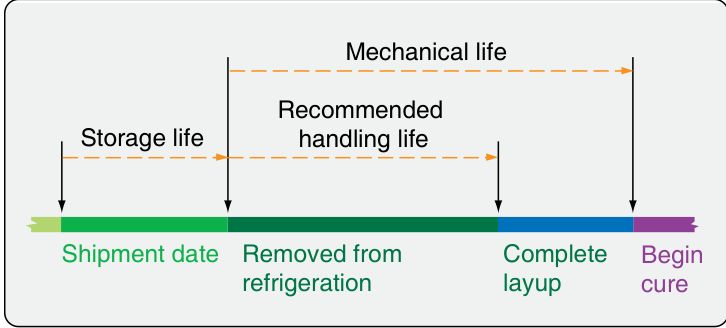
The three lives of a prepreg
| Term | Meaning | Typical |
|---|---|---|
| Storage life | Longest time in cold storage | 6 months to a year; the maker can extend it after testing |
| Mechanical life | Longest time at room temperature before the resin cures too far | Measured from freezer out to freezer back; past it, discard |
| Handling life | Recommended time at room temperature to finish layup and compaction | Shorter than the mechanical life |
FAA-H-8083-31B Vol. 1 pp. 7-26 and 7-27, figure 7-45. Values come from the material sheet; the handbook gives only the typical storage life.
Quick check
A roll of prepreg has passed its mechanical life. What now?
- Discard it
Best fit. The handbook gives no way to recover material that has passed its mechanical life.
- Put it back in the freezer
Not this one. Cold stops the clock, but it does not give time back.
- Use it if it looks fine
Not this one. A repair made from spent material can look right and still fail.
The product's data sheet and label give the limits.
Out-time: log it, then keep to it
The mechanical life is the number that matters on the bench. It starts when the material comes out of the freezer and stops when it goes back, so every trip counts, including the minutes it sat on the bench while someone fetched a tool. Keep a record of time in and out. Material that has passed its mechanical life is discarded; the handbook gives no way to recover it. The prepreg out-time log adds up the sessions for you.
Many shops cut a roll into smaller kits and bag them separately. A kit thaws faster, and the big roll stays cold. The same freezing rule covers film and foaming adhesive.
Thawing and layup
Take the bag out sealed and let it come all the way up to room temperature before you open it. A cold bag opened early collects moisture, and moisture goes into the laminate. Keep it away from dust, oil, vapours and smoke; a clean room is best, otherwise bags or plastic cover. Just before the layup, cover the unprotected sides with parting film and clean the repair area.
Then cut the plies, stack them in the right orientation and bag. Remember to take the backing material off between plies.
The freezer itself
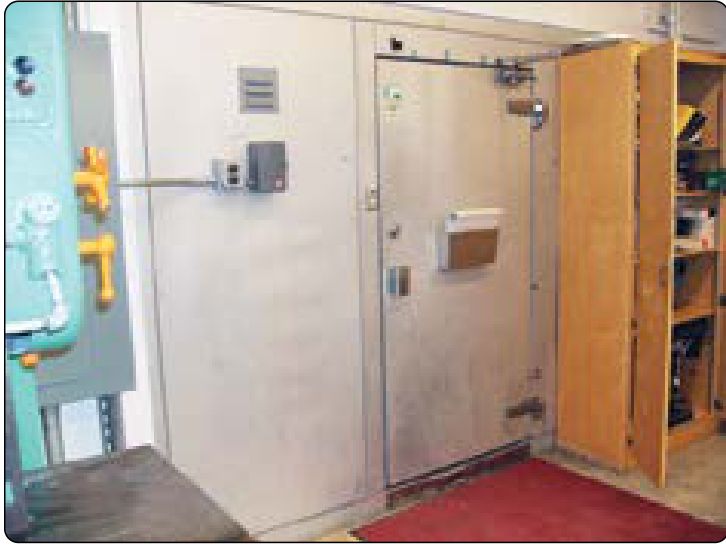
It must hold 0 °F or below and must not be the automatic-defrost kind: the defrost cycle warms the load now and then, which cuts the shelf life and eats into the out-time. Most household freezers reach 0 °F; a chest freezer is enough for small use, a walk-in for volume. Check it against a thermometer you trust, and record the reading.
Questions people actually ask
Can I refreeze prepreg?
Yes, if it is within its mechanical life and the time out is logged. The clock keeps counting the whole time it was out, and it does not reset.
Is a frost-free household freezer all right?
No. The handbook says the freezer must not be the automatic-defrost type, because the warming cycle shortens the shelf life and uses out-time.
Why not open the bag while it is cold?
Water condenses on cold material. It stays in the plies and shows up as voids or a poor bond after the cure.
How long does prepreg last in the freezer?
The storage life is usually 6 months to a year, and the maker can extend it after testing. The date is on the maker's sheet, not in the handbook.
Limits of this guide
What the sources support, and no further.
- The numbers are the maker's. Storage, mechanical and handling life, and the exact freezer temperature for a product, come from its data sheet and label. The handbook gives only typical values.
- Not covered. Sealants, paints and wood and fabric materials, and the retest of expired material.
- Labelling. The handbook says the container label gives the storage temperature; tagging each kit with lot and dates is usual practice, not a handbook rule.
Where to buy
Distributors coming soon.
Sources
- FAA-H-8083-31B, AMT Handbook — Airframe, Volume 1 (2023), Chapter 7 — p. 7-8 and p. 7-10, prepreg and foaming adhesive kept in a freezer, paste adhesive at room temperature; pp. 7-25 to 7-27, epoxy storage temperature, prepreg storage, thawing, freezers and refrigerators, storage life, mechanical life, handling life, records, kits and moisture-proof bags, figures 7-44 and 7-45.