Kevlar aramid at a glance
Where to buy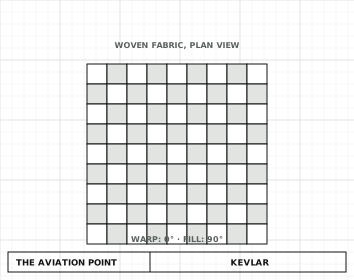
Designation
| Item | Value |
|---|---|
| Designation | Kevlar aramid |
| Class | Composites |
| Type | aramid fiber |
Typical yarn properties (DuPont Table II-1)
| Property | Kevlar 29 | Kevlar 49 |
|---|---|---|
| Density | 0.052 lb/in³ (1.44 g/cm³) | 0.052 lb/in³ (1.44 g/cm³) |
| Yarn tensile strength | 424,000 psi (2,920 MPa) | 435,000 psi (3,000 MPa) |
| Yarn tensile modulus | 10.2 Msi (70,500 MPa) | 16.3 Msi (112,400 MPa), converted |
| Elongation at break | 3.6% | 2.4% |
| Impregnated strand strength | 525,000 psi (3,600 MPa) | 525,000 psi (3,600 MPa) |
| Impregnated strand modulus | 12.0 Msi (83,000 MPa) | 18.0 Msi (124,000 MPa) |
| Moisture, equilibrium from bone-dry | 4.5% | 3.5% |
| Decomposition in air | 800–900 °F (427–482 °C) | 800–900 °F (427–482 °C) |
| Recommended long-term maximum in air | 300–350 °F (149–177 °C) | 300–350 °F (149–177 °C) |
DuPont says the table gives typical values, "not product specifications". The Kevlar 49 yarn modulus line prints "6.3 × 10⁶" in the text copy used here, next to 112,400 MPa; 112,400 MPa converts to 16.3 Msi, which is the value shown. Kevlar does not melt; it decomposes.
A Kevlar fabric
| Fabric | Weave | Weight | Thickness | Count per in | Breaking strength |
|---|---|---|---|---|---|
| BGF aramid 195 denier, plain weave (listed Style 120) | Plain | 1.8 oz/yd² (61 g/m², converted) | 0.0039 in (0.10 mm) | 34 × 34 | 200 / 200 lbf/in |
BGF Industries data sheet via a distributor (see the carbon and aramid page).
Notes from the guide
- Yarn data, not laminate data.
- Heat. DuPont warns tensile properties drop at or above 300–350 °F for extended periods.
- Moisture. The fiber properties are virtually unaffected by moisture, but the part still must be sealed against water (FAA).
Where to buy
AmericaDistributor coming soonOur partner for this region is on its way
EuropeDistributor coming soonOur partner for this region is on its way
OceaniaDistributor coming soonOur partner for this region is on its way
Distributors coming soon.
Sources
- DuPont, Kevlar Aramid Fiber Technical Guide, Section II, Table II-1 (pp. 5-6) and thermal properties (p. 12) — typical yarn properties of Kevlar 29 and Kevlar 49.
- FAA-H-8083-31B, AMT Handbook — Airframe, Volume 1 (2023), Chapter 7 — aramid fiber, advantages, moisture, cutting (p. 7-5).
- BGF Industries aramid data sheet, Kevlar 120 — plain weave, 195 denier, 34 × 34, 1.8 OSY, 0.0039 in, 200 / 200 lbf/in.
Educational reference only. not approved data. Always consult the applicable SRM, AMM, or AC 43.13-1B and your certifying authority.