7075-T6 at a glance
Where to buy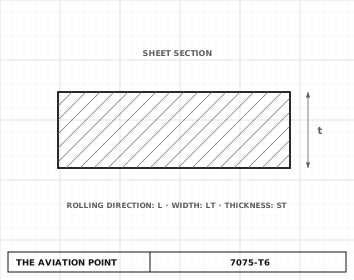
Designation
| Item | Value |
|---|---|
| Designation | 7075-T6 |
| Class | Aluminum |
| Type | wrought aluminum alloy |
Composition
| Element | Limit |
|---|---|
| Si | 0.40 |
| Fe | 0.50 |
| Cu | 1.2–2.0 |
| Mn | 0.30 |
| Mg | 2.1–2.9 |
| Cr | 0.18–0.28 |
| Zn | 5.1–6.1 |
| Ti | 0.20 |
| Al | Remainder |
A single number is a maximum. Other elements: 0.05 each, 0.15 total, except where the Teal Sheets say otherwise. Source: Aluminum Association Teal Sheets (Aug 2018).
Specifications and forms
| Specification | Form |
|---|---|
| AMS 4044, AMS 4045, AMS 4078, AMS-QQ-A-250/12, /24 | Bare sheet and plate |
| AMS 4049, AMS-QQ-A-250/13, /25 | Clad sheet and plate |
| AMS 4122, 4123, 4124, 4186, 4187, AMS-QQ-A-225/9 | Bar and rod |
| AMS-QQ-A-200/11, /15 | Extrusion |
| AMS 4126 | Forging |
Specifications as listed by MIL-HDBK-5J. Federal QQ-A specifications passed to SAE as AMS-QQ-A. Check the current revision.
Properties
| Property | Value | Source |
|---|---|---|
| Brinell hardness, 7075-T6 | 135 (500 kg load, 10 mm ball) | AC 43.13-1B CHG 1, Table 4-5 |
| Sheet tensile stress behind the AN-3 bolt count in a splice | 70,000 psi | AC 43.13-1B CHG 1, Table 4-9 engineering note d (table title lists bare 7075-T6 sheet) |
| Welding | Do not weld — severe cracking | AC 43.13-1B CHG 1, par. 4-89d |
| Density | 0.101 lb/in³ (2.81 g/cm³) | MIL-HDBK-5J; Teal Sheets |
| Stress corrosion, T6 plate | L: A · LT: B · ST: D | MIL-HDBK-5J Table 3.1.2.3.1(a) |
The 70,000 psi figure is the value the AC used to calculate its own splice table. It is a specific context, not a general-purpose allowable, and it is shared with the other alloys in the table title.
Bend radii, 7075 (AC 43.13-1B Table 4-6)
| Alloy and temper | 0.016" | 0.032" | 0.064" | 0.128" | 0.182" | 0.258" |
|---|---|---|---|---|---|---|
| 7075-O | 0 | 0 – 1t | 0 – 1t | ½t – 1½t | 1t – 2t | 1½t – 3t |
| 7075-T6 | 2t – 4t | 3t – 5t | 4t – 6t | 5t – 7t | 5t – 7t | 6t – 10t |
Recommended radii for 90-degree bends, sheet thickness t. “0” means no radius required. Alclad sheet may be bent over slightly smaller radii than the uncoated alloy (Table 4-6 footnote 1).
Minimum bend radius, inches (AMT Handbook Chart 204)
| Alloy and temper | 0.020" | 0.032" | 0.040" | 0.063" | 0.125" | 0.190" |
|---|---|---|---|---|---|---|
| 7075-T6 | .12 | .19 | .22 | .31 | .88 | 1.38 |
Selected thicknesses from FAA-H-8083-31B Chart 204, p. 4-61. Chart 204 and AC Table 4-6 do not agree everywhere: where they differ, use the larger radius or the SRM.
Design allowables — 7075-T6/T62 bare sheet
0.040–0.125 in thick. MIL-HDBK-5J Table 3.7.6.0(b1). A and B bases in ksi unless a unit is shown.
| Property | A basis | B basis | Unit |
|---|---|---|---|
| Ftu, L | 78 | 80 | ksi |
| Ftu, LT | 78 | 80 | ksi |
| Fty, L | 70 | 72 | ksi |
| Fty, LT | 68 | 70 | ksi |
| Fcy, L | 69 | 71 | ksi |
| Fcy, LT | 72 | 74 | ksi |
| Fsu | 47 | 48 | ksi |
| Fbru, e/D = 1.5 | 121 | 124 | ksi |
| Property | A basis | B basis | Unit |
|---|---|---|---|
| Fbru, e/D = 2.0 | 156 | 160 | ksi |
| Fbry, e/D = 1.5 | 102 | 105 | ksi |
| Fbry, e/D = 2.0 | 119 | 122 | ksi |
| Elongation, LT (S-basis) | 8 | — | % |
| E | 10.3 | 10.3 | 10³ ksi |
| Ec | 10.5 | 10.5 | 10³ ksi |
| G | 3.9 | 3.9 | 10³ ksi |
| Density | 0.101 | 0.101 | lb/in³ |
Form: sheet; temper: T6 and T62; specification: AMS 4045 and AMS-QQ-A-250/12; thickness 0.040–0.125 in. Bearing values are dry-pin values (MIL-HDBK-5J Section 1.4.7.1). The handbook prints E, Ec, G and density once across both bases, and the elongation in the A column with the B cell blank. Source: MIL-HDBK-5J (31 Jan 2003), Table 3.7.6.0(b1), p. 3-371. MIL-HDBK-5J (2003) is superseded by MMPDS; check current MMPDS before design use. Density 0.101 lb/in³ is about 2.80 g/cm³ (converted); the sheet weight calculator uses the same figure.
Forms and thicknesses in stock
| Distributor sheet | Listed | Thickness, in |
|---|---|---|
| 7075-T6 Aluminium Sheet | 0.025"–0.125" · 4×2, 4×4, 6×4 ft | .025, .032, .040, .050, .063, .090, .125 |
As distributors list them, not a statement of what a specification allows.
Weight by thickness
| Thickness, in | mm | lb/ft² | kg/m² |
|---|---|---|---|
| 0.016 | 0.41 | 0.233 | 1.14 |
| 0.020 | 0.51 | 0.291 | 1.42 |
| 0.025 | 0.64 | 0.364 | 1.78 |
| 0.032 | 0.81 | 0.465 | 2.27 |
| 0.040 | 1.02 | 0.582 | 2.84 |
| 0.050 | 1.27 | 0.727 | 3.55 |
| 0.063 | 1.60 | 0.916 | 4.47 |
| 0.071 | 1.80 | 1.033 | 5.04 |
| 0.080 | 2.03 | 1.164 | 5.68 |
| 0.090 | 2.29 | 1.309 | 6.39 |
| 0.100 | 2.54 | 1.454 | 7.10 |
| 0.125 | 3.17 | 1.818 | 8.88 |
Computed for density 0.101 by our sheet weight calculator. Kilograms and millimetres converted.
Notes from the guide
- Not a source of design allowables. Strength, elongation, shear, bearing and modulus come from MMPDS with their basis and thickness range. The structural repair manual governs a repair.
- Not for forming. Cold straightening or forming of 7075-T6 can cause cracking (AC par. 4-58b). If a part must be bent tight, that is a design question, not a shop one.
- Not a drop-in for 2024-T3. Different fatigue and fracture behaviour. Material substitution in a structural repair is approved-data territory.
Where to buy
Distributors coming soon.
Sources
- FAA AC 43.13-1B CHG 1, Chapter 4 — Tables 4-4, 4-5, 4-6, 4-9; pars. 4-54, 4-58, 4-89; Chapter 6 — pars. 6-16, 6-18, Figure 6-9 — hardness, bend radii, temper definitions, splice-table stress, repair, welding and corrosion statements.
- FAA-H-8083-31, AMT Handbook — Airframe, Volume 1, Chapter 4, pp. 4-30 to 4-31 — 7075 properties, tempers and corrosion behaviour.
- MIL-HDBK-5J, Metallic Materials and Elements for Aerospace Vehicle Structures — density, and the home of the design allowables (Chapter 3, aluminum). Cancelled; replaced by MMPDS.
- MIL-HDBK-5J (31 Jan 2003), Table 3.7.6.0(b1), p. 3-371 — 7075-T6/T62 sheet, 0.040–0.125 in: Ftu, Fty, Fcy, Fsu, Fbru, Fbry, elongation, E, Ec, G and density.
- MMPDS (formerly MIL-HDBK-5) — the current home of design allowables with A, B and S basis. Cancelled MIL-HDBK-5J was superseded by it. A repair substantiation cites MMPDS or the SRM, not a website.
- MIL-HDBK-5J (31 Jan 2003), Chapter 3 — Tables 3.1.2.3.1(a), 3.7.6.0(a). Cancelled and superseded by MMPDS: check current MMPDS before design use.
- Aluminum Association, International Alloy Designations (Teal Sheets), rev. Aug 2018 — chemical composition limits and nominal densities.
- Distributor listings — stock forms, sizes and listed facts, read 30 September 2026.