Drying a sandwich part under a vacuum bag
Where to buy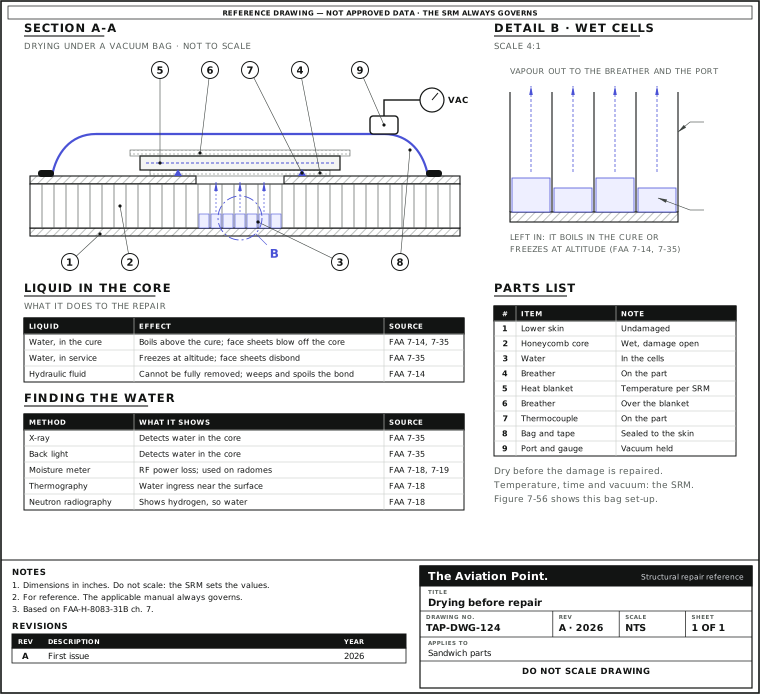
Why the core must be dry
Water boils in the cure. Most repair material systems cure above the boiling point of water. Trapped water turns to steam and can disbond the skin from the core wherever it sits, so core drying cycles are normally part of the repair (H-31B p. 7-14). If the water is not removed, the face sheets blow off the core during the elevated temperature cure and the damage grows (p. 7-35).
Water freezes in service. Water left in a honeycomb core can freeze at the low temperatures of high altitude and disbond the face sheets (p. 7-35).
Hydraulic fluid is worse. Once a sandwich core is saturated with phosphate-ester hydraulic fluid it is almost impossible to remove. The part keeps weeping fluid, even in the cure, until the bondline is contaminated and does not bond. The Handbook recommends removing the contaminated core and adhesive as part of the repair (p. 7-14).
Fibre type matters. Aramid fibres absorb water: service reports show some aramid parts taking up to 8 percent of their weight in water, so aramid parts need protection from the environment (p. 7-5).
Dry it or cut it out?
The core under a damaged panel is soaked with hydraulic fluid. What does the Handbook recommend?
- Dry it longer under the bag
Not this one. Complete removal of hydraulic fluid from a saturated core is almost impossible; it keeps weeping into the bondline.
- Remove the contaminated core and adhesive
Best fit. That is the Handbook's recommendation, because the fluid stops the bondline bonding.
- Repair over it at room temperature
Not this one. The fluid still contaminates the bondline, so full bonding does not occur.
The SRM gives the repair scheme for the replacement core.
Finding the water
| Method | What it does | Source |
|---|---|---|
| X-ray | Detects water in the core | H 7-35 |
| Back light | Detects water in the core | H 7-35 |
| Moisture meter | Measures the radio-frequency power loss caused by water in honeycomb; often used on nose radomes | H 7-18, 7-19 |
| Thermography | Shows water ingress into laminates and honeycomb core; best for thin laminates and defects near the surface | H 7-18 |
| Neutron radiography | Reveals light elements such as hydrogen, so water and corrosion products | H 7-18 |
Drying the part
1. Map the damage and the liquid. Inspect the damage and check round it for water, oil, fuel, dirt or other foreign matter (p. 7-35). Use the methods above; thick laminates need more than a visual check and a tap test.
2. Identify the liquid. Water is dried out. Core saturated with hydraulic fluid is cut out with its adhesive, because drying will not remove it (p. 7-14).
3. Bag the area. The Handbook's vacuum bag method for drying parts stacks, from the part up: breather cloth, heat blanket, breather cloth, with thermocouples on the repair area, under a vacuum bag with a port and a gauge (figure 7-56, p. 7-34). The vacuum draws the vapour out through the breather; the blanket supplies the heat.
4. Heat to the SRM. Temperature, time and vacuum for drying come from the SRM or the material maker; the Handbook gives none. Hot air systems are mainly used for small repairs and for drying the repair area (p. 7-24). Some operators dry a damaged part in the autoclave before the repair to avoid further damage in the cure (p. 7-14).
5. Then repair. Only a dry part goes on to damage removal, taper sanding and layup; the wet layup procedure itself starts with drying the part (p. 7-28).
What to check before the repair starts
| Check | How | Source |
|---|---|---|
| Liquid identified | Water dried; hydraulic-fluid core and adhesive removed | H 7-14 |
| No water left in the repair zone | The method that found it, against the SRM acceptance | H 7-18, 7-35 |
| Thermocouples on the part | Connected to a hot bonder or temperature monitor | H 7-22, 7-24 |
| Bag holds vacuum | Gauge on the port | H 7-34 |
Defects and fixes
| Defect | Cause | Fix | Source |
|---|---|---|---|
| Face sheets blow off in the cure | Water left in the core | Dry the core before the repair | H 7-14, 7-35 |
| Face sheets disbond in service | Water left in the core freezes at altitude | Remove the water before the repair | H 7-35 |
| Bondline does not bond | Core saturated with hydraulic fluid weeps during the cure | Remove the contaminated core and adhesive | H 7-14 |
| Water found again later | Liquid ingression through damage left unrepaired or poor core edge close-outs | Repair the damage promptly; seal the edges as the SRM says | H 7-14 |
Questions people actually ask
At what temperature should a part be dried?
The one in the SRM or the material maker's instructions. The Handbook describes the method, a vacuum bag with a heat blanket, but gives no drying temperature or time.
Can hydraulic fluid be dried out like water?
No. The Handbook says complete removal from a saturated core is almost impossible; the part weeps fluid into the bondline during the cure. Remove the contaminated core and adhesive.
How is water found without opening the part?
X-ray, back light or a moisture detector, per the Handbook. Moisture meters measure radio-frequency power loss and are often used on radomes; thermography and neutron radiography also show water.
Why does water matter if the repair cures at room temperature?
Water left in the core can still freeze at altitude and disbond the face sheets, and it keeps the bondline from bonding. Dry the part whatever the cure.
Limits of this guide
What the sources support, and no further.
- The manual governs. Drying temperature, time, vacuum and acceptance come from the SRM or the material maker.
- No figures invented. The Handbook gives the method and the reasons; it gives no drying schedule.
- Hydraulic fluid. Contaminated core is removed, not dried.
Where to buy
Distributors coming soon.
Keep going
Calculators
Guides
Data sheets
Books
Sources
- FAA-H-8083-31B, Aviation Maintenance Technician Handbook: Airframe, Chapter 7 — p. 7-5, aramid fibres absorb water; p. 7-14, liquid ingression, water and hydraulic fluid in the core, core drying cycles; pp. 7-18 and 7-19, thermography, neutron radiography, moisture detector; pp. 7-22 and 7-24, thermocouples and hot air systems; p. 7-28, dry the part before a wet layup; pp. 7-34 and 7-35, figure 7-56, vacuum bag method for drying parts, steps 1 and 2 of a core repair.