1Identification
Where to buyNumbers at a glance
| Item | Value, in (mm) or lb (N) | Source |
|---|---|---|
| Grade A cotton, TSO-C15d (AMS 3806) | New 80 lb/in (14.0 N/mm); unairworthy below 56 lb/in (9.8 N/mm) | AC Table 2-1, 2-33 |
| Intermediate cotton, TSO-C14b (AMS 3804) | New 65 lb/in (11.4 N/mm); below 46 lb/in (8.1 N/mm) | AC Table 2-1, 2-33 |
| Lightweight cotton, AMS 3802 (gliders) | New 50 lb/in (8.8 N/mm); below 35 lb/in (6.1 N/mm) | AC Table 2-1, 2-33 |
| Grade A required | Wing loading 9 lb/ft² (44 kg/m²) or more, or Vne 160 mph (139 kt) or more | AC Table 2-1, 2-33 b |
| Strip test sample | 1-1/4 × 4 in (32 × 102), coatings off, raveled to 1 in (25) wide | AC 2-34; H: 4 to 6 in long |
| Lacing cord / machine thread / hand thread | 40 lb (178 N) / 5 lb (22 N) / 14 lb (62 N) breaking strength, min | AC 2-5 c to e |
| Reinforcing tape | 40 lb (178 N) min in shear against one lace or fastener; cotton MIL-T-5661: 150 lb (667 N) per 1/2 in (13) width | AC 2-5 a, Table 2-2 |
| Hand sewing | 4 stitches per inch min; locked at 10 stitches max; edge folded under 3/8 in (9.5) min | AC 2-7 a(2) |
| Doping conditions | 65 to 75 °F (18 to 24 °C); relative humidity under 65 % (par. 2-21) or 20 to 60 % (Table 2-4) | AC 2-21 a(6), Table 2-4 |
| Polyester shrink | About 5 % at 250 °F (121 °C), 10 % at 350 °F (177 °C); processes run 225 to 350 °F (107 to 177 °C) | H, heat shrinking; AC 2-2 b |
| Dope acidity | 0.06 % max, as acetic acid | AC 2-20 b |
| Inspection rings (CAB plastic) | 3-9/16 in (90) inside diameter; fabric patch over them lapping 1 in (25) min | AC 2-14 a |
| Worn screw holes in ribs | No. 4 screw: redrill 1-1/2 hole diameters away with a No. 44 drill (0.086 in, 2.18), or fit a No. 6 screw (No. 36 drill, 0.1065 in, 2.71) in the worn hole, usually without redrilling. 1/8 in blind rivet: redrill 1-1/2 diameters away with a No. 30 drill (0.128 in, 3.25) | AC 2-6 b |
AC = AC 43.13-1B chapter 2; H = FAA-H-8083-31B chapter 3. The STC manual governs a covering installed under it.
Fabrics and how to tell them apart
| Fabric | Standard | Threads per inch | How to recognize it | Source |
|---|---|---|---|---|
| Grade A cotton (mercerised) | TSO-C15d, AMS 3806 or MIL-C-5646 | 80 to 84 | Off-white; nap and fiber ends on the back under a glass; burns to a dry ash | AC Table 2-1, 2-31, 2-31 d |
| Intermediate cotton | TSO-C14b, AMS 3804 | 80 to 94 | As Grade A | AC Table 2-1, 2-31 |
| Lightweight cotton | AMS 3802 | 110 max | Gliders of 8 lb/ft² or less and Vne 135 mph or less | AC Table 2-1 |
| Aircraft linen | British 7F1 (meets TSO-C15) | About Grade A | Slightly darker than cotton; irregular threads, one half the size of the next | AC Table 2-1, 2-31 a |
| Polyester | STC and PMA; TSO-C15d or C14b | Up to 94 | Whiter than cotton; monofilament, no nap; melts, then burns to a charred ash | AC 2-31 b, d; H, Approved Materials |
| Glass | STC | About 36 | White, one source pre-coated blue; no nap; glows in a flame without burning; not harmed by UV | AC 2-31 c, d, 2-30 c(1) |
Light purple on the back of cotton or linen: fungicide was in the dope (AC 2-31 a). A burn test also tells nitrate dope (ignites at once) from butyrate (burns at less than half the rate) (AC 2-32). On polyester, look for the STC fabric stamps inside the wings and fuselage and read the records (AC 2-32 a).
Polyester fabrics as printed in the Handbook
| Fabric | Weight, oz/yd² (g/m²) | Count, warp × fill | New breaking strength, lb (warp, fill) | Standard |
|---|---|---|---|---|
| Ceconite 101 | 3.5 (119) | 69 × 63 | 125, 116 | TSO-C15d |
| Ceconite 102 | 3.16 (107) | 60 × 60 | 106, 113 | TSO-C15d |
| Poly-Fiber Heavy Duty-3 | 3.5 (119) | 69 × 63 | 125, 116 | TSO-C15d |
| Poly-Fiber Medium-3 | 3.16 (107) | 60 × 60 | 106, 113 | TSO-C15d |
| Poly-Fiber Uncertified Light | 1.87 (63) | 90 × 76 | 66, 72 | Uncertified |
| Superflite SF 101 | 3.7 (125) | 70 × 51 | 80, 130 | TSO-C15d |
| Superflite SF 102 | 2.7 (92) | 72 × 64 | 90, 90 | TSO-C15d |
| Superflite SF 104 | 1.8 (61) | 94 × 91 | 75, 55 | Uncertified |
| Grade A cotton | 4.5 (153) | 80 × 84 | 80, 80 | TSO-C15d |
FAA-H-8083-31B Fig. 3-4. Minimum deteriorated strength: 70 % of the fabric the aircraft was originally specified with, not of the polyester's own new strength (Fig. 3-4; AC 2-33 a). Covering systems named in Handbook Fig. 3-9: Air-Tech, Ceconite, Poly-Fiber (Stits), Stewart Systems, Superflite. Brand names as references only; each system's STC manual is its own approved data.
Approval basis: who decides what goes on
Same quality as the original. Recover or repair with fabric of equal quality and strength to the manufacturer's; TSO-C15d or TSO-C14b fabric is recommended over AMS 3802 on aircraft first covered with the lower grade. Another fabric or coating than the original is a major alteration needing FAA approval (AC 43.13-1B par. 2-5). Cotton or linen cord, thread and tapes are not used with polyester or glass (par. 2-5).
Three routes for different materials. An STC for that aircraft model, which lists the materials and steps (any deviation makes the aircraft unairworthy); a field approval on FAA Form 337; or a new process approved through the type certificate data sheet. Re-covering is a major repair, with FAA Form 337 and an inspector with Inspection Authorization involved from the start (FAA-H-8083-31B ch. 3; 14 CFR 43 App. A (b)(1)(xxvii)).
The STC takes precedence. Its fabric, cement, tapes, threads, coatings and heat steps must be followed; only its approved materials may be used (AC par. 2-3 c; H, Approved Materials). Each STC can differ in cement overlap, sewn seam and shrinking temperature (par. 2-3 d).
2Allowable damage
Inspecting the covering
Unacceptable on sight: loose finishing tape or reinforcing patches; chafing under fairings; brittle, cracking, peeling or deteriorated coatings; tears and rock damage; broken or missing rib lacing; rodent nests. The covering must be uniformly taut, without loose or wrinkled areas and without excess tension that warps longerons, ribs or trailing edges. There is no method for measuring tension other than observation (AC 43.13-1B par. 2-30, 2-30 a).
Loose fabric that flutters in the slipstream, balloons, or sinks too far in flight is unacceptable (par. 2-30 b). On glass fabric, pull with a large suction cup at every rib, above all in the slipstream: if the covering lifts, relace with double the original number of laces and new reinforcing tape (par. 2-30 b(3)). Wrinkles from moisture absorbed by a poor dope film, or from moving a cold aircraft into warmth, are temporary (par. 2-30 note).
Coating cracks. Press exposed fabric firmly with a thumb as a first check; cracks let any fabric deteriorate and must be closed by sealing, by removing and replacing the coatings locally, or by re-covering (par. 2-30 c). On STC systems whose manual includes it, the coating is judged first: flexible, not brittle, undamaged by a hard knuckle push; then a 60-watt lamp held 1 ft (305 mm) outside must show no light inside (FAA-H-8083-31B ch. 3, Fabric Strength).
Frequency. Fabric condition is determined at every 100-hour and annual inspection (AC par. 2-33 a).
Fabric strength: when the covering is unairworthy
| Aircraft | Fabric required (new) | Unairworthy below | Source |
|---|---|---|---|
| Wing loading 9 lb/ft² (44 kg/m²) or more, or Vne 160 mph (139 kt) or more | Grade A: 80 lb/in (14.0 N/mm) | 56 lb/in (9.8 N/mm) | AC Table 2-1, 2-33 b; H Fig. 3-10 |
| Wing loading under 9 lb/ft² and Vne under 160 mph | Intermediate: 65 lb/in (11.4 N/mm) | 46 lb/in (8.1 N/mm), whatever the grade installed | AC Table 2-1, 2-33 b; H Fig. 3-10 |
| Glider or sailplane, 8 lb/ft² (39 kg/m²) or less and Vne 135 mph (117 kt) or less | AMS 3802: 50 lb/in (8.8 N/mm) | 35 lb/in (6.1 N/mm), whatever the grade installed | AC Table 2-1, 2-33 c; H Fig. 3-10 |
The 70 % is of the fabric the aircraft requires, not of the fabric installed: Grade A on an aircraft that needs only intermediate may fall to 46 lb/in (AC 2-33 a). Polyester re-covering an aircraft certificated with Grade A must stay above 56 lb (H, Fabric Strength).
Strength tests and what each one proves
| Test | How | What it proves | Source |
|---|---|---|---|
| Thumb press | Firm press on fabric exposed at a coating crack | A first indication only | AC 2-30 c |
| Maule punch tester | Spring-loaded, scale in breaking strength; pushed square on the fabric to the minimum value | No puncture: may be considered airworthy; puncture near the limit: strip test. Mechanic's opinion only | AC 2-34; H, Fabric Testing Devices |
| Seyboth punch tester | Pin with a color scale; always punctures a small hole | As the Maule; the hole needs a repair | H, Fabric Testing Devices |
| Strip test | 1-1/4 × 4 in (32 × 102) strip from an exposed top surface (a dark color degrades fastest), coatings removed (MEK soak), raveled to 1 in (25); one end clamped, a container hung from the other and filled with sand until it breaks | Breaking strength = lower clamp + container + load | AC 2-34; H, Fabric Strength |
| Laboratory | ASTM D5035 strip method (D1682 is discontinued; its grab method is now D5034) | The answer when the strip test is in doubt | AC 2-34 and note |
Mechanical testers are not FAA approved, depend on calibration and coating thickness, and do not apply to glass fabric, which shears and reads low (AC 2-34). The Handbook adds that they were designed for cotton and linen, not modern polyester.
The strip test rig
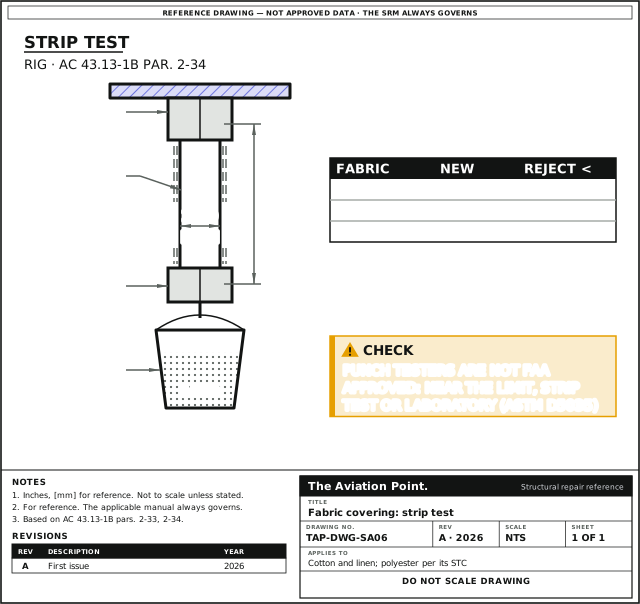
What you find, and what to do
| Finding | Decision | Source |
|---|---|---|
| Fabric below its strength limit | NOT ALLOWED: remove it and re-cover | AC 2-33, 2-35 |
| Fabric sound, dope cracked | CHECK: rejuvenator, two aluminum-pigmented coats, sand, a third aluminum coat, then color; STC materials per the STC manual | AC 2-35 |
| Coating cracks exposing the fabric | NOT ALLOWED to stay: seal, or strip and recoat locally, or re-cover | AC 2-30 c(3) |
| Loose fabric, ballooning, flutter in the slipstream | NOT ALLOWED: find the cause (dope film, slack, bent structure, heat) | AC 2-30 b |
| Excess tension warping ribs, longerons or trailing edges | NOT ALLOWED | AC 2-30, 2-30 a |
| Glass covering lifts at the ribs under a suction cup | Relace with double the original laces and new reinforcing tape | AC 2-30 b(3) |
| Broken or missing lacing, loose tapes, chafe under fairings, nests | NOT ALLOWED: repair before return to service | AC 2-30 |
| Tear with all fabric present | ALLOWED: sewn closure and finishing tape | AC 2-43 |
| Hole or damaged area | ALLOWED: sewn-in patch or doped-on patch by size and Vne; or a new panel | AC 2-44, 2-45 |
3Repair
Envelope or blanket?
Envelope
- Made
- Sections machine-sewn into a sleeve, chordwise or two widths spanwise, fitted with T-head pins
- Closing
- Machine-sewn at tip and trailing edge where geometry allows; the rest hand-sewn or doped per Vne
- Seams
- Over structure, usually at trailing edges and the top and bottom of the fuselage
Blanket
- Made
- Flat sections sewn side by side, or one piece wrapped over a straight edge
- Closing
- Three sides hand-sewn or overlapped and doped per Vne
- Seams
- Overlap set by the covering instructions; doped seams only over structure the full width of the seam
Either method is acceptable (AC 43.13-1B par. 2-8 a, b; FAA-H-8083-31B ch. 3, Blanket Method vs. Envelope Method). No holes for fittings, rings or grommets, and no lacing or fasteners, until the fabric is semi-taut and stabilized with dope (par. 2-8 d).
Seam overlaps and tape widths
| Seam | Overlap, in (mm) | Finishing tape, in (mm) | Source |
|---|---|---|---|
| Sewn spanwise, leading edge | —: sewn seam | 4 (102) min, pinked, centered | AC 2-7 a(4) |
| Sewn spanwise, trailing edge | —: sewn seam | 3 (76) min, pinked. Vne over 200 mph (174 kt): V notches 1 in (25) deep, 1/4 in (6.4) wide, every 6 in (152) or less | AC 2-7 a(5) |
| Sewn spanwise, upper or lower surface; sewn chordwise | —: sewn seam | 3 (76) min, centered | AC 2-7 a(6), a(7) |
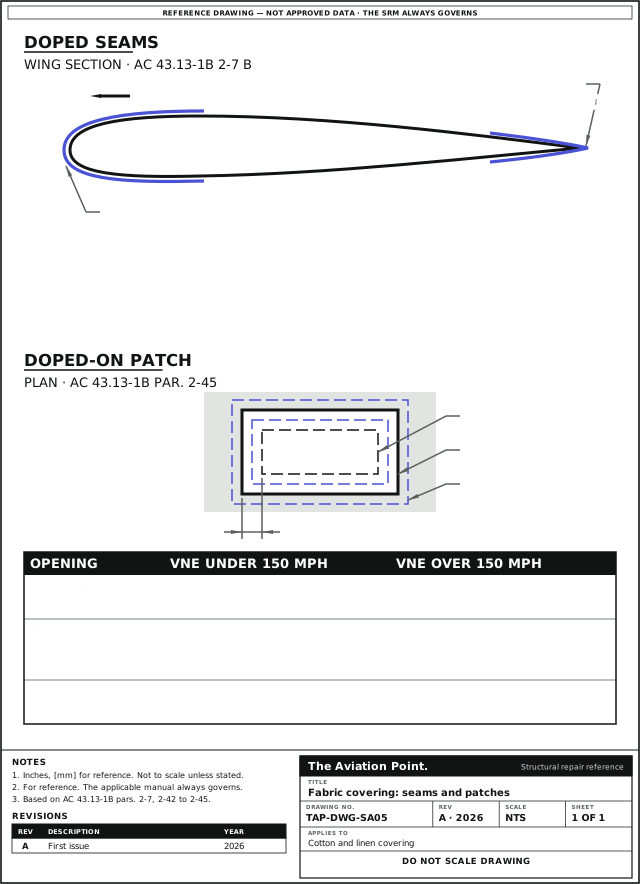
| Doped spanwise, leading edge | 4 (102) min | 4 (102) min | AC 2-7 b(1) |
| Doped spanwise, trailing edge | 3 (76) min | 4 (102) min, pinked | AC 2-7 b(2) |
| Doped: tips, butts, control and tail surface perimeters, fuselage | 2 (51) | 3 (76) min | AC 2-7 b(3) |
| Doped, leading edge, Vne 150 mph (130 kt) or less | 2 (51) | 3 (76) min | AC 2-7 b(4) |
| Doped, wing perimeter except leading edge, surface perimeters, fuselage, Vne 150 mph or less | 1 (25) | 3 (76) min | AC 2-7 b(5) |
Seams parallel to the line of flight are preferred; spanwise is acceptable (AC 2-7). Polyester: the overlap is in the covering instructions; the Handbook gives typical minimums of 2 to 4 in where the airflow is critical and 1 to 2 in elsewhere (H, Seams).
Attachment, tapes, rings and drains
| Item | Rule | Source |
|---|---|---|
| Method of attachment | As the original manufacturer's, in kind and location; any deviation (screws, rivets, clips, cord) is a major alteration | AC 2-8, 2-10 a |
| Knot when the original is unknown | Modified seine knot; ends left at least 1/4 in (6.4 mm) | AC 2-10 a, d(1) |
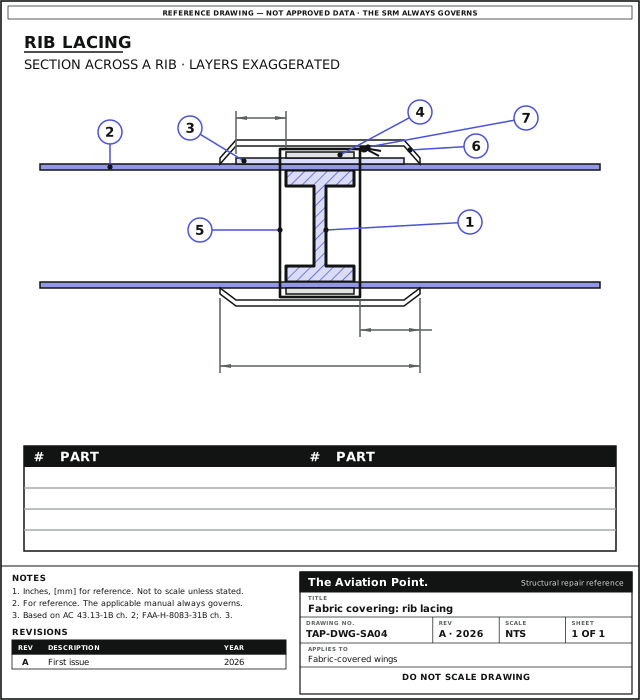
| Rib lace spacing | No greater than the original. If unknown: —, read AC Fig. 2-12 at the aircraft's Vne, closer in the slipstream; empennage and fuselage up to twice the wing slipstream spacing | AC 2-11 a, b; H Fig. 3-26 |
| First lace from the leading-edge fairing | Half the lace spacing, max | AC 2-10 c note; H Fig. 3-28 |
| Slipstream | Propeller diameter plus one rib outboard | AC 2-9 c |
| Reinforcing tape | Doped on before lacing; continuous along a rib, 1 in (25 mm) past the last attachment; 2 in (51 mm) pieces at sparse attachments; as wide as the rib under lacing | AC 2-9 a, b |
| Anti-tear strips | Vne over 250 mph (217 kt): under the reinforcing tape over the whole top surface and the bottom in the slipstream, 1/2 in (13 mm) past the cap edges | AC 2-9 c |
| Self-tapping screws | One size larger in a redrilled hole; at least two threads past the cap strip; thin aluminum washer; pinked tape over the head | AC 2-12 c |
| Washers replacing plastic ones | Aluminum, same diameter | AC 2-11 c |
| Finishing tape over attachments | Bonds 3/8 in (9.5 mm) min each side of every attachment; 2 in (51 mm) usual; 1/2 in (13 mm) past the ends of the reinforcing tapes; bias-cut tape narrows to about two thirds on tip bows | AC 2-13 b, c |
| Inspection access | Over every bellcrank, pulley, cable guide, fitting serviced yearly; bottom surface unless the original had them on top | AC 2-14 a |
| Drain grommets | Lowest point of every panel in the stored attitude; seaplane type where water splashes; open flat ones by cutting, never by punching | AC 2-14 b |
| Control surfaces | Static and dynamic balance not adversely affected; weight distribution and mass balance checked | AC 2-5 f; 14 CFR 43 App. A (a)(1)(xiii) |
Rib lacing in section: what goes on, in what order
Dope and finish on cotton and linen
| Step or rule | What AC 43.13-1B says | Source |
|---|---|---|
| Shrinking | Wet the fabric with distilled water, never tap water; let it dry before the first coat | AC 2-21 a |
| First coat | Brushed in one direction; fungicide recommended on natural fibers: zinc dimethyldithiocarbamate, 4 oz per gallon (30 g/L) of unthinned dope if the maker gives no ratio; MIL-D-7850 fungicidal dope is tinted purple | AC 2-21 a(2) to (4) |
| Next coats | Taut after about 1 h at 70 °F (21 °C); second coat cross-brushed; a third if sag remains after 2 h | AC 2-21 b |
| Drying and recoat | Each 10 °F (5.6 °C) change in temperature changes drying time by 100 %; after several weeks between coats above 70 °F, spray coats of thinner, or dope with retarder or rejuvenator, on the lightly sanded film first | AC 2-21 a(6), 2-20 e |
| Nitrate and butyrate | Butyrate may go over nitrate; never nitrate over butyrate; their thinners are not interchangeable | AC 2-20 c |
| Tension | Clear dope gives the most, aluminum-pigmented less, color the least; too thick a film can warp a light airframe | AC 2-20, 2-20 d |
| Aluminum-pigmented coats | Two coats, dried at least 4 h at 70 °F, wet-sanded with 280 grit or finer only to smooth them, never through to the clear coats; the last coat is not sanded, to keep the UV protection along tape and patch edges | AC 2-21 |
| Blush | Rework with closely timed coats of a 50/50 blend of blush retarder and dope thinner | AC 2-23 |
| Polish | Rubbing compound and wax only after the solvents have left, usually 2 weeks | AC Table 2-4 |
Polyester under an STC uses its own cement, heat steps (typically 225 to 350 °F, 107 to 177 °C), sealer and UV coats; follow the process manual (H, heat shrinking).
Repairs to the covering: size, Vne and tape
| Damage | Repair | Overlap or tape, in (mm) | Source |
|---|---|---|---|
| Tear, all fabric present | Sew the edges together with a curved needle after removing the dope to the clear coats 2 in (51) each side; clear coat, then finishing tape centered on the stitches | Tape 3 (76); opening 8 to 16 in (203 to 406): 4 (102); over 16 in, on a wing top surface, or Vne over 150 mph: 6 (152) | AC 2-43 |
| Opening that cannot be stitched closed | Sewn-in patch: trim square, fold the patch edges 1/2 in (13) under, stitch, wet, one clear coat, tape | Tape 3 (76); 4 (102) and 6 (152) on the same rules as a tear | AC 2-44 |
| Opening up to 8 in (203), Vne under 150 mph | Doped-on patch | Overlap 2 (51) | AC 2-45 |
| Opening up to 8 in, Vne over 150 mph | Doped-on patch | Overlap 2 (51), plus 2 (51) tape on all sides | AC 2-45 c |
| Opening 8 to 16 in, Vne under 150 mph | Doped-on patch | Overlap 1/4 of the largest dimension, 4 (102) max | AC 2-45 d |
| Opening 8 to 16 in, wing top surface, Vne over 150 mph | Doped-on patch | Overlap 4 (102), plus 2 (51) tape on all sides | AC 2-45 e |
| Opening over 16 in (406) | Doped-on patch | Overlap 4 (102); tape 4 (102) under 150 mph, 6 (152) over | AC 2-45 f, g |
| New section edge within 1 in (25) of an attaching member | Extend the section 3 in (76) past the member; duplicate the lacing or attachment without removing the original | — | AC 2-42 f |
| New fabric section over two adjacent wing ribs | MAJOR REPAIR: logbook entry and FAA Form 337 | — | AC 2-42 d; 14 CFR 43 App. A (b)(1)(xxvi) |
| Covering approved under a TC or an STC (not cotton or linen) | The aircraft manufacturer's or the STC holder's repair instructions | —: their manual | AC 2-42 h; H, Polyester Fabric Repairs |
Before any new section or tape: remove the pigmented and aluminum coats down to the clear dope (thinner and a dull knife, fabric supported from behind). Patch edges not under tape: pinked, or raveled 1/4 in (6.4 mm) (AC 2-42 b, e). Par. 2-45 says «less than» and «greater than» 150 mph: at exactly 150 mph use the stricter row.
Doped seams and doped-on patches: overlap and tape
Step by step: a doped-on patch on cotton
| Step | Action | What to do |
|---|---|---|
| 1 | Identify the covering | Records and fabric stamps: if it was installed under an STC, its manual governs and the steps below do not apply (AC 2-42 h). |
| 2 | Size the repair | Largest dimension of the opening, the aircraft's Vne and the location (wing top surface or not) give the overlap and tape from the table above. |
| 3 | Prepare | Trim irregular edges; soften the pigmented and aluminum coats with thinner and scrape to the clear coats, supporting the fabric from behind (AC 2-42 b, 2-45). |
| 4 | Hold loose edges | If needed, run small threads across the opening from edge to edge; clip them after, or leave them (AC 2-45 a). |
| 5 | Lay the patch | Clear dope round the opening, patch on with pinked or raveled edges, brush out voids and wrinkles, saturating only the overlap (AC 2-45 b). |
| 6 | Shrink and build up | After 1 h at 70 °F (21 °C), wet the patch with distilled water; when dry, clear, aluminum and color coats as par. 2-21; tapes where the table asks for them. |
| 7 | Record | Logbook entry; FAA Form 337 when the repair is major (AC 2-42 d). |
Worked example: a 10 in tear on a wing top surface
Grade A cotton on an aircraft with Vne 140 mph (122 kt) and wing loading 8.5 lb/ft² (41.5 kg/m²). A 10 in (254 mm) straight tear in the top surface of the wing, all fabric present. A made-up case to show how the AC paragraphs combine.
- Strength limit: wing loading under 9 lb/ft² and Vne under 160 mph, so the aircraft requires intermediate fabric: the Grade A installed stays airworthy down to 46 lb/in (8.1 N/mm) (par. 2-33 a, b).
- Sewn closure (par. 2-43): 10 in is in the 8 to 16 in band (4 in tape), but the tear is on a wing top surface, so the tape goes to 6 in (152 mm) (par. 2-43 c).
- Doped-on patch instead (par. 2-45 d): Vne under 150 mph, so overlap = 10 / 4 = 2-1/2 in (64 mm), under the 4 in maximum. Par. 2-45 e (4 in overlap and 2 in tape) applies only above 150 mph.
- Patch edges not under tape: pinked or raveled 1/4 in (6.4 mm) (par. 2-42 e).
- If the new fabric runs over two adjacent wing ribs, it is a major repair: FAA Form 337 (par. 2-42 d).
Sewn: 6 in (152 mm) tape centered on the stitches. Doped-on patch: 2-1/2 in (64 mm) overlap, no tape required by par. 2-45 d. Fabric limit: 46 lb/in.
Cross-check against other documents
| Point | Document | What it says | Reading |
|---|---|---|---|
| Strength class | AC 2-33 b, c; H, Fabric Strength and Fig. 3-10 | AC: the lower limits need wing loading under 9 lb/ft² and Vne under 160 mph (gliders: 8 lb/ft² and 135 mph). H writes «or» | The AC wording governs: both conditions before the lower figure applies. |
| Strip size | AC 2-34; H, Fabric Strength | AC: 1-1/4 × 4 in. H: 1-1/4 × 4 to 6 in. Both ravel to 1 in | Agree on the 1 in test width. |
| Punch testers | AC 2-34; H, Fabric Testing Devices | AC: not FAA approved, not for glass. H: designed for cotton and linen, not modern polyester | Opinion only; the strip test, a laboratory or the STC method decides. |
| Humidity for doping | AC 2-21 a(6); AC Table 2-4 | Under 65 %; Table 2-4: 20 to 60 % | Keep to 20 to 60 %. |
| Overlaps on polyester | AC 2-7 b; H, Seams | AC sets them by location and Vne. H: typical 2 to 4 in in critical airflow, 1 to 2 in elsewhere, as the covering instructions say | The STC governs polyester; the AC table is for cotton and linen. |
| Major repair threshold | AC 2-42 d; 14 CFR 43 App. A (b)(1)(xxvi) | AC: a new section over two adjacent wing ribs is major. Rule: an area greater than needed to repair two adjacent ribs | Treat a section over two adjacent ribs as major: Form 337. |
| Sewn repairs on polyester | AC 2-43, 2-44; H, Polyester Fabric Repairs | AC methods are sewn, written for cotton and linen. H: nearly all polyester repairs are cemented per the STC; a technique from one system can make another unairworthy | Use the STC repair; do not mix systems. |
Quick check
Vne 145 mph, wing loading 8 lb/ft², covered in Grade A cotton. The strip test breaks at 50 lb. Is the fabric airworthy?
- Yes: it is above 46 lb, the limit for the fabric the aircraft requires
Best fit. Yes: under 9 lb/ft² and under 160 mph the aircraft needs intermediate fabric, so the limit is 46 lb/in whatever grade is installed (AC 43.13-1B par. 2-33).
- No: Grade A must stay above 56 lb
Not this one. No: the limit follows the fabric the aircraft requires, not the fabric installed.
- No: a punch tester must confirm it first
Not this one. No: punch testers are not FAA approved; the strip test is the more accurate one (par. 2-34).
On a real job, the SRM decides.
Questions people actually ask
Can I repair a polyester covering with AC 43.13-1B?
If it was installed under an STC, its manual governs repairs and takes precedence over the AC (AC 43.13-1B pars. 2-3 c, 2-42 h). The AC's sewn methods were written for cotton and linen; most STC repairs are cemented (FAA-H-8083-31B ch. 3).
Is a Maule reading enough to sign the fabric off?
It is an opinion: mechanical testers are not FAA approved. In doubt, cut a strip and test it, or send it to a laboratory to ASTM D5035 (par. 2-34).
How often must fabric strength be checked?
At every 100-hour and annual inspection (par. 2-33 a).
When do I need FAA Form 337?
Re-covering (14 CFR 43 App. A (b)(1)(xxvii)); a repair larger than two adjacent ribs ((b)(1)(xxvi); AC par. 2-42 d); and another fabric or coating than the original, which is a major alteration (par. 2-5).
Why aluminum-pigmented dope under the color?
It blocks UV, which deteriorates cotton, linen and polyester; the last aluminum coat over tape edges is not sanded so the protection stays (pars. 2-21, 2-30 c).
Can a cracked dope finish be saved?
If the fabric is still strong, yes: rejuvenator restores the film, then aluminum and color coats. If the fabric has lost its strength, the only cure is to re-cover (par. 2-35).
Limits of this guide
What the sources support, and no further.
- The STC manual governs any covering installed under it: materials, temperatures, coats, inspection and repairs.
- Rib lace spacing by Vne is a chart (AC Fig. 2-12, H Fig. 3-26) not reproduced here: read it at the aircraft's Vne.
- No method measures tension; it is judged by observation (AC par. 2-30 a).
- Glass deck cloth over plywood with epoxy (AC par. 2-6 g) and the dope schedule for plywood (par. 2-22) are not detailed here.
- Typical, not authority. The aircraft's approved data governs.
Where to buy
Are you a distributor? Get listed →
Distributors coming soon.
Keep going
Calculators
Guides
Books
Buy
Distributors coming soon.
Main sources
- AC 43.13-1B with Change 1, Acceptable Methods, Techniques, and Practices: Aircraft Inspection and Repair — Chapter 2: pars. 2-1 to 2-14 with Tables 2-1, 2-2 and Fig. 2-12 (materials, seams, covering, lacing, tapes, rings and grommets); pars. 2-20 to 2-23 with Tables 2-3, 2-4 (dope); pars. 2-30 to 2-35 (inspection, identification, strength, testing, rejuvenation); pars. 2-42 to 2-45 (repairs).
- FAA-H-8083-31B, Aviation Maintenance Technician Handbook: Airframe, Volume 1, Chapter 3, Aircraft Fabric Covering — Approval routes; Approved Materials and Fig. 3-4; Fig. 3-9; Fabric Strength and Fig. 3-10; Fabric Testing Devices and Fig. 3-11; Blanket Method vs. Envelope Method; Seams; Fabric Cement; rib lacing, Figs. 3-26, 3-28; Polyester Fabric Repairs.
- 14 CFR Part 43, Appendix A, Major Alterations, Major Repairs, and Preventive Maintenance — (a)(1)(xiii); (b)(1)(xxvi) and (xxvii).
Cross-checked with other manuals and standards in our library.