1Identification
Where to buyThe drawing
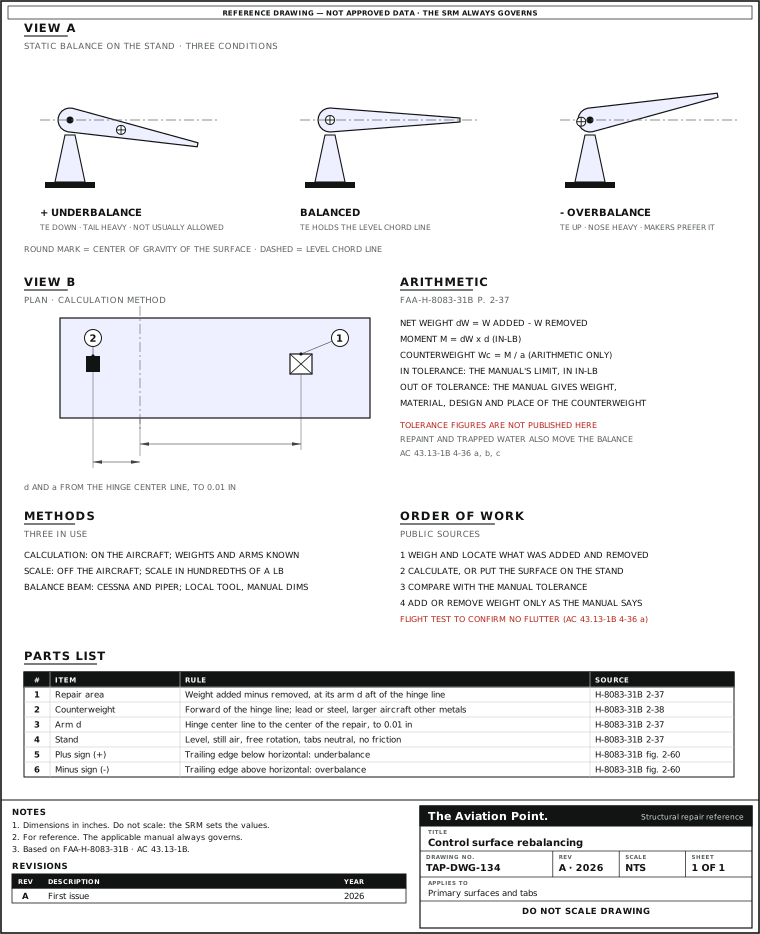
Conditions on the stand
| Condition | What you see | Source |
|---|---|---|
| Underbalance, plus (+) | Trailing edge goes below horizontal: tail heavy. Not usually allowed; poor flight behavior | FAA-H-8083-31B p. 2-36, fig. 2-60 |
| Overbalance, minus (−) | Trailing edge rises above horizontal: nose heavy. Most manufacturers advocate a nose-heavy surface, within their tolerance | FAA-H-8083-31B p. 2-36, fig. 2-60 |
| Balanced | The surface holds the level chord line | FAA-H-8083-31B fig. 2-60 |
| Static balance | The tendency to stay stationary when supported from its own center of gravity | FAA-H-8083-31B p. 2-36 |
| Dynamic balance | Keeping balance while the surface moves in flight; weights placed correctly along the span, in most cases forward of the hinge center line | FAA-H-8083-31B pp. 2-36, 2-37 |
What moves the balance
| Event | Rule | Source |
|---|---|---|
| Repair adding weight fore or aft of the hinge center line | The surface must be rebalanced. Repairs to a surface or its tabs generally add weight aft of the hinge line, so static rebalancing of the surface and the tabs follows | FAA-H-8083-31B pp. 2-36, 2-37 |
| Repaint | Check the balance whenever the aircraft is repainted. Do not add coats beyond what the manufacturer applied; consult the manufacturer on finishing and balance | FAA-H-8083-31B p. 2-36; AC 43.13-1B par. 4-36 b |
| Re-covering fabric surfaces | Make sure static and dynamic balance are not adversely affected; weight distribution and mass balance count | AC 43.13-1B par. 2-5 f |
| Trapped water or ice | Flutter has occurred from water or ice collecting in a surface; check and keep the ventilation and drainage | AC 43.13-1B par. 4-36 c |
| Adding or removing balance weights | Only when necessary and as the manufacturer instructs; flight test to confirm flutter is not a problem | AC 43.13-1B par. 4-36 a |
2Allowable damage
What sets the limit
| Question | What the public sources say | Source |
|---|---|---|
| How much unbalance is allowed? | "The original or maximum allowable value": the manufacturer's. In the calculation method, the result in inch-pounds must be within the specified tolerances. No generic value is published | AC 43.13-1B par. 4-36 a; FAA-H-8083-31B p. 2-37 |
| Which way is acceptable? | Tail heavy (underbalance) is not usually allowed; nose heavy (overbalance) is the manufacturers' preference | FAA-H-8083-31B p. 2-36 |
| Where may weight be added? | As a general rule repair so weight distribution is not affected in any way; no weight aft of the hinge line that the repair does not account for | AC 43.13-1B pars. 1-38, 4-36 a |
| Does a repair need approval? | Changes to fixed or movable control surfaces that affect flutter and vibration characteristics are major alterations; repairs to monocoque or semimonocoque control surfaces are major repairs | 14 CFR Part 43 App. A (a)(1)(xiii), (b)(1)(ii) |
| Repair type approved for one aircraft | Not automatically approved for another type; use the aircraft's SRM | FAA-H-8083-31B p. 4-88 |
Balance: what the documents say
| Point | What each document says | Agree or differ |
|---|---|---|
| Under- and overbalance | FAA-H-8083-31B p. 2-36: on the stand, a trailing edge that moves down below the horizontal shows underbalance. | The Handbook defines it; the AC and the T.O. give the warning. |
| Finish and water | AC 43.13-1B par. 4-36 b and c: do not add coats of paint beyond what the maker applied; keep the ventilation and drainage open, because trapped water or ice unbalances the surface. | Agree with the Handbook that any added weight is a balance change. |
| Warning | T.O. 1-1A-1 par. 1.7.1: exercise care when repairing ailerons, rudders and elevators to avoid disturbing static balance. | Agree. The tolerance itself is the aircraft's; this guide shows a dash for it. |
FAA-H-8083-31B p. 2-36; AC 43.13-1B CHG 1 par. 4-36 b and c; T.O. 1-1A-1 par. 1.7.1.
Three methods of measuring the balance
| Method | Where and what it needs | Source |
|---|---|---|
| Calculation | Can be done without removing the surface. Needs the weight removed and the weight added by the repair, and the distance from the hinge center line to the center of the repair, to the nearest 0.01 in. Net weight times distance gives inch-pounds; compare with the specified tolerance | FAA-H-8083-31B pp. 2-37, 2-38 |
| Scale | Surface off the aircraft, on a stand and jigs; a scale graduated in hundredths of a pound; bubble protractor for neutral | FAA-H-8083-31B p. 2-38, fig. 2-64 |
| Balance beam | Used by Cessna and Piper; a tool made locally to the dimensions in the maintenance manual; a sliding weight on the beam is moved until the surface balances, and the manual says where the balance point is and where to add weight | FAA-H-8083-31B p. 2-38 |
The stand must be level and in an area free of air currents; the surface turns freely about its hinge points, tabs secured in neutral. Friction gives a false reading of over- or underbalance (H-8083-31B p. 2-37).
3Repair
Step by step
| Step | Action | What to do |
|---|---|---|
| 1 | Know the value you are aiming for | The maintenance manual or the manufacturer gives the balance tolerance, the method and the stand. The public documents give the principle only (FAA-H-8083-31B p. 2-36: explicit instructions are in the manufacturer's service and overhaul manuals and must be followed closely). |
| 2 | Weigh what you take out and what you put in | Skin, doubler, rivets, sealant, primer and paint: the calculation needs the weight removed and the weight added, and the distance from the hinge center line to the center of the repair, to 0.01 in (p. 2-37). Weigh them on a scale before they go on. |
| 3 | Choose the method | Calculation on the aircraft for a small local repair; the scale or the balance beam, with the surface off the aircraft, for a large repair, a repaint or when the calculation is not within tolerance. |
| 4 | Set up the stand | Level stand in still air. Tab secured in neutral. Neutral position by bubble protractor with the chord line horizontal. Check the surface rotates freely on its hinge points before you read anything (pp. 2-37, 2-38). |
| 5 | Read and compare | Trailing edge down is plus, underbalance; trailing edge up is minus, overbalance. Compare the result, or the calculated inch-pounds, with the manual's tolerance. |
| 6 | Correct only as the manual says | If it is out of tolerance, the manual gives the weight, the material, the design and the installation location of the weights. Lead or steel are the common materials; larger aircraft may use denser metals, depleted uranium among them, which is radioactive and has its own handling precautions (p. 2-38). Add or remove balance weights only as the manufacturer instructs (AC 43.13-1B par. 4-36 a). |
| 7 | Refit, check and fly | Refit and rig as in the alignment guide. Flight testing must be done to make sure flutter is not a problem (AC 43.13-1B par. 4-36 a). |
| 8 | Record | Entry under 14 CFR 43.9: the work done or a reference to the data used, the date, who did it and the approval for return to service. Keep the weights, the arm and the result with the work record. |
What to check when it is done
| Look at | Accept | Source |
|---|---|---|
| Balance | Inside the manufacturer's tolerance, by the method the manual names | AC 43.13-1B par. 4-36 a |
| Direction | Not tail heavy; nose heavy only inside the tolerance | FAA-H-8083-31B p. 2-36 |
| Weights | Installed as the manufacturer instructs: material, location, security | FAA-H-8083-31B p. 2-38 |
| Drain and vent holes | Open and in their original places | AC 43.13-1B pars. 4-36 c, 1-37 |
| Tab free play | Inside 2 % of the tab chord (tab span 35 % or less), see the alignment guide | AC 43.13-1B par. 4-36 d |
| Paint | No more coats than the manufacturer applied | AC 43.13-1B par. 4-36 b |
| Records | Entry under 14 CFR 43.9, with the weights and arm kept with it | 14 CFR 43.9 |
Worked example: calculation method
| Step | Working | Result |
|---|---|---|
| Weight removed (damaged skin cut-out) | Weighed on a scale | 0.021 lb |
| Weight added (patch, rivets, primer) | Weighed before fitting | 0.074 lb |
| Net weight added, ΔW | 0.074 − 0.021 | 0.053 lb, aft of the hinge line |
| Arm d, hinge center line to the center of the repair | Measured to 0.01 in | 14.37 in |
| Moment M | 0.053 lb × 14.37 in = 0.7616 | 0.76 in-lb |
| Tolerance | The aircraft manual's figure, in inch-pounds | — |
| If the manual asks for a counterweight 2.50 in forward of the hinge | M ÷ a = 0.7616 ÷ 2.50 = 0.305 | About 0.30 lb as arithmetic; weight, material and place from the manual |
Every number in this example is chosen to show the arithmetic; none is published data. The method (net weight times distance from the hinge center line, in inch-pounds, compared with the specified tolerance) is FAA-H-8083-31B p. 2-37.
Quick check
On the stand the trailing edge rises above the horizontal. What is it called, and is it normally accepted?
- Overbalance, minus (−): nose heavy, which most manufacturers prefer, inside their tolerance
Best fit. Yes: FAA-H-8083-31B p. 2-36.
- Underbalance, plus (+): tail heavy
Not this one. No: underbalance is the trailing edge going down, and it is not usually allowed.
- Balanced: any rise is within tolerance
Not this one. No: a balanced surface holds the level chord line; the tolerance is the manual's.
On a real job, the SRM decides.
Questions people actually ask
Do I have to rebalance after a repaint?
The balance must be checked whenever the aircraft is repainted (FAA-H-8083-31B p. 2-36). Do not add coats of paint beyond what the manufacturer applied; ask the manufacturer for the finishing and balance instructions (AC 43.13-1B par. 4-36 b).
Can I rebalance without taking the surface off?
Only by the calculation method, which needs the weights and the arm to be known. The scale method needs the surface removed, and the balance beam method puts it on level supports with a tool made to the manual's dimensions (FAA-H-8083-31B pp. 2-37, 2-38).
Is a small patch a problem?
Any repair that adds weight fore or aft of the hinge center line needs the check (FAA-H-8083-31B p. 2-36). The effect is proportionately greater on lighter surfaces than on older, heavier designs (AC 43.13-1B par. 4-36 a).
What does the balance weight look like?
The manufacturer's design: lead or steel in most cases, ahead of the hinge line. The public documents give no dimensions.
Is water inside a surface a balance problem?
It has caused flutter. Check and keep the ventilation and drainage provisions when you do maintenance (AC 43.13-1B par. 4-36 c).
Limits of this guide
What the sources support, and no further.
- No tolerance figure is published. The permitted unbalance, in inch-pounds or on a scale, is in the aircraft maintenance manual.
- No weights of paint, sealant or fasteners are published here: weigh them.
- The handbook section is for familiarization only (FAA-H-8083-31B p. 2-36); the manufacturer's service and overhaul manuals govern.
- Counterweight design (material, shape, place) belongs to the manufacturer.
- Fabric covered surfaces and helicopters have their own balance procedures; only the AC 43.13-1B pointer for fabric is cited.
Where to buy
Are you a distributor? Get listed →
Distributors coming soon.
Keep going
Calculators
Guides
How to do it
Books
Buy
Distributors coming soon.
Main sources
- FAA-H-8083-31B, Aviation Maintenance Technician Handbook: Airframe, chapters 2 and 4 — Pp. 2-36 to 2-38 (rebalancing, static and dynamic balance, procedures, methods, counterweights, figs. 2-60 to 2-64); p. 4-88 (balance changes; the aircraft manual governs).
- AC 43.13-1B CHG 1, Acceptable Methods, Techniques, and Practices: Aircraft Inspection and Repair — Pars. 1-37 and 1-38 (drain holes; control surface flutter precautions); 2-5 f (fabric surfaces); 4-36 a to d (balance changes, painting, trapped water or ice, trim tab free play).
- 14 CFR Part 43 — Appendix A, paragraphs (a)(1)(xiii) and (b)(1)(ii); par. 43.9 (maintenance record content).
- TO 1-1A-1 / NAVAIR 01-1A-1, General Manual for Structural Repair (15 Jan 2016) — Par. 1.7.1 (warning on static balance; lead weights ahead of the hinge line).
Cross-checked with other manuals and standards in our library.