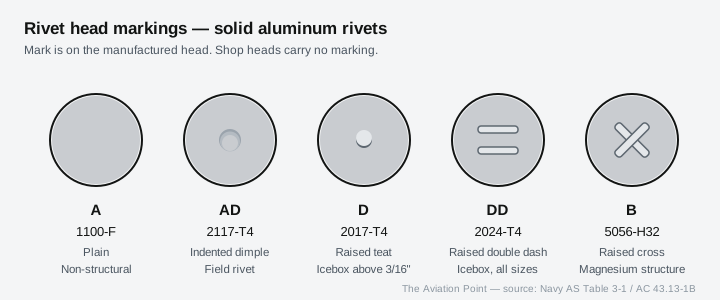
Head markings — the identification table
Where to buyThe mark is on the manufactured head, the one that came from the factory. Once a rivet is driven, the shop head carries no marking at all — which is why identifying rivets already in an aircraft means looking at the factory head side.
| Head marking | Code | Alloy | Condition | Storage | Typical use | Source |
|---|---|---|---|---|---|---|
| Plain — no mark | A | 1100-F | F | Indefinite | Non-structural only. Fairings, trim, placards, nameplates. | MS20470 Rev. H |
| Indented dimple | AD | 2117-T4 | T4 | Indefinite | The field rivet. The overwhelming majority of general aviation structural riveting. | MS20470 Rev. H |
| Raised teat (single raised dot) | D | 2017-T4 | T4 | Icebox above 3/16" — see below | Higher strength than AD, where the drawing calls for it. | MS20470 Rev. H |
| Raised double dash | DD | 2024-T4 | T4 | Icebox, all sizes — see below | Highest strength of the common aluminum rivets, and the hardest to drive. | MS20470 Rev. H |
| Raised cross | B | 5056-H32 | H32 | Indefinite | Magnesium structures. Chosen for galvanic compatibility, not for strength. | MS20470 Rev. H |
| Ring | E | 7050-T73 | T73 | Indefinite: driven as received, in the T condition | Replaces DD without the icebox. Head mark: a recessed ring, outside diameter at most 75 % of the shank and .010 in deep at most, required on 7050 rivets made after 2 July 1990 (MS20470H sheet 1, requirement 6). Older references (FAA-H-8083-31B Fig. 4-77, TO 1-1A-1 Table 5-2) show a raised ring. Shear 43 ksi driven (7050-T731, MIL-HDBK-5J Table 8.1.2(b), as Fig. 4-77); 41 ksi is the undriven 7050-T73 minimum and the figure in T.O. 1-1A-1 Table 5-2. | MS20470 Rev. H, requirement 6; FAA-H-8083-31B Fig. 4-77; T.O. 1-1A-1 Table 5-2 |
| Three raised dashes | — | 7075-T73 | T73 | Indefinite | High-strength aluminum; AC Table 4-8 gives it no AN code letter. | AC 43.13-1B Table 4-8 |
| Indented square | K | 2219-T81 | T81 | Not stated | Inactive for new design (MS20470H). | MS20470 Rev. H |
| Indented triangle | J | 2219-T62 | T62 | Not stated | Same triangle as carbon steel: on an aluminum MS head it means J. | MS20470 Rev. H |
| Indented diamond | T | Ti-45Cb (titanium-columbium) | — | Not stated | Titanium rivets in composites where strength, weight and hole tolerance are critical (TO 1-1A-1). | MS20470 Rev. H |
| Recessed dash | F (AN code) | Corrosion-resistant steel (CRES) | Annealed | Indefinite | CRES parts: firewalls, exhaust brackets (AC 43.13-1B par. 7-2f). MS20613 universal head. | AC 43.13-1B Table 4-8; MS20427 note b |
| Recessed triangle | — | Carbon steel | Annealed | Indefinite | Steel parts; no galvanized rivets where heat is high (AC 43.13-1B par. 7-2e). MS20613 universal head. | AC 43.13-1B Table 4-8; MS20427 note b |
| Recessed double dots | M (part number) | Monel, nickel-copper | Annealed, driven as received | Indefinite | Nickel alloys and high-nickel steels; interchangeable with CRES (AC par. 7-2g). MS20615, MS20427M. | AC 43.13-1B Table 4-8; TO 1-1A-1 Table 5-2 |
| Recessed large and small dot | — | Titanium (AC 43.13-1B) | — | Indefinite | Heat and corrosion resistance (TO 1-1A-1). Not the Ti-Cb diamond of the MS standards. | AC 43.13-1B Table 4-8; TO 1-1A-1 |
| Plain — no mark (MS20427 note b) | C | Copper | Annealed | Indefinite | Copper rivets in AN420, AN435 and MS20427. The drawing or SRM sets the use. | AN420 Rev. 3; AN435 Rev. 7; MS20427 |
| Plain (AC Table 4-8) | — | Brass | — | — | No code letter in the standards read. MS20615 covers brass in its title; the drawing sets the use. | AC 43.13-1B Table 4-8; MS20615 |
Sources: MS20470 Rev. H and MS20426 Rev. L, sheet 1 (letters A to T and their marks); AC 43.13-1B Table 4-8 and par. 7-2 (steel, CRES, Monel, titanium, 7075-T73); FAA-H-8083-31B Fig. 4-77 (E); TO 1-1A-1 Table 5-2; US Navy AM training series Table 3-1. A plain head is not always 1100: AC Table 4-8 also lists copper, brass and one Monel with plain heads, and the AN435 data sheet marks only mild-steel rivets (recessed triangle), so an AN435 CRES rivet can be plain. Not stated: no source gives a storage rule.
Alloy codes in the part number — and where one letter means two things
The letter after the standard number is the alloy. A letter is only valid inside its own standard: C is copper in AN420, AN435 and MS20427, but passivated corrosion-resistant steel in MS20613.
| Code | Alloy | Used in | Source |
|---|---|---|---|
| A | 1100-F aluminum | MS20470, MS20426 | MS20470 Rev. H |
| AD | 2117-T4 aluminum | MS20470, MS20426, NAS1097, NAS1241, NAS1242, MS14218 | MS20470 Rev. H; NAS1097 |
| B | 5056-H32 aluminum | MS20470, MS20426 | MS20470 Rev. H |
| D | 2017-T4 aluminum (inactive for new design) | MS20470, MS20426, NAS1097 | MS20470 Rev. H |
| DD | 2024-T4 aluminum (inactive for new design) | MS20470, MS20426, MS14218 | MS20470 Rev. H |
| E · KE | 7050-T73 aluminum; KE is the letter NAS documents use | MS20470, MS20426, MS14218 (E); NAS1097 (E, KE) | FAA-H-8083-31B Fig. 4-77; MIL-HDBK-5J Table 8.1.2(b) |
| K | 2219-T81 aluminum (inactive for new design) | MS20470, MS20426 | MS20470 Rev. H |
| J | 2219-T62 aluminum | MS20470, MS20426 | MS20470 Rev. H |
| T · U | Titanium-columbium 45Cb | T: MS20470, MS20426, MS14218; U: NAS1097 | MS20470 Rev. H; NAS1097 |
| C | Copper (annealed) | AN420 (-C), AN435 (C), MS20427 (C before the diameter) | AN420 Rev. 3; AN435 Rev. 7; MS20427 |
| C (MS20613) | Corrosion-resistant steel, 300 series, passivated | MS20613 — not copper | MS20613 |
| F | Corrosion-resistant steel, 300 series | AN435 (F), MS20427 (F) | AN435 Rev. 7; MS20427 |
| M | Monel (nickel-copper), QQ-N-281 | AN435, MS20427, MS20615, NAS1200 | AN435 Rev. 7; MS20427; MS20615; NAS1200 |
| P | Carbon steel, cadmium plated | MS20613 (P) | MS20613 |
| X · none | Carbon steel: X black oxide (MS20427), no letter (AN435, plain dash) | MS20427, AN435 | MS20427; AN435 Rev. 7 |
A letter after the diameter in MS20427 is a finish, not an alloy (MS20427-2C2 is carbon steel, cadmium plated). Read the letter with the standard it sits in.
Monel rivets — the two dots
The mark. AC 43.13-1B Table 4-8 gives Monel (nickel-copper alloy) rivets recessed double dots; TO 1-1A-1 Table 5-2 draws the same two dots side by side, as twin teats or dimples. In the part number the material letter is M: MS20427M. The AC also lists a Monel rivet with a plain head, so a plain head alone does not prove 1100.
The standards. MS20615 is the universal head for brass, copper and nickel-copper (Monel) rivets; MS20427M is the 100° countersunk Monel rivet that MIL-HDBK-5J tabulates. Both are superseded by NASM20615 and NASM20427.
How it goes in. As received: no heat treatment before use and no icebox (AC Table 4-8; TO 1-1A-1 gives the material annealed). AC par. 7-2g: Monel rivets are more easily driven than stainless steel ones.
Where it is used. For riveting high-nickel steel alloys and nickel alloys. Monel rivets may be used interchangeably with stainless steel (CRES) rivets, but stainless rivets are preferred in stainless parts (AC 43.13-1B par. 7-2g; TO 1-1A-1 par. 5.3.2.6). When installing titanium parts the FAA Airframe Handbook calls for Monel rivets or close-tolerance steel fasteners (FAA-H-8083-31B p. 4-84).
Strength. 49 000 psi shear (AC Table 4-8); MIL-HDBK-5J gives Fsu 49 ksi for MS20427M.
Icebox rivets — why D and DD are different
2024 (DD) rivets, and 2017 (D) rivets above 3/16 inch in diameter, are too hard to drive in their fully aged condition. They crack rather than upset. So they are solution heat treated and then kept refrigerated to suppress the natural aging that would otherwise harden them within hours. AC 43.13-1B is precise about the threshold, and it is the part most charts get wrong: “The 2117 rivets may be driven in the condition received, but 2017 rivets above 3/16 inch in diameter and all 2024 rivets are to be kept packed in dry ice or refrigerated…” A 1/8 inch D rivet is not an icebox rivet.
Out of the freezer, the clock starts, and the sources do not agree on how long it runs. AC 43.13-1B gives no time limit. The FAA Airframe Handbook glossary (p. G-19) says they become quite hard within a few hours at room temperature, and that a subfreezing icebox delays this for several days. The US Navy Aviation Structural Mechanic training manual (p. 3-2) is stricter: drive within 20 minutes after quenching, or refrigerate at or below 32 °F to delay the aging time 24 hours. Take the limit from the rivet specification or your shop's procedure. Past it the rivets need re-heat-treating — you do not simply drive them harder.
2117 (AD) rivets exist precisely to avoid this. They are slightly weaker than 2017, and in exchange they need no heat treatment, no refrigeration and no clock. They can sit in a drawer for a decade and drive perfectly. This is why the great majority of what you will ever buy and drive is AD.
The practical consequence for anyone identifying rivets: if you find a double dash, or a raised teat above 3/16 inch, in an unlabeled drawer, you do not know its condition. It may have been out of refrigeration for years. Identifying the alloy tells you what it is; it does not tell you whether it is usable.
Solid-rivet standards — head, alloys, use
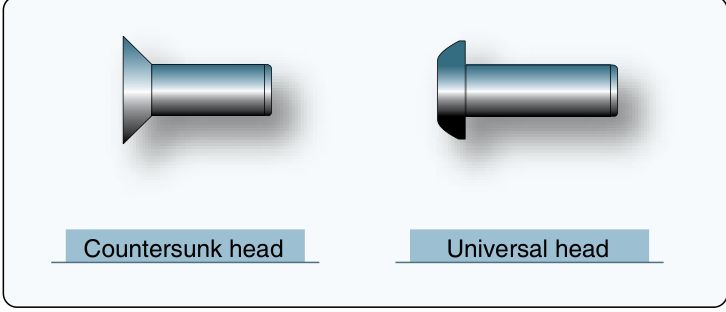
The head marking gives the alloy; the standard number gives the shape and the family of alloys. AN and MS numbers with matching digits are the same rivet (AN470 and MS20470, AN426 and MS20426, AN427 and MS20427).
| Standard | Head | Alloys (codes) | Where it is used | Source |
|---|---|---|---|---|
| MS20470 · AN470 | Universal | A, AD, B, D, DD, E, K, J, T | General-purpose protruding head; replaced the round, brazier and flat heads in most new work. | MS20470 Rev. H |
| MS20426 · AN426 | 100° countersunk | A, AD, B, D, DD, E, K, J, T | Flush surfaces where aerodynamic smoothness matters. | MS20426 Rev. L |
| NAS1097 | 100° flush shear, reduced head | AD, D, E · KE, U | Sheet too thin for the full MS20426 head, about two-thirds its height. A shear head is never shaved. | MIL-HDBK-5J Table 8.1.2.2(n); FAA-H-8083-31B p. 4-39 |
| MS14218 · MS14219 | 120° flush: shear head, tension head | E, T, AD, DD (MS14218) | Flatter heads for machine-countersunk sheet; interference fit in MS14218. BRFS is also a 120° shear head. | MIL-HDBK-5J |
| NAS1200 | 100° flush shear | M (Monel) | Monel flush shear rivet. | NAS1200 |
| MS20427 · AN427 | 100° countersunk | Carbon steel (X), F, M, C | Flush rivets in steel, CRES, Monel and copper. AN420 (90° countersunk, iron or copper) is canceled: use MS20427. | MS20427; AN420 Rev. 3 |
| MS20613 | Universal | P carbon steel, C CRES | Steel and CRES structure; no galvanized rivets on steel parts subjected to high heat (AC par. 7-2e). | MS20613; AC 43.13-1B par. 7-2 |
| MS20615 | Universal | M (Monel) | Monel, nickel and high-nickel steels; the title also covers brass and copper rivets (AC par. 7-2g). | MS20615; AC 43.13-1B par. 7-2g |
| AN435 | Round | Carbon steel, F, M, C | Steel, CRES, Monel and copper round-head rivets. | AN435 Rev. 7 |
| MS35743 | Pan, small solid | Carbon steel, annealed | Small steel rivets; the standard gives no alloy code letters. | MS35743 Rev. A |
| MS9403 · AN123151 to AN125700 | Universal or 100° flush | Heat-resistant steel (AMS 5737, 7229, 7228), nickel base (AMS 7232), mild steel cadmium plated | High-temperature structure; the drawing sets the range. | MS9403 Rev. A; AN123151 to AN125700 |
| NAS1241 | 100° flush shear, oversize shank | AD | Oversize repair rivet for an MS20426 hole opened up. Same head as the standard rivet. Only with approved data. | NAS1241; AC 43.13-1B par. 4-57 |
| NAS1242 | Universal, oversize shank | AD | Oversize repair rivet for an MS20470 hole opened up. Same head as the standard rivet. Only with approved data. | NAS1242; AC 43.13-1B par. 4-57 |
| AN430 · AN455 · AN442 (MS20430 · MS20455 · MS20442) | Round · brazier · flat | — | Older designs: round for internal structure, brazier for thin-sheet skin, flat where clearance is tight. Superseded by AN470; the alloy codes are in the part number. | FAA-H-8083-31B ch. 4 |
| ASNA2049 · 2050 · 2051 | Reduced 100° · protruding · 100° countersunk | DX (2017A-T4) | European-standard solid rivets with a radiused shank end. | ASNA2049 · 2050 · 2051 |
A standard and its oversize repair rivet (NAS1241, NAS1242) have the same head; the shank oversize is in the standard's table. «—» = the standard or source read gives no code letter; the aircraft SRM or drawing sets the alloy.
Reading the whole part number
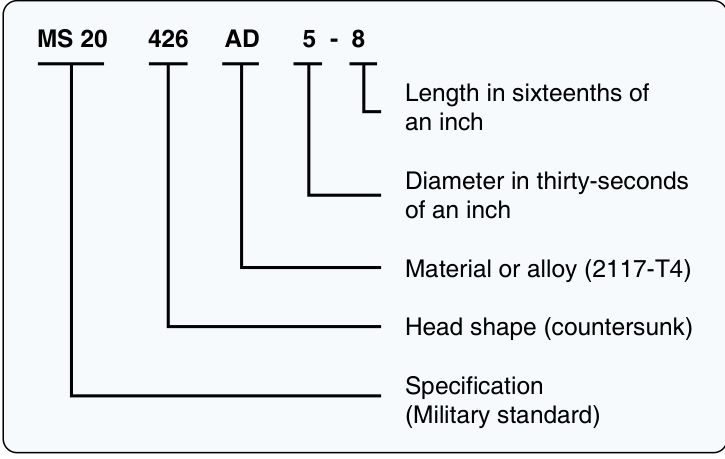
Take AN470AD4-5 apart and every character earns its place:
AN470 — the head style. Universal head.
AD — the alloy code from the table above. 2117-T4.
4 — shank diameter in thirty-seconds of an inch. 4/32" = 1/8".
-5 — length in sixteenths of an inch. 5/16".
The two different fractions in one part number are not a mistake and they are the single most common misreading. Diameter is always in 32nds; length is always in 16ths. A -4 rivet is 1/4" long, not 4/32".
Where the alloy code is absent — AN470-4-5 — the drawing is specifying geometry and leaving alloy to another callout. Do not assume AD.
Worked example — identifying an unknown rivet
A rivet in an unlabeled bag, protruding head, no packaging.
- Look at the factory head under good light and at an angle. Raised features catch a shadow; indented ones fill with it.
- You see a small raised bump in the center — a raised teat. That is D, 2017-T4.
- Measure the shank with callipers: 0.125". That is 4/32", so the diameter code is 4.
- Measure the overall length under the head: 0.313". That is 5/16", so the length code is -5.
- Head shape is a universal head, so AN470.
- Full identification: AN470D4-5. At 1/8 inch it is under the AC's 3/16 inch threshold, so it is not an icebox rivet, but a bag with no label gives it no traceability — identified, but not cleared for use.
AN470D4-5. Identification tells you what it is. Whether it can be driven is a separate question, and for any rivet from an unlabeled bag the answer is no.
Questions people actually ask
What does AD mean on a rivet?
2117-T4 aluminum alloy, marked with an indented dimple in the center of the head. It is the standard general-purpose structural rivet in general aviation and needs no heat treatment or refrigeration.
What is the difference between AD and DD rivets?
AD is 2117-T4, marked with an indented dimple, drivable straight from the drawer. DD is 2024-T4, marked with a raised double dash, stronger, harder to drive, and an icebox rivet — it must be kept refrigerated and driven within its time limit or re-heat-treated. They are not interchangeable in either direction without approved data.
What is an icebox rivet?
A rivet that has been solution heat treated and must then be kept refrigerated to delay natural aging. It covers all 2024 (DD) rivets and 2017 (D) rivets above 3/16 inch in diameter — smaller D rivets are not icebox rivets. Out of refrigeration they harden and will crack rather than upset cleanly: within a few hours at room temperature by the FAA Handbook, while a Navy training manual says to drive them within 20 minutes of quenching. Take the limit from the rivet specification.
Is MS20470 the same as AN470?
Yes. MS20470 is the later Military Standard designation for the same universal-head rivet the older AN470 callout describes. A drawing may use either depending on its vintage; the rivet is the same.
Why is there no marking on the rivets in my aircraft?
You are almost certainly looking at shop heads. The marking is on the manufactured head only, and the shop head is formed by the bucking bar with no marking at all. Find the factory-head side of the joint.
Can I identify a rivet after it is driven?
Only from the factory head, and only if it is accessible, unpainted and unworn. There is no reliable way to determine alloy from a formed shop head by eye.
Limits — when NOT to use this chart
A head marking is an aid to identification, not a certification.
- A marking is not traceability. Airworthy rivets come with documentation. A correctly marked rivet from an unknown source is still an unknown rivet, and identifying it does not make it installable on a certified aircraft.
- Worn, corroded and painted heads mislead. A raised teat wears down; an indented dimple fills with primer. If the mark is not unambiguous, do not guess.
- One symbol can mean two alloys. The indented triangle is carbon steel in AC 43.13-1B and J (2219-T62) on an aluminum MS20470 or MS20426 head; TO 1-1A-1 also gives an indented square to treated alloy steel. Read the mark with the standard and the bag label.
- D and DD condition cannot be identified visually. Nothing about a 2024-T4 rivet's appearance tells you whether it has been out of refrigeration for an hour or two years.
- Substituting alloys is a repair-design decision. AD is not a drop-in replacement for DD because it is easier to drive. The drawing specifies the alloy for a reason.
- Blind rivets are a different system entirely. CherryMAX, Olympic and similar families are identified by stem and sleeve markings under their own manufacturer schemes.
Where to buy
Are you a distributor? Get listed →
Distributors coming soon.
Keep going
Calculators
Guides
How to do it
Tools
Data sheets
Books
Buy
Distributors coming soon.
Main sources
- US Navy Aviation Structural Mechanic (AM) training series, NAVEDTRA 14315, Table 3-1 Rivet Material Identification — the five aluminum alloy codes, head markings and storage requirements; the 20 minute and 24 hour figures, p. 3-2.
- FAA AC 43.13-1B CHG 1, Chapter 4 — rivet selection, icebox rivet handling, head styles, and Table 4-8 — which alloys come in which head style, and the source of the 7075-T73 row. Table 4-8 continued (steel, CRES, Monel, titanium) and par. 7-2, material applications.
- FAA-H-8083-31 and -31B, AMT Handbook — Airframe, Chapter 4 — Fig. 4-77, rivet identification (E, 7050-T73, driven in the T condition); p. 4-39, shear heads are never shaved; p. 4-84, Monel rivets with titanium parts. Glossary entry Icebox rivet, p. G-19 (FAA-H-8083-31).
- MS20470 Rev. H and MS20426 Rev. L (Distribution A) — sheet 1 of each: the material letters A, AD, B, D, DD, E, K, J and T and their head marks; MS20470 requirement 6, the 7050 indented ring.
- MIL-HDBK-5J, Chapter 8 — Table 8.1.1.1 rivet shear strengths; Table 8.1.2.2 joints of MS20427M Monel, NAS1097 100° flush shear heads and the MS14218, MS14219 and BRFS 120° heads.
- TO 1-1A-1 / NAVAIR 01-1A-1, Table 5-2 and par. 5.3.2 — rivet identification (E circle, Monel twin teats or dimples, carbon steel and CRES marks) and rivet uses.
- The Aviation Point data — a machine-countersunk sheet at least the head height plus 0.010 in thick.
- AN420, AN435, MS20427, MS20613, MS20615, MS35743, MS9403, NAS1097, NAS1200, NAS1241, NAS1242, MIL-R-47196A par. 3.4.2 — alloy codes, head styles and the notes on head marking (MS20427 note b; AN435 recessed triangle on mild steel).
Cross-checked with other manuals and standards in our library.