Four heads, one shank, and the ring
Where to buy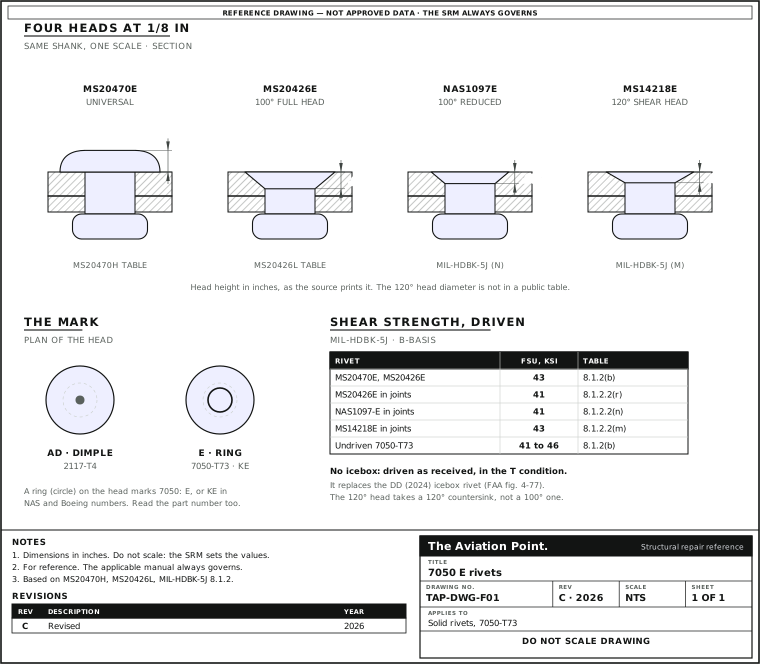
How to recognise it
| Look at | What you see | Source |
|---|---|---|
| Head mark | A ring (circle) on the head | MS20470H, MS20426L; FAA-H-8083-31B fig. 4-77; T.O. 1-1A-1 Table 5-2 |
| Raised or indented | The public sources do not agree; the ring itself is the mark | As above |
| Not to confuse with | The AD dimple, a small dot; and the three raised dashes AC 43.13-1B gives to 7075-T73 | AC 43.13-1B Table 4-8 |
| Part number letter | E in MS20470, MS20426 and MS14218 numbers; E or KE in NAS1097 numbers | FAA-H-8083-31B fig. 4-77; MIL-HDBK-5J Table 8.1.2(b) note h |
KE is the Boeing code for 7050 (FAA-H-8083-31B fig. 4-77). MIL-HDBK-5J writes 7050-T731 for the driven rivet: the last 1 records the strength gained by driving (Table 8.1.2(b) note d).
Where the letter E appears
| Standard | Head | Example | Notes |
|---|---|---|---|
| MS20470 | Universal | MS20470E4-5 | AD is the general-purpose alloy; D, DD and K are inactive for new design (MS20470H) |
| MS20426 | 100° countersunk | MS20426E4-5 | Superseded by NASM20426 with the same part numbers (Notice 1) |
| NAS1097 | 100° reduced (flush shear) | NAS1097E4-5, NAS1097KE4-4 | Smaller head than MS20426 on the same shank: NAS1097 guide |
| MS14218 (NASM14218) | 120° flush shear, interference | MS14218E5-6 | Federal records give the same items as BRFZ, BACR15FV and VRFZ numbers |
Finish letters A, D, F, S or N and a -5 for an extra 1/32 in of length may follow MS20470 and MS20426 numbers (MS20470H).
Reading the part number
MS20470E4-5: universal head, E for 7050-T73, diameter 4/32 = 1/8 in, length 5/16 in. MS20426E4-5 is the same rivet with a 100° head. Lengths go in 1/16 in steps; for the 1/8 in E rivet with a universal head the standard lists 3/16 in to 1-1/2 in.
NAS1097 also puts the material first: NAS1097E4-5, NAS1097KE4-4. MIL-HDBK-5J notes that E is written KE in NAS documents (Table 8.1.2(b) note h).
BRFZ5E3 puts the diameter before the material. Federal item records (DLA FLIS) give it the same stock number as MS14218E5-3: BRFZ + diameter + material + length matched MS14218 + material + diameter - length in 27 of 28 records checked. That is a reading of the records, not a printed rule, so check each part on the fastener cross-reference.
The part number decoder reads solid rivet numbers segment by segment.
Shear strength of the E rivet
| Diameter | Single shear, driven, lb (Fsu 43 ksi) | NAS1097-E in joints, lb (Fsu 41 ksi) |
|---|---|---|
| 1/16 in | 152 | — |
| 3/32 in | 311 | — |
| 1/8 in | 558 | 531 |
| 5/32 in | 854 | 814 |
| 3/16 in | 1,230 | 1,175 |
| 1/4 in | 2,230 | 2,125 |
| 5/16 in | 3,520 | — |
| 3/8 in | 5,030 | — |
MIL-HDBK-5J Table 8.1.2(b): driven E (7050-T731), Fsu 43 ksi, B-basis, single shear on the nominal hole of Table 8.1.2(a); undriven 7050-T73 is 41 to 46 ksi. In its joint tables MIL-HDBK-5J uses Fsu = 41 ksi for MS20426E (Table 8.1.2.2(r)) and NAS1097-E (Table 8.1.2.2(n), tests in 0.130, 0.158, 0.191 and 0.254 in holes), and 43 ksi for MS14218E (Table 8.1.2.2(m)). FAA-H-8083-31B fig. 4-77 gives 43 ksi; T.O. 1-1A-1 Table 5-2 gives 41,000 psi. The joint depends on the sheet too: rivet strength calculator and the SRM.
The countersink for each flush head
| Rivet | Angle | Head height at 1/8 in | Note |
|---|---|---|---|
| MS20426E | 100° | .042 (reference) | MS20426L table |
| NAS1097E, KE | 100° | .029 (reference) | Smaller head than MS20426: cut to the head you install |
| MS14218E | 120° | .027 (reference) | A 100° cutter is the wrong tool; head diameter not in a public table |
Head heights: MS20426L; MIL-HDBK-5J Tables 8.1.2.2(n) and (m). Set the cutter with countersink cage setting; choose between countersink and dimple with countersink or dimple.
Drills, standard and oversize
| Rivet | Pilot | Final drill (in) | 1st oversize, 1/64 in | 2nd oversize: next size |
|---|---|---|---|---|
| 3/32 in (-3) | 3/32 (0.0938) | #40 (0.098) | No public part | 1/8 in: #30 (0.1285) |
| 1/8 in (-4) | 1/8 (0.125) | #30 (0.1285) | No public part | 5/32 in: #21 (0.159) |
| 5/32 in (-5) | 5/32 (0.1562) | #21 (0.159) | No public part | 3/16 in: #11 (0.191) |
| 3/16 in (-6) | 3/16 (0.1875) | #11 (0.191) | No public part | 7/32 in: #1 (0.228) |
| 7/32 in (-7) | None printed | #1 (0.228) | No public part | 1/4 in: F (0.257) |
| 1/4 in (-8) | 1/4 (0.25) | F (0.257) | No public part | 5/16 in (1/16 in step above 1/4 in); drill not in the public tables |
Pilot and final drill: FAA-H-8083-31B fig. 4-90; the final drills are confirmed in MIL-R-47196A Table I, which also lists #20 for 5/32 in and #10 for 3/16 in, and gives #1 for 7/32 in with no pilot. Both tables go by diameter, not by alloy. 2nd oversize: the next larger rivet, in steps of no more than 1/32 in up to 1/4 in and 1/16 in above (MIL-R-47196A 3.4.1, 3.4.2), with edge distance and spacing still at the minimums (AC 43.13-1B par. 4-57b). 1st oversize: the repair rivets NAS1241 and NAS1242 (shank 1/64 in over nominal in -4 and -5, 1/32 in over in -6 and -8; DLA FLIS) are 2117-T4 on their data sheets; no public 1/64 in 7050 rivet was found. The SRM, the drawing or the approved repair data governs.
Installing and checking
| Step | What to do | Source |
|---|---|---|
| Heat treatment | None: no icebox; driven as received, in the T condition | FAA-H-8083-31B fig. 4-77 |
| Drill | Pilot, then the final drill of the diameter | FAA-H-8083-31B fig. 4-90 |
| Countersink | 100° or 120°, to the head you install | MS20426L; MIL-HDBK-5J 8.1.2.2(m), (n) |
| Drive | Fill the hole at the shear plane: the strengths assume it | MIL-HDBK-5J Table 8.1.2(b) note a |
| Shop head | At least 1.5 × the nominal hole | MIL-HDBK-5J Table 8.1.2(b) note e |
| Check | Shop head diameter and height, head seated, no cracks | Shop head calculator |
Where it is used
FAA-H-8083-31B fig. 4-77 calls the 7050 rivet the replacement for the DD (2024) icebox rivet, driven in the T condition. T.O. 1-1A-1 par. 3.4.6 describes 7050-T73 rivets as high-shear-strength, high-temperature rivets for aluminium alloy sheet, intended to substitute for 2024-T4 rivets.
A substitution on an aircraft is still the SRM's or the engineer's call: the rivet replacement calculator and the rivet replacement guide show what to check, and rivet alloy and icebox gives the icebox rules of the other alloys.
Questions people actually ask
Does the E rivet need the icebox?
No. FAA-H-8083-31B fig. 4-77: it is driven in the T condition, as received. It is the icebox-free replacement for the DD rivet.
Is the ring raised or indented?
The public sources do not agree, so this guide does not say. The ring is the mark, and the E or KE in the part number confirms it.
Is 7050 the same as 7075?
No. AC 43.13-1B Table 4-8 lists a 7075-T73 rivet with three raised dashes and no part-number letter; the 7050 E rivet carries a ring.
Which strength do I use, 41 or 43 ksi?
MIL-HDBK-5J gives 43 ksi for the driven E rivet (Table 8.1.2(b)) but uses 41 ksi in its joint tables for MS20426E and NAS1097-E. Use the value the SRM or the engineering data uses.
Limits of this guide
What the sources support, and no further.
- Ring relief. Raised or indented is not settled by the public sources, so the drawing shows the ring as a line.
- Drills by diameter. No public table gives drills by alloy; the E rivet takes the drill of its diameter.
- MS14218: only the head height is public; its head diameter is not.
- BRFZ and MS14218 are tied by federal item records, part by part, not by a printed rule.
- Reference data, not approved data. The SRM, the drawing or the approved repair data governs over every figure here.
Where to buy
Distributors coming soon.
Keep going
Calculators
Guides
How to do it
Tools
Data sheets
Books
Buy
Distributors coming soon.
Sources
- FAA-H-8083-31B, Aviation Maintenance Technician Handbook, Airframe, chapter 4 — Fig. 4-77, rivet alloy codes, marks and strengths; fig. 4-90, pilot and final drills.
- MIL-HDBK-5J (31 Jan 2003), Tables 8.1.2(a), 8.1.2(b), 8.1.2.2(m), (n), (r) — Nominal holes, driven shear of E, and the joint tables of MS14218E, NAS1097-E and MS20426E.
- MS20470 Rev. H and MS20426 Rev. L (14 Sep 1993) — Materials, letters, head tables and the 7050 marking note.
- FAA AC 43.13-1B CHG 1, Table 4-8 — The 7075-T73 three-dash row and the other head marks.
- T.O. 1-1A-1 (NAVAIR 01-1A-1) — Par. 3.4.6, use of 7050-T73 rivets; Table 5-2, marks and driven shear.
- US federal item records (DLA FLIS) — Same-stock-number pairs of BRFZ, MS14218, BACR15FV and VRFZ numbers.
- MIL-R-47196A(MI), 6 Sep 1977 — Table I drills; 3.4.1 and 3.4.2, the next larger rivet.