The bolt installed, the hole by class, the number
Where to buy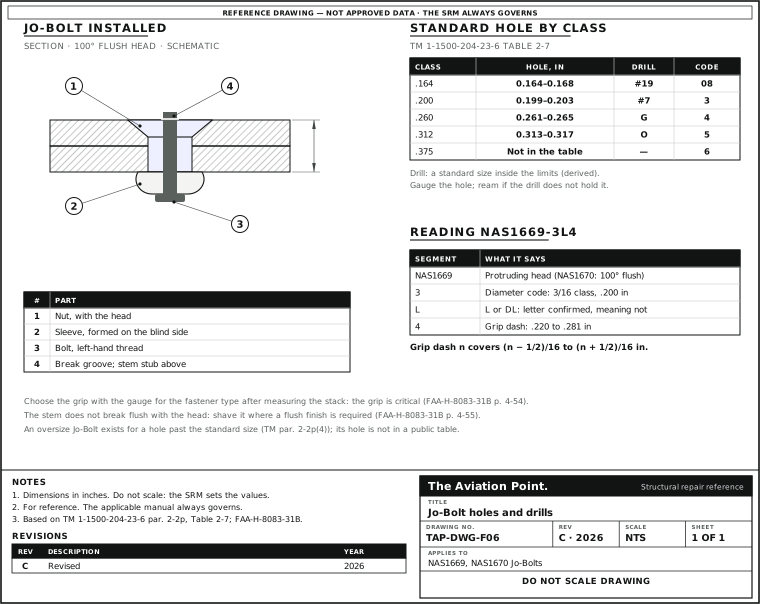
Diameter codes
| Code | Class | Listed diameter, in | Shank in MIL-HDBK-5J, in |
|---|---|---|---|
| 08 | 5/32 class | .164 | .163 |
| 3 | 3/16 class | .200 | .198 |
| 4 | 1/4 class | .260 | .259 |
| 5 | 5/16 class | .312 | .311 |
| 6 | 3/8 class | .375 | .373 |
Codes as the NAS data sheets and federal records use them (for example NAS1669-5L2 = PP312-2 and NAS1669-6L7 = PP375-7); shanks from MIL-HDBK-5J Table 8.1.3.2.3(g).
Standard hole and drill by class
| Class (code) | Hole, in | Drill inside the limits | Note |
|---|---|---|---|
| .164 (08) | 0.164–0.168 | #19 (0.166) | Derived |
| .200 (3) | 0.199–0.203 | #7 (0.201) | Derived |
| .260 (4) | 0.261–0.265 | G (0.261) | Derived; G sits on the minimum |
| .312 (5) | 0.313–0.317 | O (0.316) | Derived |
| .375 (6) | Not in Table 2-7 | None | Hole on the drawing or in the maker's data |
Hole limits: TM 1-1500-204-23-6 Table 2-7, Jo- and V-Bolt substitution (p. 2-25). The TM prints the hole, not a drill: the drill shown is a standard size inside the limits, nearest the middle (derived). Jo-Bolts are used in close-tolerance holes (TM par. 2-2p): gauge the hole and ream if the drill does not hold the limits. MIL-HDBK-5J tested NAS1670-L in 0.165/0.166, 0.200/0.201, 0.261/0.262, 0.312/0.313 and 0.375/0.376 in holes: test holes, not a shop table.
Standard, 1st and 2nd oversize
| Level | What exists | Hole |
|---|---|---|
| Standard | NAS1669 and NAS1670, letters L and DL | Table above |
| 1st oversize | NAS1750 (100° flush) and NAS1751 (hex), 1/64 in over the standard shank, for a hole past the standard size (TM par. 2-2p(4); Monogram PLT111 and PLT211) | 5/32 in .180–.183 · 3/16 in .215–.218 · 1/4 in .276–.279 · 5/16 in .327–.330 · 3/8 in .390–.393 |
| 2nd oversize | No second oversize is published | None |
The SRM, the drawing or the approved repair data decides whether an oversize fastener may be used.
Reading NAS1669-3L4
NAS1669 is the protruding-head Jo-Bolt and NAS1670 the 100° flush head. Then come the diameter code (3 = 3/16 class, .200 in), the letter L or DL, and the grip dash in 1/16 in. Federal records write the dash: NAS1669-3L17.
L and DL are confirmed part-number letters; their meaning is not stated in a public text. Some federal records of DL items show a drive-nut feature, others do not.
Grip dash n covers (n − 1/2)/16 to (n + 1/2)/16 in: L3 is 0.157 to 0.219 in, L4 0.220 to 0.281 in. Every grip row of the NAS1669 and NAS1670 data sheets, and of five public listings, follows this rule.
Cross numbers
| NAS | Partner, L | Partner, DL | Evidence |
|---|---|---|---|
| NAS1669 (protruding) | PLT210 | PLT5210, BL5210 | PLT dash = diameter in 1/32 in (08→5, 3→6, 4→8, 5→10, 6→12), same grip dash; 81 of 81 federal pairs |
| NAS1670 (100° flush) | PLT110 | PLT5110, BL5110 | Same rule; 130 of 130 federal pairs |
| NAS1750 | PLT111 | PLT5111, BL5111 | Federal records, also BACB30GF; title not confirmed |
| NAS1751 | PLT211 | None found | Federal records; title not confirmed |
Same stock number in DLA federal item records (FLIS); example NAS1669-3L17 = PLT210-6-17. Fairchild FF and BE numbers and Monogram PP numbers appear in the same records. A record proves that item; the rule is a reading of the records. See the fastener cross-reference.
Strength, NAS1670-L
| Class | Fastener shear, lb |
|---|---|
| 5/32 (0.163) | 1,678 |
| 3/16 (0.198) | 2,620 |
| 1/4 (0.259) | 4,500 |
| 5/16 (0.311) | 6,000 |
| 3/8 (0.373) | 9,750 |
NAS1670-L blind 100° flush head, alloy steel: MIL-HDBK-5J Table 8.1.3.2.3(g), data supplied by Monogram Aerospace Fasteners. The strength standard is NAS1675, not public. No public table for NAS1669.
Installing a Jo-Bolt
| Step | What | Source |
|---|---|---|
| 1 · Hole | Drill to the class limits; gauge; ream if needed | TM 1-1500-204-23-6 par. 2-2p, Table 2-7 |
| 2 · Grip | Measure the stack with the grip gauge for the type; the grip is critical | FAA-H-8083-31B p. 4-54 |
| 3 · Insert | Fastener in the hole, tool over the screw (stem) and the nut | FAA-H-8083-31B p. 4-54 |
| 4 · Drive | Hold the nut, turn the screw: the sleeve is drawn over the tapered nose of the nut and forms against the blind side | FAA-H-8083-31B p. 4-55 |
| 5 · Break | The screw breaks in its break groove when the sleeve is set; it does not break flush | FAA-H-8083-31B p. 4-55 |
| 6 · Shave | Where a flush finish is required, use the screw break-off shaver tool | FAA-H-8083-31B p. 4-55 |
The bolt has left-hand threads and driving flats on the threaded end; powered and hand tooling exist (FAA-H-8083-31B p. 4-54). See blind rivet installation for the general practice.
Where Jo-Bolts are used
T.O. 1-1A-1 par. 5.3.1.2.9: Jo-Bolts are used in severe fatigue applications, close-tolerance straight-shank interference configurations and reduced head configurations. They are made in alloy steel, aluminium alloy, high-strength steel, CRES, titanium and Inconel.
FAA-H-8083-31B p. 4-54 groups Jo-Bolts with Visu-Lok, Composi-Lok, OSI Bolt and Radial-Lok as drive-nut blind bolts for high-strength joints in metals and composites where the blind side cannot be reached.
ASNA0081 (100° countersunk) and ASNA0082 (hexagon head) are self-locking blind bolts of the Jo-Bolt type, with their own diameter marks and hole table: see ASNA fasteners and the ASNA0081 data sheet.
ASNA Jo-Bolt type: holes
| Mark | Class | Hole, in | Tool |
|---|---|---|---|
| 2 | 4.15 mm (#8 class) | 0.165–0.167 | Reamer (0.002 in range) |
| 3 | 4.8 mm (#10 class) | 0.190–0.192 | Reamer (0.002 in range) |
| 4 | 6.3 mm (1/4 in class) | 0.249–0.251 | Reamer (0.002 in range) |
| 5 | 7.89 mm (5/16 in class) | 0.311–0.313 | Reamer (0.002 in range) |
The ASNA0081 and ASNA0082 sheets print the holes in mm; the inch values are converted. Mark 6 (9.49 mm) has no hole row.
Questions people actually ask
What does the 3 in NAS1669-3L4 mean?
The diameter class: 3/16 in, listed as .200 in. Jo-Bolt diameter codes are 08, 3, 4, 5 and 6, not steps of 1/32 in.
Which drill for a .200 in Jo-Bolt?
#7 (0.201 in) falls inside the TM hole limits of 0.199 to 0.203 in. Gauge the hole and ream if the drill does not hold the limits.
Is there an oversize Jo-Bolt?
Yes: an oversize type exists for holes past the standard size (TM 1-1500-204-23-6 par. 2-2p(4)). No public table gives its hole; use the maker's data or the SRM.
Why does the stem stick out after installation?
The stem of a Jo-Bolt does not break off flush with the head. Where a flush finish is needed, shave it with the screw break-off shaver tool (FAA-H-8083-31B p. 4-55).
Limits of this guide
What the sources support, and no further.
- Oversize hole: no public figure; the maker's data or the SRM.
- L and DL: confirmed letters, meaning not confirmed.
- NAS1750, NAS1751, NAS1672 and NAS1673: titles and materials are not confirmed in a public text; only their federal cross records are given.
- No strength table for NAS1669 in public data.
- Reference data, not approved data. The SRM, the drawing or the approved repair data governs over every figure here.
Where to buy
Distributors coming soon.
Keep going
Calculators
Guides
How to do it
Tools
Data sheets
Books
Buy
Distributors coming soon.
Sources
- TM 1-1500-204-23-6 (with Change 4) — Par. 2-2p Jo-Bolts and their oversize type; Table 2-7, Jo- and V-Bolt substitution, hole limits (p. 2-25).
- FAA-H-8083-31B, Aviation Maintenance Technician Handbook, Airframe, chapter 4 — Pp. 4-54, 4-55: drive-nut blind bolts, grip and installation.
- T.O. 1-1A-1 (NAVAIR 01-1A-1) — Par. 5.3.1.2.9, Jo-Bolt (Visu-Lok) fasteners.
- MIL-HDBK-5J (31 Jan 2003), Table 8.1.3.2.3(g) — NAS1670-L shear strength, shanks and test holes.
- US federal item records (DLA FLIS) — Same-stock-number pairs of NAS1669, NAS1670, NAS1750 and NAS1751 with PLT, BL, FF, BE and PP numbers.
- ASNA0081 and ASNA0082 standard sheets — ASNA0081 and ASNA0082 hole table.