The drawing
Where to buy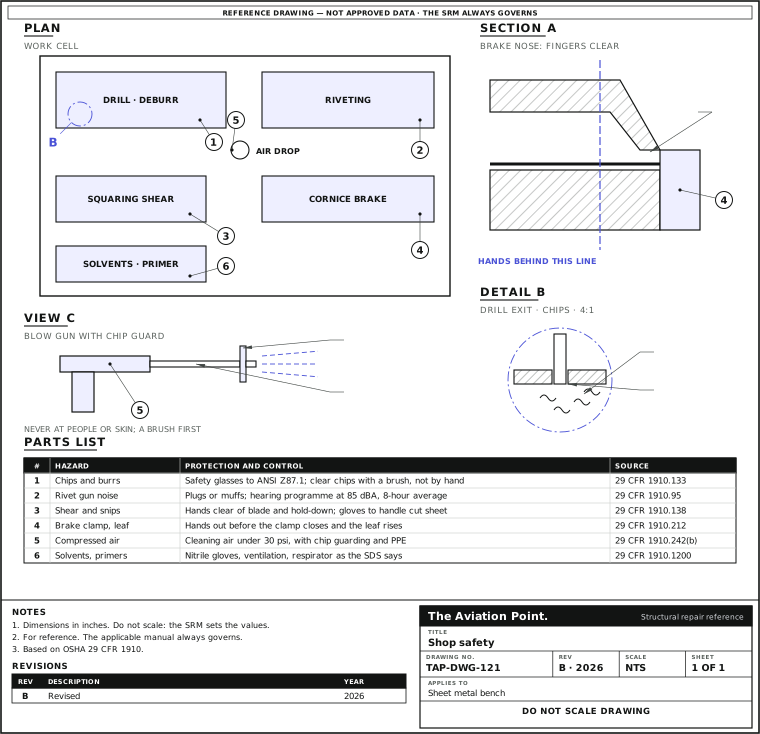
Before you start work
| Step | Action | What to do |
|---|---|---|
| 1 | Glasses on | Safety glasses marked to ANSI Z87.1 before you enter the cell, side shields on. Check: no cracks, lenses clean. |
| 2 | Hearing protection at hand | Plugs or muffs for riveting and air tools. Check: plugs clean and the right size, muffs seal round the ear. |
| 3 | Clothing and hands | No rings, loose sleeves or ties near drills and rolls. Work gloves for handling sheet; nitrile gloves for solvents and sealants. Check: never gloves on a turning drill. |
| 4 | Machines | Shear and brake guards in place, hold-downs working, pedals clear. Check: only the operator at the machine. |
| 5 | Shop air | Hoses and couplings sound; the cleaning nozzle limited to under 30 psi with chip guarding. Check: no air at people or skin. |
| 6 | Solvents and primers | Read the SDS, ventilate, close the container after use, wipes in a closed bin. Check: every container labelled. |
| 7 | Clean as you go | Chips and offcuts off the bench with a brush, floor clear of rivets and sheet. Check: no sharp scrap on the floor or bench. |
PPE and consumables
| Item | What for | How to use | Buying guide | Catalog |
|---|---|---|---|---|
| Safety glasses | Chips, burrs, wire ends | Z87.1 mark, side shields | — | Safety glasses |
| Face shield | Grinding, cutting wire | Over glasses, never instead | — | Face shield |
| Ear plugs | Rivet gun, air tools | Roll, insert, hold until expanded | — | Ear plugs |
| Earmuffs | Long riveting sessions | Seal round the ear, no hair under | — | Earmuffs |
| Work gloves | Handling cut sheet | Off at the drill press and drill motor | — | Work gloves |
| Nitrile gloves | Solvents, sealants, primers | Change when torn or soaked | — | Nitrile gloves |
| Half-face respirator | Primer spray, solvent vapour | Cartridge as the SDS says; fit check | — | Respirator |
| Safety footwear | Dropped bars, sheet, tools | Toe cap, closed shoe | — | Safety footwear |
Hazards by station
| Station | Hazard | Protection | Rule |
|---|---|---|---|
| Drill and deburr | Chips and burrs in the eye or hand | Glasses; brush chips, never by hand | 29 CFR 1910.133 |
| Riveting | Noise | Plugs or muffs; hearing programme from 85 dBA, 8-hour average | 29 CFR 1910.95 |
| Squaring shear, snips | Cuts, crushed fingers | Hands clear of blade and hold-down; gloves for sheet | 29 CFR 1910.212, 1910.138 |
| Cornice brake | Pinch at the clamp and the leaf | Hands out before clamping and while the leaf moves | 29 CFR 1910.212 |
| Shop air | Air and chips driven into skin and eyes | Cleaning air under 30 psi, chip guarding, PPE | 29 CFR 1910.242(b) |
| Solvents, primers | Vapour, skin contact, fire | Nitrile gloves, ventilation, SDS, closed containers | 29 CFR 1910.1200 |
Sources: OSHA 29 CFR 1910.95, .133, .138, .212, .242, .1200 (ecfr.gov). The 85 dBA figure is the OSHA action level for a hearing conservation programme; 90 dBA is the permissible limit.
Defects and fixes
| Unsafe practice | Cause | Fix | Action |
|---|---|---|---|
| Chips blown off with shop air | Quicker than a brush | Brush or vacuum; air only under 30 psi with guarding | Deburring |
| Gloves on a turning drill | Left on after handling sheet | Gloves off at the drill; hold the work in a clamp | Drilling |
| Hand under the brake clamp | Adjusting the sheet while clamping | Line up first, hands out, then clamp | Bending |
| No hearing protection for a short job | Only a few rivets | Plugs in for any riveting | Riveting |
| Solvent can left open | Job interrupted | Close it; wipes in a closed bin | Composite shop safety |
After 29 CFR 1910.95, .133, .212, .242 and .1200.
Inspection and acceptance
| Look at | Accept | Reject → action |
|---|---|---|
| Glasses | Z87.1 marked, side shields, no cracks | Replace |
| Hearing protection | Clean, fitted, at the riveting station | Replace plugs; refit muffs |
| Shear and brake | Guards and hold-downs in place and working | Tag out; report |
| Air nozzle | Cleaning nozzle under 30 psi, hose sound | Replace the nozzle or hose |
| Solvent containers | Labelled, closed, SDS at hand | Label or remove; get the SDS |
Sources: 29 CFR 1910.133, .95, .212, .242(b), .1200.
Quick check
You need to clear chips off a drilled part. Which is right?
- A brush, or shop air under 30 psi with chip guarding and glasses on
Best fit. Right. OSHA 29 CFR 1910.242(b) limits cleaning air to under 30 psi with effective chip guarding and PPE.
- Full shop pressure, pointed away from people
Not this one. No. Full pressure drives chips into skin and eyes; the limit is under 30 psi.
- Wipe them off with the hand
Not this one. No. Aluminium chips and burrs cut; use a brush.
On a real job, the SRM decides.
Questions people actually ask
Do I need hearing protection for a few rivets?
Yes. A rivet gun is loud at the ear even for short bursts. OSHA requires a hearing conservation programme when the 8-hour average reaches 85 dBA; plugs cost nothing next to hearing loss.
Gloves or no gloves?
Gloves to handle cut sheet; no gloves on a turning drill or roll, where they can be caught. Nitrile gloves for solvents and sealants.
Is prescription eyewear enough?
Only if it is marked to ANSI Z87.1 with side protection. Otherwise wear safety glasses or goggles over it (29 CFR 1910.133).
Limits of this guide
A summary of the general rules for a sheet metal bench.
- Local law and the shop's rules come first. OSHA applies in the United States; other countries have their own equivalent rules.
- Products differ. The SDS of each solvent, primer and sealant sets its gloves, respirator and ventilation.
Where to buy
Distributors coming soon.
Keep going
Guides
How to do it
Books
Buy
Distributors coming soon.
Sources
- OSHA 29 CFR 1910.133, Eye and face protection — ANSI Z87.1 eye protection where there are flying particles.
- OSHA 29 CFR 1910.95, Occupational noise exposure — 85 dBA action level, 90 dBA permissible limit, 8-hour average.
- OSHA 29 CFR 1910.138, Hand protection — Gloves for cuts, lacerations and chemicals.
- OSHA 29 CFR 1910.212, Machine guarding — Point of operation and pinch points.
- OSHA 29 CFR 1910.242, Hand and portable powered tools — (b): cleaning air under 30 psi with chip guarding and PPE.
- OSHA 29 CFR 1910.1200, Hazard communication — Labels and safety data sheets.
- FAA-H-8083-30B, AMT Handbook General, ch. 1 — Shop and flight line safety.
- FAA-H-8083-31B, AMT Handbook Airframe, ch. 4 — Shear, brake and drilling cautions.