From sheet to riveted joint
Where to buy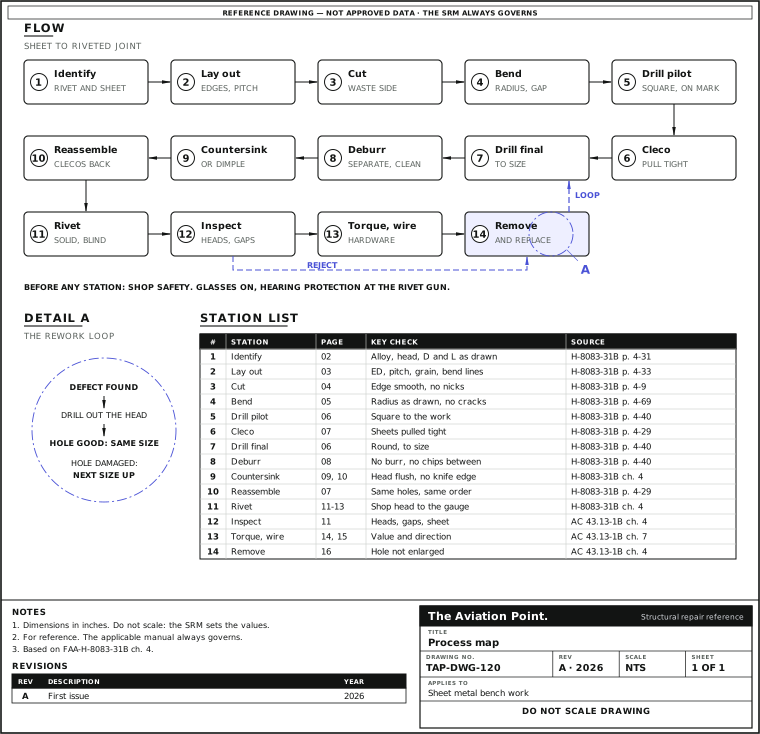
The fourteen stations
| # | Station | Key check | Chapter | Source |
|---|---|---|---|---|
| 1 | Identify | Alloy, head, diameter and length as drawn | Rivet identification | H-8083-31B p. 4-31 |
| 2 | Lay out | Edge distance, pitch, grain, bend lines | Sheet layout | H-8083-31B p. 4-33 |
| 3 | Cut | Edge smooth, no nicks | Cutting sheet | H-8083-31B p. 4-9 |
| 4 | Bend | Radius as drawn, no cracks | Bending a sheet | H-8083-31B p. 4-69 |
| 5 | Drill pilot | Square to the work | Drilling a hole | H-8083-31B p. 4-40 |
| 6 | Cleco | Sheets pulled tight | Clecoing | H-8083-31B p. 4-29 |
| 7 | Drill final | Round, to size | Drilling a hole | H-8083-31B p. 4-40 |
| 8 | Deburr | No burr, no chips between the sheets | Deburring | H-8083-31B p. 4-40 |
| 9 | Countersink or dimple | Head flush, no knife edge | Countersinking, dimpling | H-8083-31B ch. 4 |
| 10 | Reassemble | Same holes, same order | Clecoing | H-8083-31B p. 4-29 |
| 11 | Rivet | Shop head to the gauge | Riveting, blind rivets, Hi-Lok | H-8083-31B ch. 4 |
| 12 | Inspect | Heads, gaps, sheet | Riveting | AC 43.13-1B ch. 4 |
| 13 | Torque and wire | Value and direction | Torquing, safety wire | AC 43.13-1B ch. 7 |
| 14 | Remove and replace | Hole not enlarged | Removing a rivet | AC 43.13-1B ch. 4 |
Source: FAA-H-8083-31B ch. 4; AC 43.13-1B ch. 4 and 7. Sizes, spacing and torque values come from the drawing or the SRM, never from this page. Shop safety applies before every station.
How to use the flow
| Step | Action | What to do |
|---|---|---|
| 1 | Start from the drawing or the SRM | It names the rivet, the sheet, the spacing and the order. The flow below only shows where each chapter fits. |
| 2 | Work the stations in order | Do not drill the final holes before the pilot holes are clecoed, and do not rivet before the holes are deburred. Check: each station has one key check, listed in the table. |
| 3 | Send a bad rivet round the loop | A rejected rivet is drilled out through the manufactured head. Fit the same size if the hole is good, the next size up if it is not. Check: the hole is round and not enlarged beyond the next size. |
| 4 | Close out with the inspection | Look at both heads, the gaps and the sheet before the next assembly step. Check: shop heads to the gauge, no sheet damage. |
Safety. Glasses on before any station and hearing protection at the rivet gun. The rules are in shop safety at the sheet metal bench. The shop's own rules and the manufacturer's instructions take precedence.
Questions people actually ask
Can I drill the final holes before clecoing?
No. Pilot holes first, sheets held with clecoes, then the final size. Drilling loose sheets lets them shift and leaves the holes out of line.
When is a rivet rejected?
When the head, the shop head or the sheet shows a defect in the riveting inspection table. It is then drilled out, see removing a rivet.
Is this the repair procedure?
No. It is the order of the bench work. The repair itself, its rivets and its spacing come from the drawing or the structural repair manual.
Limits of this guide
A summary of the general order of the bench work.
- The manual governs. Where the SRM, the drawing or the fastener maker sets a different order or value, follow it.
- One path among several. Some jobs skip stations: a part that needs no bend goes straight from cutting to drilling. Blind rivets and bolts replace station 11 with their own chapters.
Where to buy
AmericaDistributor coming soonOur partner for this region is on its way
EuropeDistributor coming soonOur partner for this region is on its way
OceaniaDistributor coming soonOur partner for this region is on its way
Distributors coming soon.
Keep going
Calculators
Guides
How to do it
Tools
Books
Buy
Distributors coming soon.
Sources
- FAA-H-8083-31B, Aviation Maintenance Technician Handbook: Airframe, Chapter 4 — pp. 4-9, 4-29, 4-31, 4-33, 4-40, 4-69: cutting, clecoing, rivet identification, layout, drilling and deburring, bending.
- FAA AC 43.13-1B CHG 1, Acceptable Methods, Techniques and Practices — ch. 4, riveting and rivet removal; ch. 7, hardware, torque and safety wire.
Educational reference only. not approved data. Always consult the applicable SRM, AMM, or AC 43.13-1B and your certifying authority.