1Identification
Where to buyWorking temperatures and the fire
Recognizing titanium and magnesium
| Property | Titanium | Magnesium | Source |
|---|---|---|---|
| Look and feel | Light, strong, ductile, nonmagnetic | Silvery-white; the lightest structural metal | TO 1-1A-1 pars. 4.2.4.1, 4.2.5.1.1 |
| Weight | Between the aluminum alloys and stainless steel in density, modulus and strength | 0.065 lb/in³ (1.80 g/cm³), against 0.101 lb/in³ for aluminum alloys and 0.285 lb/in³ for steel | TO 1-1A-1 par. 4.2.4.1, Table 4-6 |
| Corrosion | Excellent in sea water and marine air at normal temperatures; an oxide film protects it | The most chemically active airframe metal and the hardest to protect; it shows early as lifted paint and white spots | TO 1-1A-1 par. 4.2.4.1; AC 43.13-1B pars. 6-181, 6-148 |
| Alloyed with | Aluminum, vanadium, tin, zirconium, molybdenum, chromium, iron: named in the alloy | Aluminum, zinc, zirconium, manganese, thorium, rare earths | MIL-HDBK-5J Table 5.1; TO 1-1A-1 par. 4.2.5.1.1 |
| Before any work | Identify the material: the first step of any repair | Positively identify the metal as magnesium before treating it | AC 43.13-1B pars. 4-1, 6-152a |
Reading the designation
| Metal | System | Examples | Source |
|---|---|---|---|
| Titanium alloys | Commercially pure (unalloyed) titanium, or an alloy named by its nominal composition in percent | Ti-6Al-4V: 6 % aluminum, 4 % vanadium, balance titanium | TO 1-1A-1 par. 4.2.4.1.5; MIL-HDBK-5J Table 5.1 |
| Titanium structure | Pure titanium is alpha up to 1620 °F (882 °C) and beta above; alloying and heat treatment set alpha, alpha-beta or beta at service temperature, and the properties with them | Alpha, near-alpha: Ti-5Al-2.5Sn, Ti-6Al-2Sn-4Zr-2Mo; alpha-beta: Ti-6Al-4V, Ti-6Al-6V-2Sn; beta: Ti-13V-11Cr-3Al, Ti-10V-2Fe-3Al | MIL-HDBK-5J par. 5.1.2, Table 5.1 |
| Magnesium alloys | ASTM nomenclature; the temper follows the alloy after a dash | AZ31B-H24 (wrought); AZ91C, EZ33A, QE22A, ZE41A (cast) | MIL-HDBK-5J pars. 4.1.1, 4.1.5, Table 4.1 |
| Magnesium tempers | F as fabricated; O annealed (wrought only); H strain-hardened (wrought only): H1 only strain-hardened, H2 then partially annealed, H3 then stabilized; second digit 2 quarter hard, 4 half hard, 6 three-quarter hard, 8 full hard | AZ31B-H24: strain-hardened and partially annealed to half hard | MIL-HDBK-5J Table 4.1.5 (from ASTM B296) |
| AZ31B products | Sheet and plate AMS 4375 and AMS 4377, plate AMS 4376, extrusion ASTM B107, forging ASTM B91 | Aluminum and zinc alloy; H24 and H26 by strain hardening and partial anneal | MIL-HDBK-5J par. 4.2.1.0, Table 4.2.1.0(a) |
| Magnesium castings | Sand ASTM B80 (QQ-M-56), permanent mold ASTM B199 (QQ-M-55), die ASTM B94 (QQ-M-38); EZ33A-T5 sand castings MIL-M-9433 | — | TO 1-1A-1 Table 4-7 |
| Thorium alloys | Magnesium alloys with thorium for elevated temperature: low-level radioactive, handling regulated | — | TO 1-1A-1 par. 4.2.5.2.1 |
The specifications of each titanium alloy are on its data sheet.
Where the documents differ
| Point | TO 1-1A-1 | The other document | Used here |
|---|---|---|---|
| Cadmium, silver, mercury on titanium | Par. 4.2.4.4: restrictions in MIL-S-5002 and MIL-STD-1568 | MIL-HDBK-5J par. 5.1.4: MIL-HDBK-1568 | The same restriction; follow the document your SRM or process specification names |
| Rivets in magnesium | Par. 3.4.5: 5056-H32 rivets, only for magnesium and mixed magnesium structures | FAA-H-8083-31B p. 4-83: type B, 5056-F | 5056 aluminum rivets; the SRM gives the part number and temper |
2Allowable damage
Titanium: limits that matter in repair
| Limit | Value | Why it matters | Source |
|---|---|---|---|
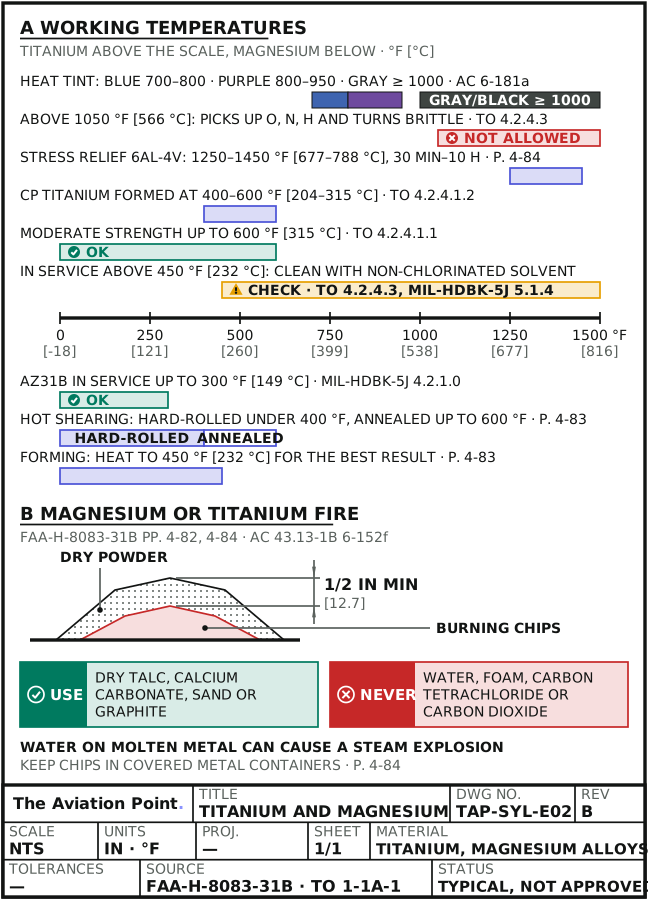
| Strength in service | Moderate strength up to 600 °F (315 °C) | It is chosen for corrosion resistance and moderate strength at low weight | TO 1-1A-1 par. 4.2.4.1.1 |
| Upper temperature | Below 1050 °F (566 °C) | Above it titanium takes up oxygen, nitrogen and hydrogen and turns brittle | TO 1-1A-1 par. 4.2.4.3 |
| Heat tint | Blue 700 to 800 °F (371 to 427 °C); purple 800 to 950 °F (427 to 510 °C); gray or black 1000 °F (538 °C) and higher | Protective discoloration: it is not removed | AC 43.13-1B par. 6-181a |
| Hot salt | Stress corrosion by dry sodium chloride, seen in laboratory tests at 450 to 500 °F (232 to 260 °C) and higher; no service failure reported | Parts used above 450 °F (232 °C) are cleaned with a nonchlorinated solvent, fingerprints included | MIL-HDBK-5J par. 5.1.4; TO 1-1A-1 par. 4.2.4.3 |
| Other media | Methyl alcohol, chloride salt solutions, hydrogen, liquid metals, also at lower temperatures | Chemical attack or stress corrosion cracking | TO 1-1A-1 par. 4.2.4.3 |
| Cadmium, silver, mercury | Contact, under certain conditions | Embrittlement | TO 1-1A-1 par. 4.2.4.4; MIL-HDBK-5J par. 5.1.4 |
| Oxygen | No contact with liquid oxygen, or gaseous oxygen at cryogenic temperature; about 50 psi (345 kPa) partial pressure ignites a fresh surface from −250 °F (−157 °C) to room temperature or higher | A crack, rupture or impact can start a violent reaction | TO 1-1A-1 par. 4.2.4.2; MIL-HDBK-5J par. 5.1.4 |
| Creep at room temperature | Can be significant above about 50 % of Fty for unalloyed titanium and about 75 % of Fty for the standard alloys | Deformation below the yield strength | MIL-HDBK-5J par. 5.1.4 |
| Cracks in water | Some alloys grow fatigue cracks faster in water or salt water; thin sheet is not susceptible, thicker sections become so | Shorter crack life in wet areas | MIL-HDBK-5J par. 5.1.4 |
| Damage on the part | — | The aircraft SRM sets it; no generic limit is published | SRM |
Magnesium: findings and limits
| Finding or limit | What it means | Source |
|---|---|---|
| Lifted paint and white spots, then snow-like mounds or white whiskers | Magnesium corrosion; the products fill several times the volume of the metal lost: correct the coating failure at once | AC 43.13-1B par. 6-148 |
| Attack at skin edges, under hold-down washers, at sheared, drilled or damaged areas | The usual places on sheet and forgings; trapped moisture behind crevices drives it | AC 43.13-1B par. 6-149 |
| Aluminum insulating washers no longer tight | Corrosion under them is likely: washers, and fasteners other than machine screws, come off for the treatment | AC 43.13-1B par. 6-149c |
| Castings | More porous and more prone to penetrating attack than wrought skin; engine cases in salt water can hole overnight | AC 43.13-1B par. 6-151 |
| Extensive corrosion removal on a structural casting | The aircraft manufacturer or a DER decides on the strength left | AC 43.13-1B par. 6-151b |
| AZ31B in service | Up to 300 °F (149 °C); long exposure to heat anneals or overages strain- or age-hardened alloys | MIL-HDBK-5J pars. 4.2.1.0, 4.1.4 |
| Welded AZ31B | Stress relief after welding prevents stress corrosion cracking | MIL-HDBK-5J par. 4.2.1.0 |
| Where magnesium is not used | Liquid de-icing and water-injection systems, integral fuel tank areas | FAA-H-8083-31B p. 4-84 |
| Methyl alcohol | It must not touch magnesium alloys | FAA-H-8083-31B p. 4-82 |
| Damage on the part | The aircraft SRM sets it; no generic limit is published | SRM |
Removing the corrosion, metal by metal, is in the corrosion guide.
3Repair
Working titanium
| Job | Rule | Source |
|---|---|---|
| Cutters | Carbide or 8 % cobalt drill bits, reamers and countersinks; sharp HSS bits work with enough force and a low-speed motor; cobalt-vanadium bits outlast HSS | FAA-H-8083-31B p. 4-84 |
| Hole size in one step | Up to 0.1563 in (5/32, 3.97 mm). For 0.1875 in (4.76 mm) and up: start at 0.1563 in and open in 0.0313 or 0.0625 in (0.79 or 1.59 mm) steps | FAA-H-8083-31B pp. 4-84, 4-85 |
| Drill speed | 0.0625 in (1.59 mm): 920 to 1,830 rpm; 0.125 in (3.18 mm): 460 to 920 rpm; 0.1875 in (4.76 mm): 230 to 460 rpm | FAA-H-8083-31B Figure 4-167 |
| Technique | A dull bit that rubs work-hardens the surface; keep holes shallow, flood with cutting fluid (water-soluble coolant or sulfurized oil on large plates), withdraw while turning, clamp stacked parts tight, back thin parts | FAA-H-8083-31B pp. 4-84, 4-85 |
| Forming 6Al-4V | Annealed, with a minimum-radius chart; stress relief at 1250 to 1450 °F (677 to 788 °C) for 30 min to 10 h; a power press brake (box and pan brakes cannot form it) | FAA-H-8083-31B p. 4-84; TO 1-1A-1 par. 4.2.4.1.5 |
| Forming CP titanium | At 400 to 600 °F (204 to 315 °C) for large deformations; harder to form than annealed stainless | TO 1-1A-1 par. 4.2.4.1.2 |
| Fasteners and contact | Monel rivets or standard close-tolerance steel fasteners; titanium isolated from magnesium, aluminum and alloy steel | TO 1-1A-1 par. 4.2.4.1.4; FAA-H-8083-31B p. 4-84 |
| No titanium in stock | 4130, 4140, 4340 or 8630 steel of the same gauge is the substitute TO 1-1A-1 names, where the SRM allows a substitute | TO 1-1A-1 par. 4.2.4.1.3 |
Corrosion removal on titanium is in the corrosion guide (AC 43.13-1B par. 6-181b).
Working magnesium
| Job | Rule | Source |
|---|---|---|
| Cutting sheet | Blade shears, blanking dies, routers or saws; never conventional shears or nibblers (rough, cracked edge); clearance 3 to 5 % of the thickness | FAA-H-8083-31B p. 4-83 |
| Cold shearing | Not on hard-rolled sheet over 0.064 in (1.63 mm) or annealed sheet over 1/8 in (3.18 mm); shave about 1/32 in (0.79 mm) off a rough edge | FAA-H-8083-31B p. 4-83 |
| Hot shearing | Annealed sheet up to 600 °F (316 °C), hard-rolled under 400 °F (204 °C); allow for shrinkage | FAA-H-8083-31B p. 4-83 |
| Sawing | The only method for plate over 1/2 in (12.7 mm); bandsaw 4 to 6 tooth pitch, nonsparking blade guides | FAA-H-8083-31B p. 4-83 |
| Bending | Cold: radius at least 7 t for soft and 12 t for hard sheet; heated: 2 to 3 t; best results heated to 450 °F (232 °C) | FAA-H-8083-31B p. 4-83 |
| Heating | Watch the temperature: it burns or forms molten pools and is ruined; a sulfur dioxide atmosphere protects it | FAA-H-8083-31B p. 4-83 |
| Layout and edges | Soft carpenter's pencil only: a scribed mark can start a fatigue crack; sharp corners and burrs off near the bend line | FAA-H-8083-31B p. 4-83 |
| Rivets and repair metal | 5056 rivets (see Where the documents differ); clad 2024-T3 is often the repair material, insulated from the magnesium | FAA-H-8083-31B p. 4-83; AC 43.13-1B par. 6-150 |
| Dissimilar metals | Protect both, separate them, plate the magnesium or film the other metal; faying surfaces get epoxy primer and sealant; on patches two coats of epoxy primer on doubler and skin, vinyl tape and sealed edges | TO 1-1A-1 pars. 4.2.5.2.4, 4.2.5.2.5; AC 43.13-1B par. 6-150 |
| Machining | Sharp tools, high speeds, heavy cuts; chips, filings and shavings in covered metal containers | FAA-H-8083-31B pp. 4-83, 4-84 |
Step by step: before working titanium or magnesium
| Step | Action | What to do |
|---|---|---|
| 1 | Identify the metal | From the marking and the paperwork; a magnesium part is positively identified before any treatment (AC 43.13-1B pars. 4-1, 6-152a). |
| 2 | Read the limits | The SRM first; then the material limits above: titanium below 1050 °F, AZ31B to 300 °F. |
| 3 | Set up for fire | Magnesium: dry powder within reach, a covered metal chip container, no water near the work (FAA-H-8083-31B pp. 4-82, 4-84). |
| 4 | Choose tools and speeds | Titanium: carbide or cobalt cutters, low speed, coolant. Magnesium: sharp tools, blade shears or saws, never nibblers (pp. 4-83 to 4-85). |
| 5 | Keep contaminants off titanium | No cadmium, silver or mercury contact outside the restrictions; a nonchlorinated solvent on parts used above 450 °F; no methyl alcohol (TO 1-1A-1 pars. 4.2.4.3, 4.2.4.4). |
| 6 | Isolate and record | Dissimilar metals insulated, epoxy primer and sealant on the faying surfaces (TO 1-1A-1 par. 4.2.5.2.4); record material, specification and what was done. |
Worked example: bending and shearing annealed AZ31B
A bracket is made from AZ31B-O sheet 0.050 in (1.27 mm) thick, with one 90° bend and one sheared edge.
- Cold bend, soft sheet: radius at least 7 t = 7 × 0.050 = 0.350 in (8.89 mm) (FAA-H-8083-31B p. 4-83).
- Heated for forming: 2 to 3 t = 0.100 to 0.150 in (2.54 to 3.81 mm), best results at 450 °F (232 °C) (p. 4-83).
- Cold shearing is allowed: annealed sheet up to 1/8 in (3.18 mm). Clearance 3 to 5 % of 0.050 in = 0.0015 to 0.0025 in (0.04 to 0.06 mm) (p. 4-83).
- Layout in soft pencil; corners and burrs off near the bend line (p. 4-83).
Worked example: a 3/16 in hole in Ti-6Al-4V
A 0.1875 in (4.76 mm) hole is drilled by hand in annealed Ti-6Al-4V sheet.
- 0.1875 in is above the 0.1563 in single-step limit: drill 0.1563 in (3.97 mm) first (FAA-H-8083-31B p. 4-84).
- Open it in one 0.0313 in (0.79 mm) step to 0.1875 in (p. 4-85).
- Speed at 0.1875 in: 230 to 460 rpm (Figure 4-167). The figure has no row for the 0.1563 in pilot: —, the SRM sets it.
- Carbide or 8 % cobalt bit, flood with cutting fluid, parts clamped tight, withdraw while turning (pp. 4-84, 4-85).
Quick check
A titanium duct clamp works at 500 °F. What do you clean it with before refitting it?
- A nonchlorinated solvent
Best fit. Yes: titanium can crack in hot salt; parts used above 450 °F are cleaned with a nonchlorinated solvent, fingerprints included (MIL-HDBK-5J par. 5.1.4; TO 1-1A-1 par. 4.2.4.3).
- Methyl alcohol
Not this one. No: TO 1-1A-1 par. 4.2.4.3 lists methyl alcohol among the media that can attack titanium.
- Abrasive paper, to take off the blue tint
Not this one. No: the tint is a protective oxide and is not removed (AC 43.13-1B par. 6-181a).
On a real job, the SRM decides.
Questions people actually ask
Why is magnesium protected so carefully?
It is the most chemically active metal in the airframe (AC 43.13-1B par. 6-148). Corrosion protection is considered for every magnesium application: anodic films, conversion coatings, paint, platings, drainage, and dissimilar-metal joints insulated with barrier strips and sealants (MIL-HDBK-5J par. 4.1.4).
Can a cadmium-plated bolt go into a titanium part?
Not without checking: contact with cadmium, silver, mercury or their compounds can embrittle titanium under certain conditions, and the restrictions are in MIL-S-5002 and MIL-STD-1568 (TO 1-1A-1 par. 4.2.4.4). The SRM names the fastener.
Is a blue or purple titanium surface damaged?
The color itself is a protective oxide from heat, 700 to 950 °F, and is not removed (AC 43.13-1B par. 6-181a). Corrosion on titanium is hard to see and usually pitting (par. 6-181b). The heat that made the color is a separate question for the SRM.
Can a magnesium skin be patched with aluminum?
Yes, where magnesium is hard to form to the contour, with full dissimilar-metal insulation: vinyl tape, sealed edges, a non-corrosive sealant and two coats of epoxy primer on doubler and skin (AC 43.13-1B par. 6-150). Clad 2024-T3 is often used (FAA-H-8083-31B p. 4-83).
Titanium is not in stock: can steel replace it?
TO 1-1A-1 par. 4.2.4.1.3 names 4130, 4140, 4340 or 8630 steel of the same gauge as the substitute. Weight and fit change, so only where the SRM or approved data allow it.
Limits — when NOT to use this
What the sources support, and no further.
- The SRM governs. Every damage limit and repair comes from the aircraft SRM and the material specification.
- No heat-treat cycles per alloy beyond the 6Al-4V stress relief the handbook prints: the specification gives them.
- Mechanical properties are on the data sheets, not here.
- Not approved data. The values are reference values from public documents.
Where to buy
Are you a distributor? Get listed →
Distributors coming soon.
Keep going
Calculators
Guides
How to do it
Data sheets
Books
Main sources
- FAA-H-8083-31B, Aviation Maintenance Technician Handbook – Airframe — Chapter 4: Working Magnesium, Working Titanium, Description of Titanium, pp. 4-82 to 4-85; Figure 4-167.
- TO 1-1A-1 / NAVAIR 01-1A-1, General Manual for Structural Repair (15 Jan 2016) — Pars. 3.4.5, 4.2.4.1 to 4.2.4.4, 4.2.5.1, 4.2.5.2.1 to 4.2.5.2.6; Tables 4-6, 4-7.
- MIL-HDBK-5J, Metallic Materials and Elements for Aerospace Vehicle Structures (31 Jan 2003) — Pars. 4.1.1, 4.1.4, 4.1.5, 4.2.1.0, 5.1.2, 5.1.4; Tables 4.1, 4.1.5, 4.2.1.0(a), 5.1.
- AC 43.13-1B CHG 1, Acceptable Methods, Techniques, and Practices: Aircraft Inspection and Repair — Par. 4-1; pars. 6-148 to 6-152, 6-181.
- Specifications named by number — AMS 4375, AMS 4376, AMS 4377, ASTM B107, ASTM B91, ASTM B80, B199, B94, B296, QQ-M-56, QQ-M-55, QQ-M-38, MIL-M-9433, MIL-S-5002, MIL-STD-1568, MIL-HDBK-1568: named as what governs; not reproduced.
Cross-checked with other manuals and standards in our library.