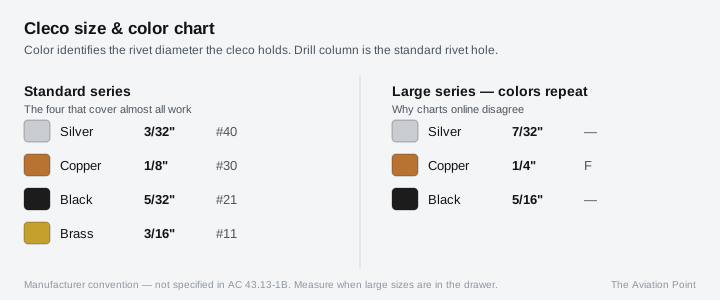
Standard series — the four you will actually use
Where to buyThese four sizes cover essentially all light aircraft and kit sheet metal work. The color identifies the rivet diameter the cleco is made for; the drill column is the standard hole drilled for that rivet.
| Color | Rivet size | Decimal | Rivet drill | Drill decimal | Also sold as |
|---|---|---|---|---|---|
| Silver | 3/32" | 0.094" | #40 | 0.0980" | Cadmium, zinc |
| Copper | 1/8" | 0.125" | #30 | 0.1285" | Bronze |
| Black | 5/32" | 0.156" | #21 | 0.1590" | — |
| Brass | 3/16" | 0.188" | #11 | 0.1910" | Gold, yellow |
Rivet drill sizes are the standard callouts for solid aluminum rivets. Some cleco listings quote the next number up (#20 for 5/32, #10 for 3/16) — see the note on drill sizes below.
Large series — where the colors repeat
Above 3/16" the color sequence starts over. This is the single most common source of confusion: a chart that lists 1/4" as copper and a chart that lists 1/8" as copper are both right, because they are describing different series.
| Color | Rivet size | Decimal | Repeats |
|---|---|---|---|
| Silver | 7/32" | 0.219" | same color as 3/32" |
| Copper | 1/4" | 0.250" | same color as 1/8" |
| Black | 5/16" | 0.313" | same color as 5/32" |
If you have a mixed drawer, measure — do not trust color alone once large clecos are in the mix.
The four cleco types, and when each one earns its place
Spring clecos are the default. A plunger and a spring; installed and removed with cleco pliers in under a second. They hold clamp-up pressure adequate for drilling and riveting, and they are what you buy by the hundred.
Wing-nut and hex-nut draw clecos trade speed for clamping force. You tighten them by hand or with a nut driver, and they pull the sheets genuinely tight — the right choice for closing a stubborn gap, seating a skin against a stringer, or holding while a sealant cures. Slow to install; you use a handful, not a hundred.
Cylindrical clecos have a smooth parallel body instead of the tapered spring plunger. They locate more precisely and are used where hole alignment across a thick stack matters.
Side-grip clamps (often sold alongside clecos) do not go through a hole at all — they clamp over an edge. Useful where you have no hole yet, or must not add one.
How many do you actually need?
The working rule on a kit build is to cleco every third to every fourth hole on a run while match-drilling, then fill in as you rivet. For a light aircraft skin that means far more than beginners expect.
A realistic starter quantity for sheet metal work is 100 in 1/8" (copper) and 50 in 3/32" (silver), plus a dozen each of 5/32" and 3/16" for the heavier joints. Two pairs of pliers, so a second person can help — or so you still have one when the first goes missing.
Worked example — reading a drawer of unknowns
You inherit a mixed tin of clecos with no packaging.
- Sort by color first. Four piles: silver, copper, black, brass.
- Measure the plunger diameter of one from each pile with calipers. A 3/32" silver cleco plunger measures close to 0.094"; a 7/32" silver one measures close to 0.219" — a difference you cannot miss once you look for it.
- If a silver pile contains both, split it by size, not by color. Same for copper (1/8" vs 1/4") and black (5/32" vs 5/16").
- Confirm against the hole: a correctly sized cleco drops into its rivet hole with no perceptible slop and no forcing.
Color narrows it to two candidates. Calipers or a test hole settle it. Never assume from color alone in a mixed drawer.
Where the sources agree, and where they do not
| Point | First source | Second source | Where they differ, and what governs |
|---|---|---|---|
| Rivet drill, 5/32 in | Handbook p. 4-44, Fig. 4-90: #21 (0.1590 in) | MIL-R-47196A Table I: #20 (0.1610 in) | They differ by one number; the tighter #21 gives 0.0027 in clearance. The repair data's callout governs; where it gives none, use the smaller. |
| Other three sizes | Handbook Fig. 4-90: 3/32 in #40, 1/8 in #30, 3/16 in #11 | MIL-R-47196A Table I: the same #40, #30 and #11 | Agree. |
| Cleco size and color | Handbook pp. 4-29 to 4-30: Cleco construction, six sizes, color coding | AC 43.13-1B par. 4-57 and 4-58: no temporary fastener named in the text read; hole round, straight, free of cracks | The color code is the Handbook's and the maker's. The AC only fixes the hole the Cleco sits in. |
Questions people actually ask
Is a 1/8" cleco copper or bronze?
The same thing. Manufacturers and distributors describe the identical finish as copper or bronze depending on the catalog. There is no 1/8" cleco in a different color.
Why does my chart say 1/4" clecos are copper when yours says 1/8" is copper?
Both are correct. The color sequence restarts on the large series: 7/32" is silver again, 1/4" is copper again, 5/16" is black again. Your chart is describing the large series; the four-color chart is describing the standard series.
Can I use a 3/32" cleco in a #40 hole?
Yes — that is exactly what it is for. Clecos are named for the rivet diameter, and #40 is the standard drill for a 3/32" solid rivet.
Why do some cleco listings say #20 and #10 instead of #21 and #11?
Because a cleco only has to fit the hole, not fill it to rivet tolerances. #20 (0.161") and #10 (0.1935") are one number larger than the standard rivet drills #21 (0.159") and #11 (0.191"), and clecos in those sizes work in either. Drill your rivet holes to the rivet standard — the cleco will still fit.
How many clecos per foot of seam?
At every third hole with a typical 4D pitch on 1/8" rivets — about 1/2" between rivets — you are placing a cleco roughly every 1.5", so about eight per foot while match-drilling.
Limits — when NOT to use this chart
The color code is a manufacturer convention, not a specification. It is not called out in AC 43.13-1B and it carries no airworthiness authority.
- Non-aviation suppliers use different schemes. Automotive, chassis and trailer suppliers publish their own color maps. This chart describes the aviation convention used by Wedgelock, Monogram, ATS and the aviation tool distributors.
- Color repeats above 3/16". Covered above — measure once large sizes are involved.
- A cleco is a temporary fastener. It holds for drilling, fitting and riveting. It is not a structural fastener and it does not fly.
- Anodized and coated variants exist whose finish reads as a different color under shop lighting. Measure if in doubt.
- Hole size, not cleco size, is what matters structurally. The rivet drill column here is the standard hole for that rivet — confirm against the drawing or SRM for the job in front of you.
Where to buy
Are you a distributor? Get listed →
Distributors coming soon.
Keep going
Calculators
Guides
How to do it
Tools
Data sheets
Books
Buy
Distributors coming soon.
Main sources
- Manufacturer catalogs (Wedgelock, Monogram, ATS) — color convention for the standard and large series.
- FAA-H-8083-31, AMT Handbook — Airframe, Volume 1 — confirms the practice — “Color coding allows for easy size recognition” — but does not say which color goes with which size. Neither does AC 43.13-1B, which defines a cleco in its glossary and stops there. Checked August 2026: the color-to-size mapping on this page is a manufacturer convention with no regulatory source, which is exactly why the charts in circulation disagree.
- FAA AC 43.13-1B CHG 1, Acceptable Methods, Techniques, and Practices: Aircraft Inspection and Repair — Par. 4-57 and 4-58: hole preparation.
- MIL-R-47196A, Rivets, Buck Type, Preparation for and Installation — Table I: drill sizes for solid rivets.
- FAA-H-8083-31B, Aviation Maintenance Technician Handbook: Airframe, Chapter 4 — Figures and paragraphs named in the rows above.
Cross-checked with other manuals and standards in our library.