1Identification
Where to buyHazards around the aircraft
| Hazard | What the documents say | Source |
|---|---|---|
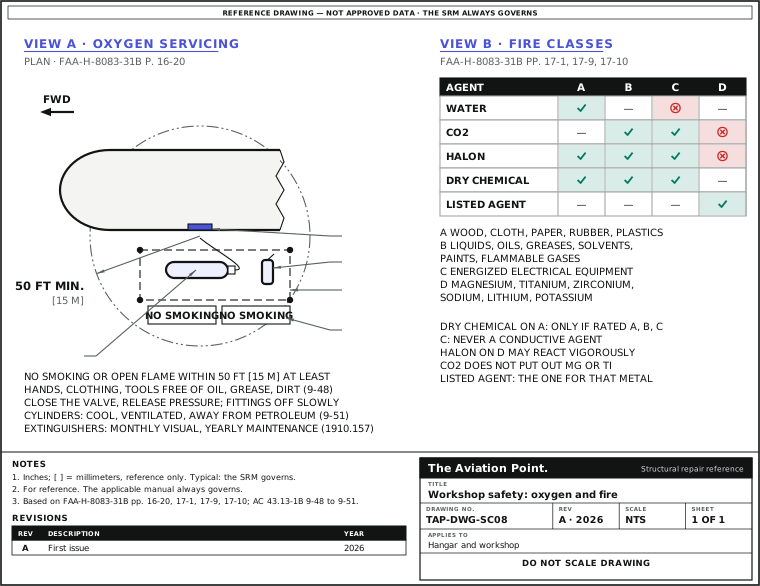
| Oxygen and oil | Hands, clothing and tools free of oil, grease and dirt: traces near compressed oxygen may cause spontaneous combustion, explosion or fire. No oil, grease, flammable solvent, lint or dust on threads or parts exposed to pressurized oxygen | AC 43.13-1B 9-48, 9-49 caution |
| Oxygen work area | Extinguisher on hand; area cordoned off, NO SMOKING placards; no smoking or open flame within at least 50 ft (15 m); clean tools, ideally dedicated to oxygen work; no adhesive tape; caps and plugs on open parts; no power-on checks; work outside where possible | FAA-H-8083-31B ch. 16, p. 16-20 |
| Oxygen pressure | Close the cylinder valve and release the pressure before work; unscrew fittings slowly. Pressurize slowly to avoid surging that could rupture a line | FAA-H-8083-31B p. 16-20; AC 43.13-1B 9-48b caution |
| Oxygen cylinders | Stored in a designated, cool, ventilated area away from petroleum products and heat. Charged only with aviation breathing oxygen | FAA-H-8083-31B p. 16-20; AC 43.13-1B 9-51 |
| Electricity | Turn power off before cleaning electrical connections | AC 43.13-1B 11-4 caution |
| Battery electrolyte | Lead-acid: neutralize with 10 % sodium bicarbonate solution; nickel-cadmium: 3 % acetic acid; then wash with clean water and dry | AC 43.13-1B 11-5 |
| Hydraulic fluid | Phosphate ester fluids resist fire but are not fireproof. Never mixed with petroleum-based fluid; wrong fluid in a system: drain, flush and treat the seals as the maker says | FAA-H-8083-31B ch. 12, p. 12-3 |
| Chemicals | A safety data sheet for each hazardous chemical, readily accessible in the work area during each shift | 29 CFR 1910.1200(g)(8) |
Fire classes and agents
| Class | What burns | Agents | Do not use | Source |
|---|---|---|---|---|
| A | Ordinary combustibles: wood, cloth, paper, rubber, plastics | Water (cools and soaks); Halon; dry chemical rated A, B, C (mono-ammonium phosphate) | — | FAA-H-8083-31B pp. 17-1, 17-9, 17-10 |
| B | Flammable liquids, oils, greases, solvents, paints, flammable gases | CO2, Halon, dry chemical | — | pp. 17-1, 17-9, 17-10 |
| C | Energized electrical equipment | A non-conductive agent: CO2, Halon, dry chemical | Conductive agents | pp. 17-1, 17-9, 17-10 |
| D | Combustible metals: magnesium, titanium, zirconium, sodium, lithium, potassium | —: the agent listed for that metal (NFPA 10) | Halon (may react vigorously); CO2 (does not put out magnesium or titanium) | pp. 17-1, 17-9, 17-10 |
Classes as NFPA 10, Standard for Portable Fire Extinguishers, defines them (cited by FAA-H-8083-31B, 2007 edition). Halon production is restricted; replacement agents named: HCFC Blend B, HFC-227ea, HFC-236fa (p. 17-9). CO2 breathed in extinguishing concentrations for 20 to 30 minutes can cause unconsciousness and death (p. 17-10).
Oxygen area and fire classes
2Allowable damage
Extinguisher checks
| Check | Interval or rule | Source |
|---|---|---|
| Charged, operable, in its place | At all times except during use | 29 CFR 1910.157(c)(4) |
| Visual inspection | Monthly | 1910.157(e)(2) |
| Maintenance check | Yearly; the date recorded and kept one year after the last entry or the life of the shell, whichever is less | 1910.157(e)(3) |
| Stored-pressure dry chemical, 12-year hydrostatic type | Emptied and maintained every 6 years | 1910.157(e)(4) |
| Hydrostatic test, 5 years | Water and antifreeze types, wetting agent, foam and soda acid (stainless steel shells), AFFF, loaded stream, carbon dioxide, dry chemical with stainless steel shell | 1910.157(f), table L-1 |
| Hydrostatic test, 12 years | Dry chemical stored pressure (mild steel, brazed brass, aluminum shells); dry chemical or dry powder cartridge or cylinder operated (mild steel); Halon 1211; Halon 1301 | Table L-1 |
| Training | On hire and at least yearly | 1910.157(g)(2) |
These are US workplace rules. Outside the US the national fire code and the organization's procedures set the intervals: «—» here.
Calibration: what the rules require
| Item | Requirement | Source |
|---|---|---|
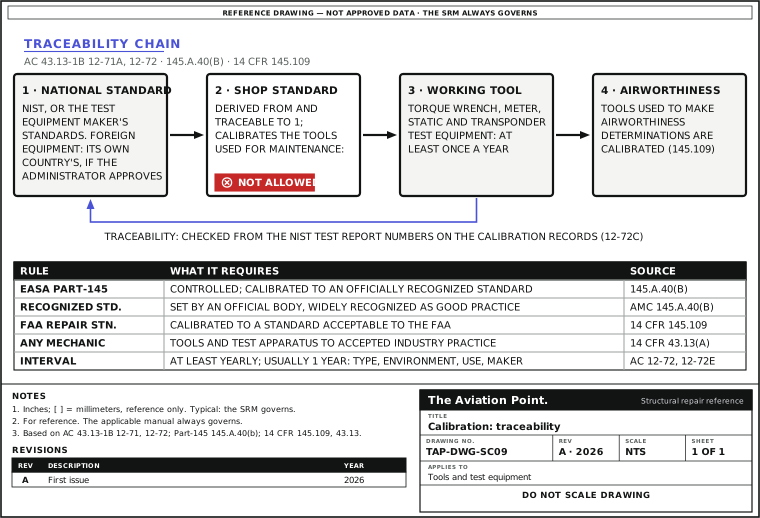
| EASA Part-145 | All tools, equipment and particularly test equipment, as appropriate, controlled and calibrated to an officially recognized standard, at a frequency that ensures serviceability and accuracy; calibration records and traceability to the standard used kept | Reg. (EU) 1321/2014 Annex II, 145.A.40(b) |
| Officially recognized standard | Established or published by an official body and widely recognized by the air transport sector as good practice | AMC 145.A.40(b) |
| FAA repair station | Test and inspection equipment and tools used to make airworthiness determinations calibrated to a standard acceptable to the FAA; equipment on the premises and under the station's control when the work is done | 14 CFR 145.109(a), (b) |
| Any mechanic | The tools, equipment and test apparatus needed to complete the work to accepted industry practice; the maker's special equipment or an equivalent acceptable to the Administrator | 14 CFR 43.13(a) |
| Traceability | Standards derived from and traceable to NIST, to the test equipment maker's standards, or, for foreign equipment, to that country's standards if the Administrator approves | AC 43.13-1B 12-71a |
| Interval | Meters, torque wrenches, static and transponder test equipment: at least once a year. Accepted practice is usually one year; type, environment, use, the maker's recommendation and past calibration history decide | 12-72, 12-72e |
| Records | Traceability checked from the NIST test report numbers on the calibration records | 12-72c |
| The standard itself | A standard used to calibrate is not used to perform maintenance | 12-72d |
| Torque wrenches | The sources give different intervals: see Torque wrench | — |
Calibration traceability
3Repair
Tool care, control and workshop materials
| Topic | Practice | Source |
|---|---|---|
| Control | Every tool and piece of test equipment controlled; calibrated items identified, with records and traceability | 145.A.40(b); 14 CFR 145.109 |
| Tool count, shadow boards, tags | —: no public rule read sets the method; the organization's procedures govern | — |
| Care of precision tools | As the maker says: torque wrench, micrometer | Tool guides |
| Oxygen tools | Clean and grease-free, ideally used only on oxygen systems | FAA-H-8083-31B p. 16-20 |
| Materials | SDS at hand; petroleum products kept apart from oxygen; hydraulic fluids never mixed | 1910.1200(g)(8); FAA-H-8083-31B pp. 12-3, 16-21 |
| Workmanship, dimensions, tolerances | Work and materials leave the aircraft at least equal to its original or properly altered condition; dimensions and tolerances from the drawing, SRM or manual | 14 CFR 43.13(b) |
Disassembly and reassembly
| Step | Action | What to do |
|---|---|---|
| 1 | Work to the data | Methods from the current maintenance manual or Instructions for Continued Airworthiness, with the tools they call for (14 CFR 43.13(a)). |
| 2 | Make safe | Power off before cleaning electrical connections (AC 43.13-1B 11-4). Oxygen: cylinder valve closed, pressure released, fittings unscrewed slowly (FAA-H-8083-31B p. 16-20). |
| 3 | Protect openings | Caps and plugs on open oxygen parts; no adhesive tape (p. 16-20). Other systems: as the manual says. |
| 4 | Reassemble | Torque first, then lock; new cotter pins, safety wire and pal nuts (AC 43.13-1B 7-38, 7-122d). See Locking devices. |
| 5 | Test | Oxygen: leak check by listening, then castile soap and water or a leak-test compound; remove all traces afterwards (9-49). |
| 6 | Record | Description of the work, date of completion, name, signature, certificate number and kind (14 CFR 43.9(a)); calibrated tools traceable through their records (145.A.40(b)). |
Worked example: is the oxygen cylinder in date?
A lightweight cylinder marked DOT 3HT 1850, last hydrostatic test June 2023, first filled 2004. The dates are made up for the example; today is November 2026.
- Lightweight cylinders: hydrostatic test every 3 years; retired after 24 years or 4,380 pressurizations, whichever comes first (AC 43.13-1B 9-51).
- June 2023 + 3 years = June 2026: the retest date is past.
- Do not return the cylinder to service until the test is done (9-48a(3)).
- Age: 2004 + 24 = 2028. Below the 24-year life limit; check the pressurization count in the records.
Out of service until hydrostatically tested; life limit 2028 or 4,380 fills.
Quick check
A magnesium wheel is burning on the ramp. Which extinguisher?
- The CO2 bottle at the stand.
Not this one. CO2 does not put out fires involving magnesium or titanium (FAA-H-8083-31B p. 17-10).
- A Halon 1211 hand extinguisher.
Not this one. Not on a class D fire: Halon may react vigorously with the burning metal (p. 17-9).
- The class D agent listed for the metal.
Best fit. A metal fire is class D (p. 17-1); the agent is the one listed for that metal (NFPA 10).
On a real job, the SRM decides.
Questions people actually ask
How often is a torque wrench calibrated?
AC 43.13-1B 12-72 says at least once a year; Part-145 asks for a frequency that keeps it serviceable and accurate (145.A.40(b)). Other sources differ: Torque wrench.
Can our reference standard also be used on aircraft?
No. A standard used for calibration is not used to perform maintenance (AC 43.13-1B 12-72d).
What is an officially recognized standard in Part-145?
One established or published by an official body and widely recognized by the air transport sector as good practice (AMC 145.A.40(b)), with traceability to it kept in the calibration records (145.A.40(b)).
Is 50 ft the rule for smoking near oxygen work?
It is the handbook's minimum (FAA-H-8083-31B p. 16-20). The aircraft manual and the airport rules may ask for more.
Limits of this guide
What the sources support, and no further.
- The manual governs. The aircraft and equipment manuals, the airport and the organization's procedures come first.
- OSHA intervals are US workplace law; elsewhere the national rules apply.
- Installed fire protection on the aircraft (detection, bottles, squibs) is not covered here.
- Tool control method (counts, shadow boards, tags): no public rule read; «—» shows who sets it.
- PPE, noise and machine guarding: Shop safety.
Where to buy
Are you a distributor? Get listed →
Distributors coming soon.
Keep going
Guides
How to do it
Tools
Books
Buy
Distributors coming soon.
Main sources
- FAA AC 43.13-1B CHG 1, Acceptable Methods, Techniques, and Practices: Aircraft Inspection and Repair — Pars. 7-38, 7-122d; 9-47 to 9-49, 9-51 (oxygen systems and cylinders); 11-4, 11-5 (electrical cleaning, battery electrolyte); 12-71, 12-72 (test equipment calibration).
- FAA-H-8083-31B, Aviation Maintenance Technician Handbook: Airframe — Ch. 12, p. 12-3 (phosphate ester fluids, intermixing); ch. 16, p. 16-20 (prevention of oxygen fires or explosions); ch. 17, pp. 17-1, 17-9, 17-10 (classes of fires, agents).
- NFPA 10, Standard for Portable Fire Extinguishers — Fire classes, as cited by FAA-H-8083-31B (2007 edition).
- OSHA 29 CFR 1910.157, Portable fire extinguishers — (c)(4), (e)(2) to (e)(4), (f) and table L-1, (g)(2).
- OSHA 29 CFR 1910.1200, Hazard communication — (g)(8): safety data sheets accessible in the work area.
- 14 CFR 43.9, 43.13 and 145.109 — 43.9(a) record entries; 43.13(a) tools and methods, (b) workmanship; 145.109(a), (b) equipment and calibration.
- Regulation (EU) No 1321/2014, Annex II (Part-145), and AMC — 145.A.40(b) equipment and tools: control and calibration; AMC 145.A.40(b), officially recognized standard.
Cross-checked with other manuals and standards in our library.