1Identification
Where to buyThe devices, by how they lock
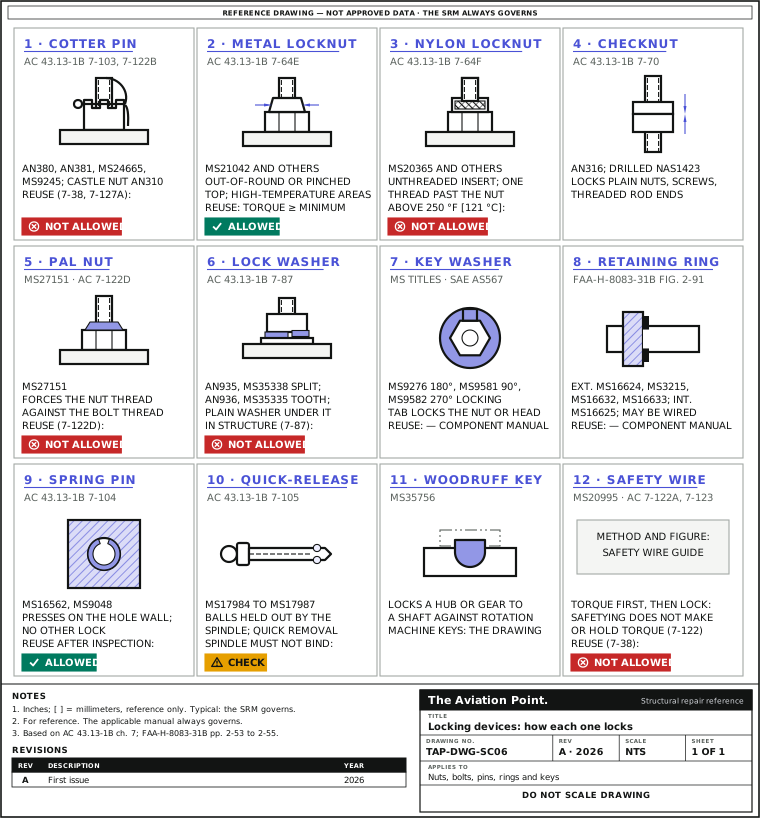
| Device | Standards | How it locks · where | Source |
|---|---|---|---|
| Safety wire (wire locking) | MS20995 | Wire between the part and a fixed point, pulling the tightening way. Cylinder studs, turnbuckles, engine accessory bolts | AC 43.13-1B 7-122a, 7-123; method: Safety wire |
| Cotter pin (cotter pin) | AN380, AN381, MS24665, MS9245 | Through the bolt hole and the nut slots. Controls, landing gear, any point that turns or actuates; AN381 or MS24665 where non-magnetic or corrosion-resistant material is wanted | 7-122b, 7-103 |
| Castle nut | AN310 | Slots for a cotter pin or wire; drilled bolts and studs in tension | 7-66 |
| Castellated shear nut | AN320 | Drilled clevis bolts and threaded taper pins, shear only | 7-67 |
| Self-locking nut, all-metal | MS21042 and others | Resilience of an out-of-round or pinched locking section; high-temperature areas | 7-64e |
| Self-locking nut, fiber or nylon insert | MS20365 and others | Unthreaded insert smaller than the nut; not above 250 °F (121 °C) | 7-64f |
| Checknut (jam nut) | AN316; drilled jam nut NAS1423 | Locks plain nuts, screws, threaded rod ends | 7-70 |
| Pal nut | MS27151 | Forces the nut thread against the bolt thread; stamped spring steel types are used once | 7-122d; FAA-H-8083-31B p. 2-55 |
| Spring lock washer, tooth lock washer | AN935, MS35338; AN936, MS35335 | Split spring or serrated star under the nut or head; only where a self-locking or castellated nut does not apply | 7-87; FAA-H-8083-31B p. 2-55 |
| Key washer (tab washer) | MS9276 180°, MS9581 90°, MS9582 270° locking | Keyed washer whose tab locks the nut or head; where the drawing or IPC calls for it. Propulsion practice: SAE AS567 | Standard titles |
| Rod-end locking washer | NAS513 | Locks a rod end; size by terminal thread | NAS513 title |
| Locking plate | —: the drawing or IPC | Plate locking one or more nuts or heads | —: the component manual sets fit and reuse |
| Spring pin | MS16562, MS9048 | Compressed in the hole, presses on the wall; no other securing | 7-104 |
| Quick-release pin | MS17984 to MS17987 | Locking balls held out by the spindle; equipment removed and refitted quickly | 7-105 |
| Retaining ring (circlip, snap ring) | External MS16624, MS3215, MS16632, MS16633; internal MS16625 | Spring ring in a groove on a shaft or in a bore; can be safety wired | Standard titles; FAA-H-8083-31B fig. 2-91; AC 7-122 |
| Key | MS35756 Key, Woodruff; machine keys: the drawing | Locks a hub or gear to a shaft against rotation | MS35756 title |
| Turnlock (quick-release) fastener | Dzus, Camloc, Airloc: panel fasteners | Quarter-turn stud into a spring or receptacle; covers, cowlings, fairings | T.O. 1-1A-1 ch. 3 and 5 |
| Turnbuckle locking clip | MS21256 | Clip into the barrel and terminal slots | 7-183, 7-184 |
General practice standards named by number: MS33540 (now NASM33540), Safety Wiring and Cotter Pinning, General Practices for; SAE AS567, General Practices for Use of Safety Wire, Key Washers, and Cotter Pins for Propulsion Systems.
How each device locks
2Allowable damage
Reuse and replacement
| Device | Reuse | Replace when | Source |
|---|---|---|---|
| Cotter pin | NOT ALLOWED | Every removal | AC 43.13-1B 7-38, 7-103, 7-127a |
| Safety wire | NOT ALLOWED | Every removal | 7-38 |
| Pal or speed nut | NOT ALLOWED | Every removal | 7-122d |
| Self-locking nut | ALLOWED while it locks | Below the minimum prevailing torque of table 7-2 (values on Torquing) | 7-64f, 7-122c |
| Spring pin | ALLOWED after inspection | Pin or hole deformed | 7-104b |
| Quick-release pin | ALLOWED | Spindle binds: the balls may stay open and the pin fall out under vibration | 7-105 |
| Lock washer | — | —: the manual sets it; AC 43.13-1B gives no reuse rule | — |
| Key washer, locking plate | — | —: the component manual, or SAE AS567 in propulsion work | — |
| Retaining ring | — | —: the component manual and the ring standard | — |
Inspection and acceptance
| Check | Accept | Reject | Source |
|---|---|---|---|
| Cotter pin size | Largest that fits the pin hole and the nut slots | Smaller pin; a used pin | FAA-H-8083-31B p. 2-55; AC 7-127a |
| Castellated nut slot | Torque in range and a slot lined up | Torque past the maximum to reach a slot; change the plain washer instead | AC 7-40f, 7-86 |
| Self-locking nut | One thread past the nut; prevailing torque at or above the minimum | Fiber or nylon nut that does not reach the minimum: do not reuse | 7-64f |
| Self-locking nut position | — | On a part subject to rotation; where a loose part could be drawn into a turbine intake; on panels opened before or after each flight | 7-64a, c, d |
| Lock washer | Plain washer under it | In primary or secondary structure, or accessories where failure could damage the aircraft or hurt people; frequent removal, corrosion areas, airflow | 7-87 |
| Spring pin hole | Not enlarged or deformed | Gap closed by misalignment, or excess insertion force | 7-104c |
| Quick-release pin | Spindle free, balls lock | Spindle binding | 7-105 |
| Keyway, magnetic particle check | —: the NDT manual sets the acceptance | Keyways and thread roots can give nonrelevant indications: confirm before rejecting | 5-40b(2) |
3Repair
Fitting the lock
| Step | Action | What to do |
|---|---|---|
| 1 | Torque, then lock | Safetying does not make or keep torque (AC 43.13-1B 7-122). Lock or safety every bolt and nut except self-locking nuts (7-38). |
| 2 | Castellated nut and cotter pin | Torque in range and line up a slot without passing the maximum; a plain washer positions the nut against the pin hole (7-40f, 7-86). Largest pin that fits (FAA-H-8083-31B p. 2-55). Bending the prongs: Safety wire, cotter pin table. |
| 3 | Castellated nut and wire | Tighten to the low side of the torque range, then on until a slot lines up (7-126). |
| 4 | Self-locking nut | Feel the prevailing torque as it runs down; leave at least one thread past the nut (7-64f). |
| 5 | Lock washer | A plain washer between the lock washer and the part, to stop gouging (7-87). |
| 6 | Pal nut, wire, cotter pin | New every time (7-38, 7-122d). |
| 7 | Pins | Spring pin: no other lock; in a clevis, held by the outer members (7-104c). Clevis pin: head up or forward (7-102). Quick-release pin: check the spindle does not bind (7-105). |
| 8 | Rings, key washers, keys | Ring and groove from the ring standard, tool and reuse from the component manual. Snap rings may be safety wired as FAA-H-8083-31B fig. 2-91 shows. |
Lining up a castle nut
Worked example: AN310 nut, slot past the maximum
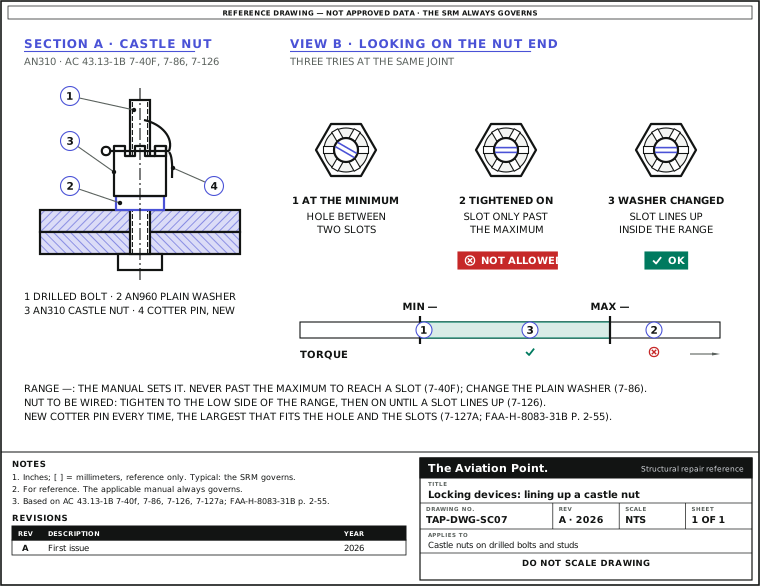
AN310 castle nut on a drilled bolt. Torque range from the manual: 95 to 110 in-lb (10.7 to 12.4 N·m). The range and readings are made up for the example.
- Run the nut down and torque to 95 in-lb: the cotter pin hole sits between two slots.
- Tighten on: the next slot lines up at 118 in-lb, above the 110 maximum. Not allowed (AC 43.13-1B 7-40f).
- Back off, change the AN960 plain washer for one that positions the nut (7-86), and torque again.
- The slot lines up at 104 in-lb, in range. Fit a new cotter pin, the largest that fits (7-127a; FAA-H-8083-31B p. 2-55).
Washer changed, slot at 104 in-lb, new cotter pin.
Quick check
An access panel is opened before every flight. Its screws go into plain nuts. What locks them?
- Self-locking nuts: no wire needed.
Not this one. Self-locking nuts are not used on panels or doors routinely opened before or after each flight (AC 43.13-1B 7-64d).
- Spring lock washers under the plain nuts.
Not this one. Not where frequent removal is required (7-87).
- The fastener the IPC calls for, such as a turnlock (quick-release) fastener.
Best fit. Covers and cowlings opened often use fasteners made for it, such as Dzus, Camloc or Airloc (T.O. 1-1A-1 ch. 3); the IPC names them.
On a real job, the SRM decides.
Questions people actually ask
Is a lock washer good enough on structure?
No. Lock washers are not used on primary or secondary structure, or on accessories where failure might damage the aircraft or endanger people (AC 43.13-1B 7-87, caution).
Can a self-locking nut go back on?
Yes, while it still reaches the minimum prevailing torque of table 7-2; repeated removal wears the lock out (7-122c). A fiber or nylon nut that cannot reach it is not reused (7-64f).
Spring pin instead of a cotter pin?
No (AC 43.13-1B 7-104c).
Which document governs safety wire and cotter pins on a military or drawing callout?
The drawing names it: often MS33540 / NASM33540, Safety Wiring and Cotter Pinning, General Practices for; in propulsion work SAE AS567, which also covers key washers.
Limits of this guide
What the sources support, and no further.
- The manual governs. The IPC, drawing, SRM and component manual come before AC 43.13-1B.
- Key washers, locking plates, retaining rings and keys: no public general rule for fitting or reuse was read; «—» shows who sets it.
- The wiring method (twists, routing, pigtail) is on the safety wire guide and chart, not repeated here.
- Torque values and prevailing torques are on the torquing guide.
Where to buy
Are you a distributor? Get listed →
Distributors coming soon.
Keep going
Calculators
Guides
How to do it
Tools
Data sheets
Books
Buy
Distributors coming soon.
Main sources
- FAA AC 43.13-1B CHG 1, Acceptable Methods, Techniques, and Practices: Aircraft Inspection and Repair — Pars. 7-38; 7-40f; 7-64; 7-66; 7-67; 7-70; 7-86; 7-87; 7-102 to 7-105; 7-122, 7-123, 7-126; 7-127a; 7-183, 7-184; 5-40b(2).
- FAA-H-8083-31B, Aviation Maintenance Technician Handbook: Airframe — Ch. 2, pp. 2-53 to 2-55: fig. 2-91 (safety wiring snap rings), cotter pins, self-locking nuts, lock washers, pal nuts.
- T.O. 1-1A-1 / NAVAIR 01-1A-1, General Manual for Structural Repair — Ch. 3 and 5: turnlock fasteners (Dzus, Camloc, Airloc).
- MS33540 / NASM33540, Safety Wiring and Cotter Pinning, General Practices for — Named by number and title.
- SAE AS567, General Practices for Use of Safety Wire, Key Washers, and Cotter Pins for Propulsion Systems — Named by number and title.
- MS35756, Key, Woodruff; MS9276, MS9581, MS9582, Washer, Key; NAS513, Washer, Rod End, Locking — Titles, as on the linked data sheets.
- OSHA 29 CFR 1910.133, Eye and face protection — Flying particles.
Cross-checked with other manuals and standards in our library.